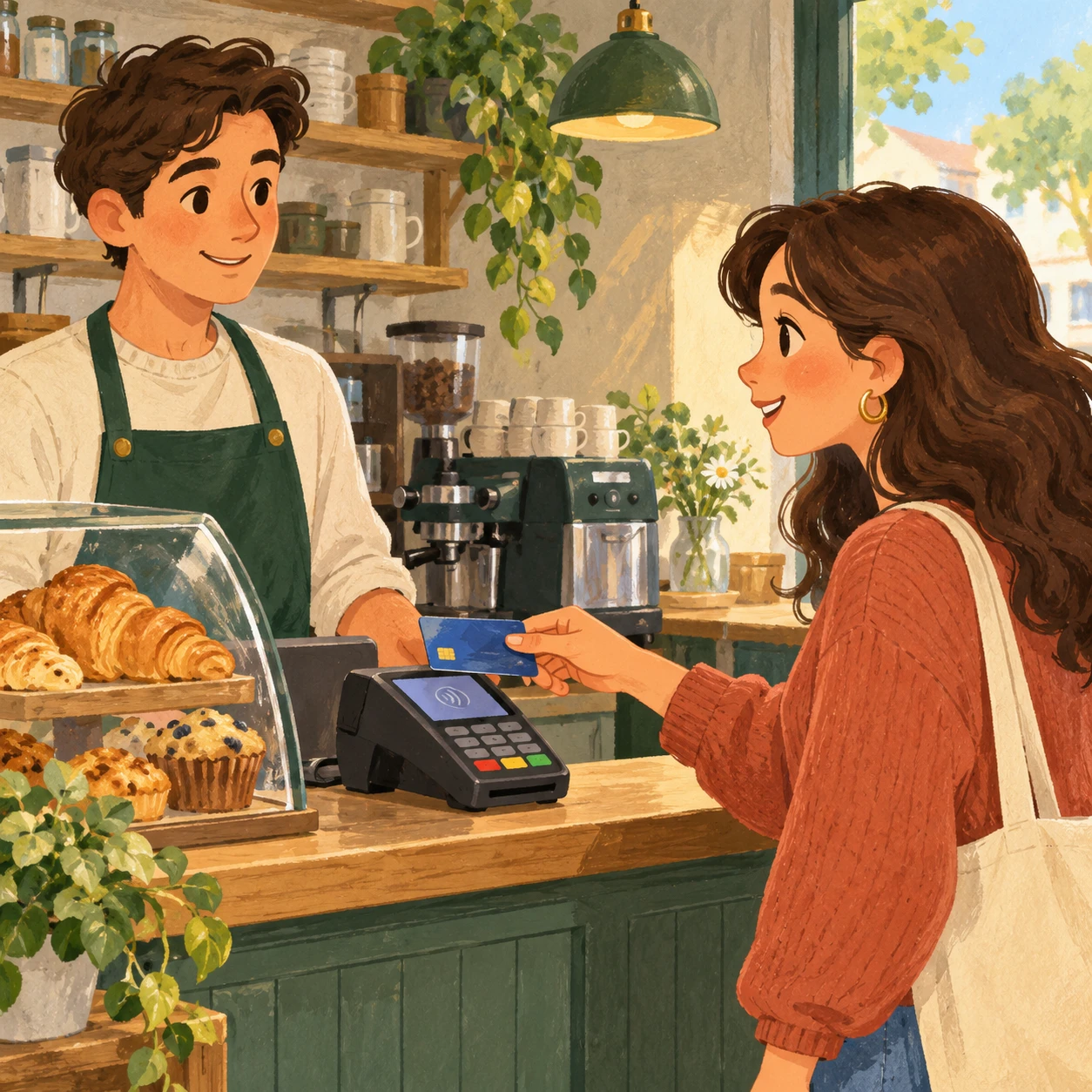
bon marché · payer · être à la bonne taille
cheap = bon marché; pay = payer; fit = être à la bonne taille
The bus is a cheap way to get there.

Prix, paiements et tailles · A2. cheap = bon marché; pay = payer; fit = être à la bonne taille
Apprends les sens en contexte, puis reconnais et retrouve chaque expression. A2 est un repère éditorial.

costing little money
The bus is a cheap way to get there.
Le bus est un moyen bon marché d’y aller.
Ces indications concernent ce sens. Les mots de la famille peuvent changer de sens ; les expressions proches ne sont pas toujours interchangeables.
Dans cette leçon : « cheap » = bon marché. Remarque « a cheap ticket » et « cheap to buy ».
cheap = bon marché; pay = payer; fit = être à la bonne taille
The bus is a cheap way to get there.
expensive = cher; spend = dépenser de l’argent; try on = essayer un vêtement
That hotel is too expensive for us.
cost = coûter; save = économiser de l’argent
How much does this ticket cost?
Which adjective means costing little money, without necessarily saying the quality is poor?
cost = coûter; save = économiser de l’argent
How much does this ticket cost?cheap = bon marché; pay = payer; fit = être à la bonne taille
The bus is a cheap way to get there.expensive = cher; spend = dépenser de l’argent; try on = essayer un vêtement
That hotel is too expensive for us.Revoyez le sens et l’explication, puis essayez une autre question sur le même emploi.
Pas encore de notes. Essayez un court échauffement.
Ouvrir une réponse enregistre une aide pour cette question.
Which adjective means costing little money, without necessarily saying the quality is poor?
Ici, « cheap » signifie bon marché. Relis l’indice : « Which adjective means costing little money, without necessarily saying the quality is poor? ».
Ici, « cheap » signifie bon marché. Relis l’indice : « Write the word or phrase from this lesson that means: costing little money. It starts with c. ».
Which adjective means costing a lot of money?
Ici, « expensive » signifie cher. Relis l’indice : « Which adjective means costing a lot of money? ».
Ici, « expensive » signifie cher. Relis l’indice : « Write the word or phrase from this lesson that means: costing a lot of money. It starts with e. ».
Choose the verb whose subject is the thing with a price: These shoes ___ fifty pounds.
Ici, « cost » signifie coûter. Relis l’indice : « Choose the verb whose subject is the thing with a price: These shoes ___ fifty pounds. ». Utilise chose + cost + montant ; personne + pay for + chose ; personne + spend + montant + on + chose. Le sujet et la préposition déterminent le choix.
Ici, « cost » signifie coûter. Relis l’indice : « Write the word or phrase from this lesson that means: have a particular price. It starts with c. ».
Complete the payment expression: I will ___ for the meal by card.
Ici, « pay » signifie payer. Relis l’indice : « Complete the payment expression: I will ___ for the meal by card. ». Utilise chose + cost + montant ; personne + pay for + chose ; personne + spend + montant + on + chose. Le sujet et la préposition déterminent le choix.
Ici, « pay » signifie payer. Relis l’indice : « Write the word or phrase from this lesson that means: give money for something. It starts with p. ».
Complete the usual structure with on: I ___ ten pounds on lunch every day.
Ici, « spend » signifie dépenser de l’argent. Relis l’indice : « Complete the usual structure with on: I ___ ten pounds on lunch every day. ». Utilise chose + cost + montant ; personne + pay for + chose ; personne + spend + montant + on + chose. Le sujet et la préposition déterminent le choix.
Ici, « spend » signifie dépenser de l’argent. Relis l’indice : « Write the word or phrase from this lesson that means: use money to buy something. It starts with s. ».
I keep part of my income for a future holiday instead of spending it now. I ___ money for the holiday.
Ici, « save » signifie économiser de l’argent. Relis l’indice : « I keep part of my income for a future holiday instead of spending it now. I ___ money for the holiday. ».
Ici, « save » signifie économiser de l’argent. Relis l’indice : « Write the word or phrase from this lesson that means: keep money instead of spending it now. It starts with s. ».
The jacket is exactly the right size for me: it will ___ me.
Ici, « fit » signifie être à la bonne taille. Relis l’indice : « The jacket is exactly the right size for me: it will ___ me. ».
Ici, « fit » signifie être à la bonne taille. Relis l’indice : « Write the word or phrase from this lesson that means: be the right size or shape. It starts with f. ».
Before buying the trousers, I put them on briefly to check the size. I ___ the trousers.
Ici, « try on » signifie essayer un vêtement. Relis l’indice : « Before buying the trousers, I put them on briefly to check the size. I ___ the trousers. ».
Ici, « try on » signifie essayer un vêtement. Relis l’indice : « Write the word or phrase from this lesson that means: put on clothing briefly to check it before buying. It starts with t. ».