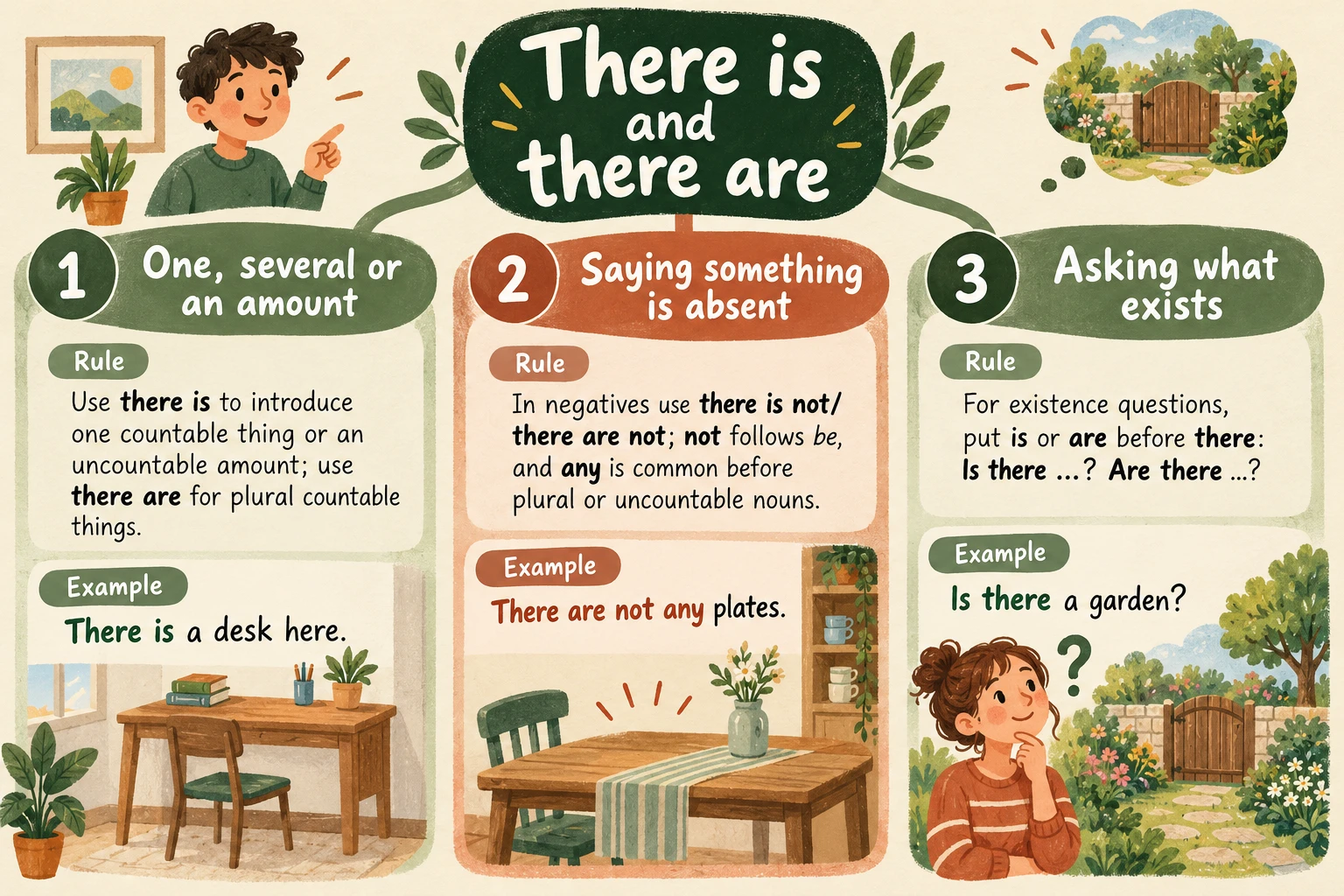
01Un élément, plusieurs ou une quantité
Utilise there is pour un élément singulier ou indénombrable ; there are pour des éléments dénombrables pluriels.
There is a desk here.
There is et there are · A1. Utilise there is pour un élément singulier ou indénombrable ; there are pour des éléments dénombrables pluriels.
Travaille There is et there are dans de courtes situations. Lis l’indice, choisis ou écris une forme, puis vérifie l’explication. Le niveau est une indication éditoriale.
Utilise there is pour un élément singulier ou indénombrable ; there are pour des éléments dénombrables pluriels.
There is a desk here.À la forme négative, utilise there is not/there are not. Not suit be ; any est courant avec pluriels et indénombrables.
There are not any plates.Pour demander si quelque chose existe, place is ou are avant there : Is there ...? Are there ...?
Is there a garden?
On the wall, there ___ a large clock.
Utilise there is pour un élément singulier ou indénombrable ; there are pour des éléments dénombrables pluriels.
There is a desk here.À la forme négative, utilise there is not/there are not. Not suit be ; any est courant avec pluriels et indénombrables.
There are not any plates.Pour demander si quelque chose existe, place is ou are avant there : Is there ...? Are there ...?
Is there a garden?Gardez la première tentative, comprenez le changement et essayez dans une nouvelle situation.
Pas encore de notes. Essayez un court échauffement.
Utilise there is pour un élément singulier ou indénombrable ; there are pour des éléments dénombrables pluriels.
There is a desk here.À la forme négative, utilise there is not/there are not. Not suit be ; any est courant avec pluriels et indénombrables.
There are not any plates.Pour demander si quelque chose existe, place is ou are avant there : Is there ...? Are there ...?
Is there a garden?Ouvrir une réponse enregistre une aide pour cette question.
On the wall, there ___ a large clock.
Observe « On the wall, there ___ a large clock. ». Utilise there is pour un élément singulier ou indénombrable ; there are pour des éléments dénombrables pluriels. Phrase complète : « On the wall, there is a large clock. ».
The fridge is empty. There ___ any milk.
Observe « The fridge is empty. There ___ any milk. ». À la forme négative, utilise there is not/there are not. Not suit be ; any est courant avec pluriels et indénombrables. Phrase complète : « The fridge is empty. There is not any milk. ».
___ there any seats near the window?
Observe « ___ there any seats near the window? ». Pour demander si quelque chose existe, place is ou are avant there : Is there ...? Are there ...? Phrase complète : « Are there any seats near the window? ».
There ___ three buses outside the school.
Phrase de référence : « There are three buses outside the school. ». Utilise there is pour un élément singulier ou indénombrable ; there are pour des éléments dénombrables pluriels.
All the children have gone. There ___ any children in the room.
Observe « All the children have gone. There ___ any children in the room. ». À la forme négative, utilise there is not/there are not. Not suit be ; any est courant avec pluriels et indénombrables. Phrase complète : « All the children have gone. There are not any children in the room. ».
___ there a cash machine in this station?
Observe « ___ there a cash machine in this station? ». Pour demander si quelque chose existe, place is ou are avant there : Is there ...? Are there ...? Phrase complète : « Is there a cash machine in this station? ».
There ___ some water in the bottle.
Phrase de référence : « There is some water in the bottle. ». Utilise there is pour un élément singulier ou indénombrable ; there are pour des éléments dénombrables pluriels.
There ___ two clean towels on your bed.
Observe « There ___ two clean towels on your bed. ». Utilise there is pour un élément singulier ou indénombrable ; there are pour des éléments dénombrables pluriels. Phrase complète : « There are two clean towels on your bed. ».
The car park is closed. There ___ any cars inside.
Observe « The car park is closed. There ___ any cars inside. ». À la forme négative, utilise there is not/there are not. Not suit be ; any est courant avec pluriels et indénombrables. Phrase complète : « The car park is closed. There are not any cars inside. ».
___ there a lift in the building?
Phrase de référence : « Is there a lift in the building? ». Pour demander si quelque chose existe, place is ou are avant there : Is there ...? Are there ...?
The tap is broken. There ___ any hot water.
Observe « The tap is broken. There ___ any hot water. ». À la forme négative, utilise there is not/there are not. Not suit be ; any est courant avec pluriels et indénombrables. Phrase complète : « The tap is broken. There is not any hot water. ».
___ there any shops open on this street?
Phrase de référence : « Are there any shops open on this street? ». Pour demander si quelque chose existe, place is ou are avant there : Is there ...? Are there ...?