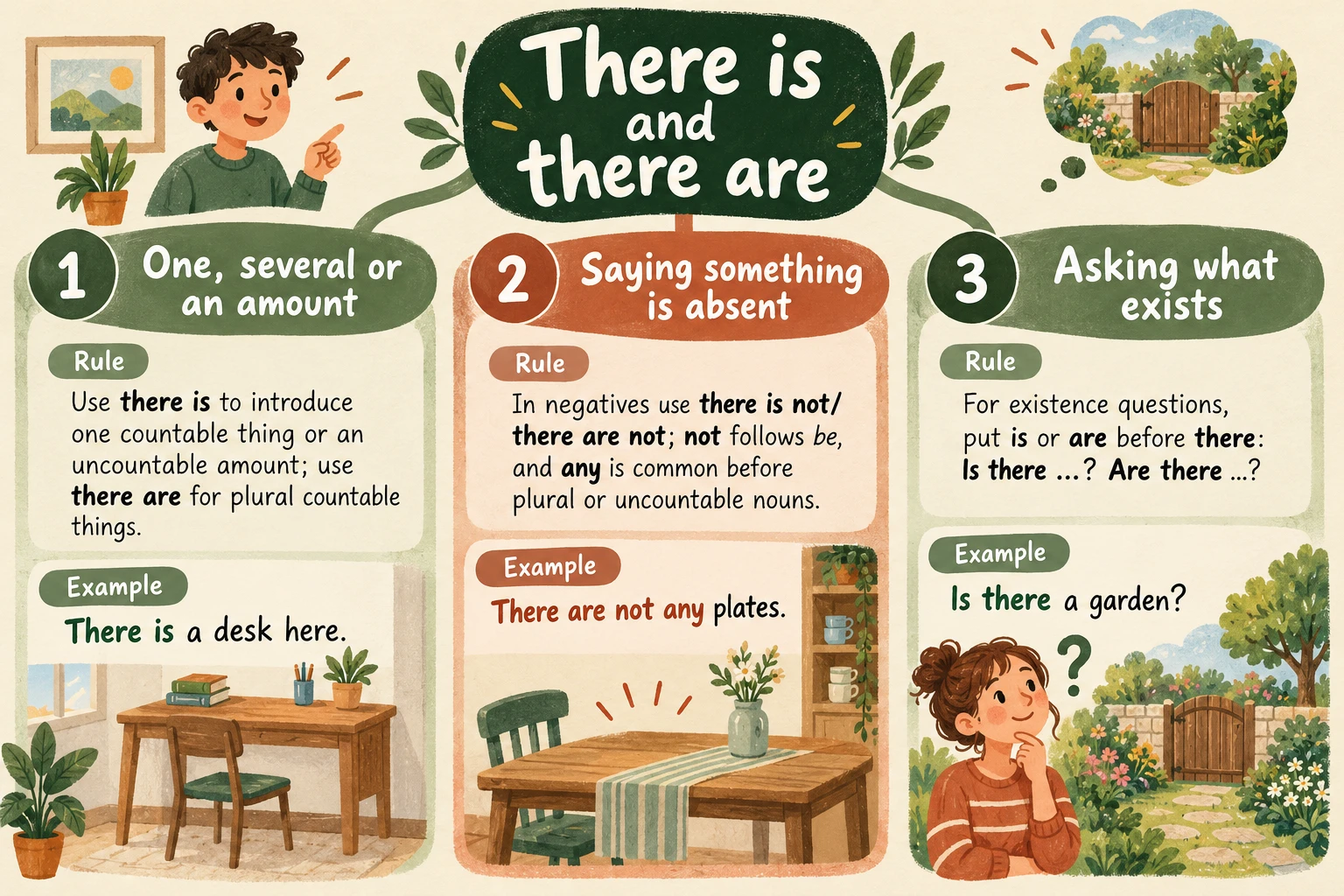
01Um, vários ou uma quantidade
Use there is para algo contável singular ou uma quantidade incontável; there are para contáveis plurais.
There is a desk here.
There is e there are · A1. Use there is para algo contável singular ou uma quantidade incontável; there are para contáveis plurais.
Pratique There is e there are em situações curtas. Leia a pista, escolha ou escreva uma forma e confira a explicação. O nível é uma orientação editorial.
Use there is para algo contável singular ou uma quantidade incontável; there are para contáveis plurais.
There is a desk here.Nas negativas, use there is not/there are not. Not vem depois de be; any é comum com plurais e incontáveis.
There are not any plates.Para perguntar sobre existência, ponha is ou are antes de there: Is there ...? Are there ...?
Is there a garden?
On the wall, there ___ a large clock.
Use there is para algo contável singular ou uma quantidade incontável; there are para contáveis plurais.
There is a desk here.Nas negativas, use there is not/there are not. Not vem depois de be; any é comum com plurais e incontáveis.
There are not any plates.Para perguntar sobre existência, ponha is ou are antes de there: Is there ...? Are there ...?
Is there a garden?Guarde a primeira tentativa, entenda a mudança e confira em outra situação.
Ainda não há revisões. Faça um aquecimento curto.
Use there is para algo contável singular ou uma quantidade incontável; there are para contáveis plurais.
There is a desk here.Nas negativas, use there is not/there are not. Not vem depois de be; any é comum com plurais e incontáveis.
There are not any plates.Para perguntar sobre existência, ponha is ou are antes de there: Is there ...? Are there ...?
Is there a garden?Abrir uma resposta registra ajuda para essa questão.
On the wall, there ___ a large clock.
Observe “On the wall, there ___ a large clock.”. Use there is para algo contável singular ou uma quantidade incontável; there are para contáveis plurais. Frase completa: “On the wall, there is a large clock.”.
The fridge is empty. There ___ any milk.
Observe “The fridge is empty. There ___ any milk.”. Nas negativas, use there is not/there are not. Not vem depois de be; any é comum com plurais e incontáveis. Frase completa: “The fridge is empty. There is not any milk.”.
___ there any seats near the window?
Observe “___ there any seats near the window?”. Para perguntar sobre existência, ponha is ou are antes de there: Is there ...? Are there ...? Frase completa: “Are there any seats near the window?”.
There ___ three buses outside the school.
Frase de referência: “There are three buses outside the school.”. Use there is para algo contável singular ou uma quantidade incontável; there are para contáveis plurais.
All the children have gone. There ___ any children in the room.
Observe “All the children have gone. There ___ any children in the room.”. Nas negativas, use there is not/there are not. Not vem depois de be; any é comum com plurais e incontáveis. Frase completa: “All the children have gone. There are not any children in the room.”.
___ there a cash machine in this station?
Observe “___ there a cash machine in this station?”. Para perguntar sobre existência, ponha is ou are antes de there: Is there ...? Are there ...? Frase completa: “Is there a cash machine in this station?”.
There ___ some water in the bottle.
Frase de referência: “There is some water in the bottle.”. Use there is para algo contável singular ou uma quantidade incontável; there are para contáveis plurais.
There ___ two clean towels on your bed.
Observe “There ___ two clean towels on your bed.”. Use there is para algo contável singular ou uma quantidade incontável; there are para contáveis plurais. Frase completa: “There are two clean towels on your bed.”.
The car park is closed. There ___ any cars inside.
Observe “The car park is closed. There ___ any cars inside.”. Nas negativas, use there is not/there are not. Not vem depois de be; any é comum com plurais e incontáveis. Frase completa: “The car park is closed. There are not any cars inside.”.
___ there a lift in the building?
Frase de referência: “Is there a lift in the building?”. Para perguntar sobre existência, ponha is ou are antes de there: Is there ...? Are there ...?
The tap is broken. There ___ any hot water.
Observe “The tap is broken. There ___ any hot water.”. Nas negativas, use there is not/there are not. Not vem depois de be; any é comum com plurais e incontáveis. Frase completa: “The tap is broken. There is not any hot water.”.
___ there any shops open on this street?
Frase de referência: “Are there any shops open on this street?”. Para perguntar sobre existência, ponha is ou are antes de there: Is there ...? Are there ...?