01Einzelnes, Mehrzahl oder Menge
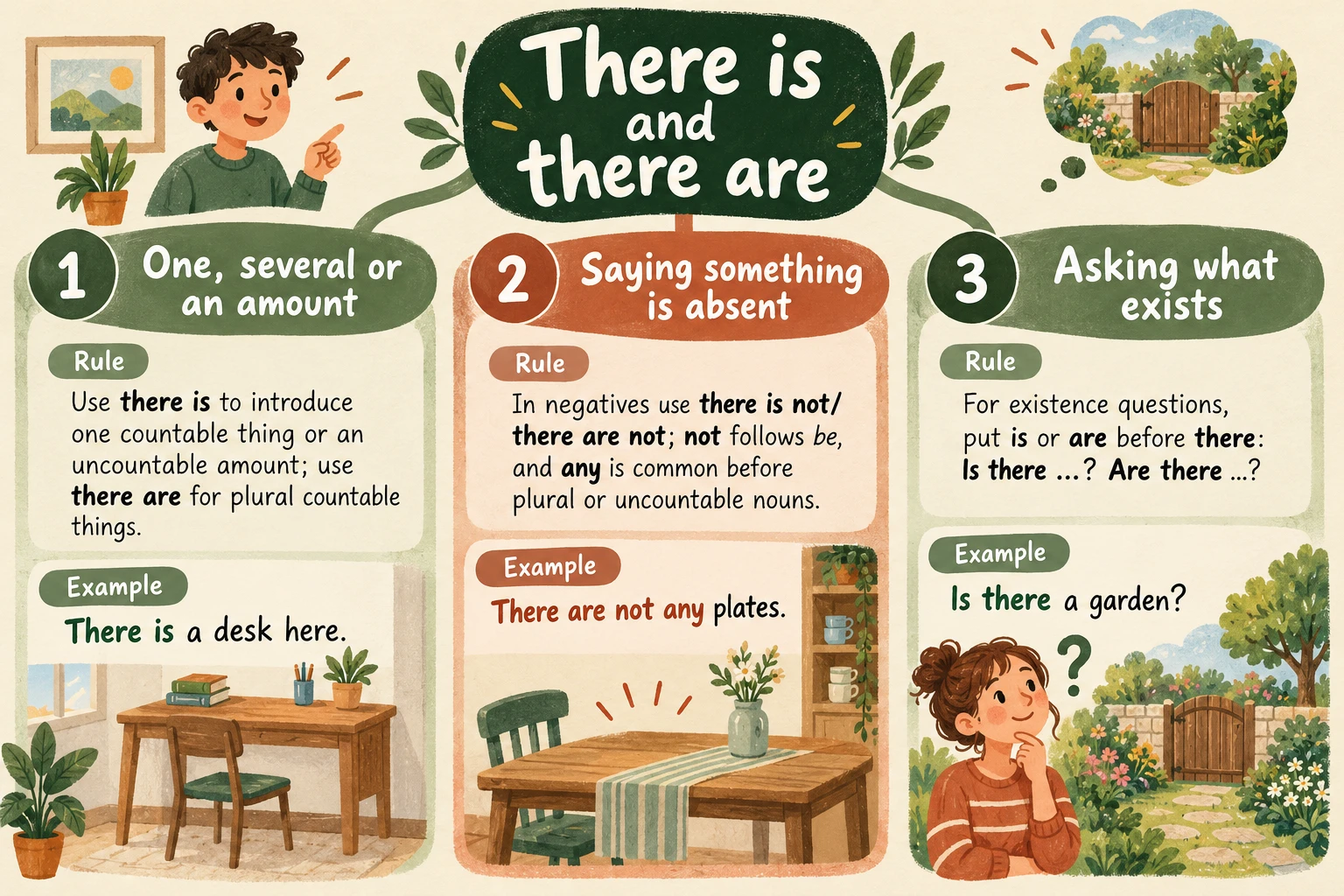
There is führt eine zählbare Sache oder eine unzählbare Menge ein; there are steht bei zählbarem Plural.
There is a desk here.
There is und there are · A1. There is führt eine zählbare Sache oder eine unzählbare Menge ein; there are steht bei zählbarem Plural.
Übe There is und there are in kurzen Situationen. Lies den Hinweis, wähle oder schreibe eine Form und prüfe die Begründung. Die Stufe dient der redaktionellen Orientierung.
There is führt eine zählbare Sache oder eine unzählbare Menge ein; there are steht bei zählbarem Plural.
There is a desk here.In der Verneinung steht there is not/there are not. Not folgt be; bei Plural oder Unzählbarem ist any üblich.
There are not any plates.Bei Existenzfragen steht is oder are vor there: Is there ...? Are there ...?
Is there a garden?
On the wall, there ___ a large clock.
There is führt eine zählbare Sache oder eine unzählbare Menge ein; there are steht bei zählbarem Plural.
There is a desk here.In der Verneinung steht there is not/there are not. Not folgt be; bei Plural oder Unzählbarem ist any üblich.
There are not any plates.Bei Existenzfragen steht is oder are vor there: Is there ...? Are there ...?
Is there a garden?Bewahre den ersten Versuch. Verstehe die Änderung. Prüfe sie in einer neuen Situation.
Noch keine Lernnotizen. Starte mit einem kurzen Einstieg.
There is führt eine zählbare Sache oder eine unzählbare Menge ein; there are steht bei zählbarem Plural.
There is a desk here.In der Verneinung steht there is not/there are not. Not folgt be; bei Plural oder Unzählbarem ist any üblich.
There are not any plates.Bei Existenzfragen steht is oder are vor there: Is there ...? Are there ...?
Is there a garden?Das Öffnen einer Antwort wird für diese Aufgabe als Hilfe erfasst.
On the wall, there ___ a large clock.
Achte auf „On the wall, there ___ a large clock.“. There is führt eine zählbare Sache oder eine unzählbare Menge ein; there are steht bei zählbarem Plural. Vollständiger Satz: „On the wall, there is a large clock.“.
The fridge is empty. There ___ any milk.
Achte auf „The fridge is empty. There ___ any milk.“. In der Verneinung steht there is not/there are not. Not folgt be; bei Plural oder Unzählbarem ist any üblich. Vollständiger Satz: „The fridge is empty. There is not any milk.“.
___ there any seats near the window?
Achte auf „___ there any seats near the window?“. Bei Existenzfragen steht is oder are vor there: Is there ...? Are there ...? Vollständiger Satz: „Are there any seats near the window?“.
There ___ three buses outside the school.
Vollständiger Beispielsatz: „There are three buses outside the school.“. There is führt eine zählbare Sache oder eine unzählbare Menge ein; there are steht bei zählbarem Plural.
All the children have gone. There ___ any children in the room.
Achte auf „All the children have gone. There ___ any children in the room.“. In der Verneinung steht there is not/there are not. Not folgt be; bei Plural oder Unzählbarem ist any üblich. Vollständiger Satz: „All the children have gone. There are not any children in the room.“.
___ there a cash machine in this station?
Achte auf „___ there a cash machine in this station?“. Bei Existenzfragen steht is oder are vor there: Is there ...? Are there ...? Vollständiger Satz: „Is there a cash machine in this station?“.
There ___ some water in the bottle.
Vollständiger Beispielsatz: „There is some water in the bottle.“. There is führt eine zählbare Sache oder eine unzählbare Menge ein; there are steht bei zählbarem Plural.
There ___ two clean towels on your bed.
Achte auf „There ___ two clean towels on your bed.“. There is führt eine zählbare Sache oder eine unzählbare Menge ein; there are steht bei zählbarem Plural. Vollständiger Satz: „There are two clean towels on your bed.“.
The car park is closed. There ___ any cars inside.
Achte auf „The car park is closed. There ___ any cars inside.“. In der Verneinung steht there is not/there are not. Not folgt be; bei Plural oder Unzählbarem ist any üblich. Vollständiger Satz: „The car park is closed. There are not any cars inside.“.
___ there a lift in the building?
Vollständiger Beispielsatz: „Is there a lift in the building?“. Bei Existenzfragen steht is oder are vor there: Is there ...? Are there ...?
The tap is broken. There ___ any hot water.
Achte auf „The tap is broken. There ___ any hot water.“. In der Verneinung steht there is not/there are not. Not folgt be; bei Plural oder Unzählbarem ist any üblich. Vollständiger Satz: „The tap is broken. There is not any hot water.“.
___ there any shops open on this street?
Vollständiger Beispielsatz: „Are there any shops open on this street?“. Bei Existenzfragen steht is oder are vor there: Is there ...? Are there ...?