
B2

Ellipse et substitution : exercices

À propos de cette leçon

Ellipse et substitution · B2. Utilisez auxiliary/modal without repeated verb phrase pour exprimer un groupe verbal omis récupérable dans le contexte ; gardez le bon auxiliaire.

Réalisez 12 exercices originaux. Appuyez-vous sur la situation pour interpréter le sens, pratiquer la forme et la réutiliser dans un nouveau contexte.

12 questions
Retrouvez-le dans Ma collection après enregistrement.
Carte des notions

Ellipsis and substitution

Commencer
Ellipsis and substitution — Carte des notions

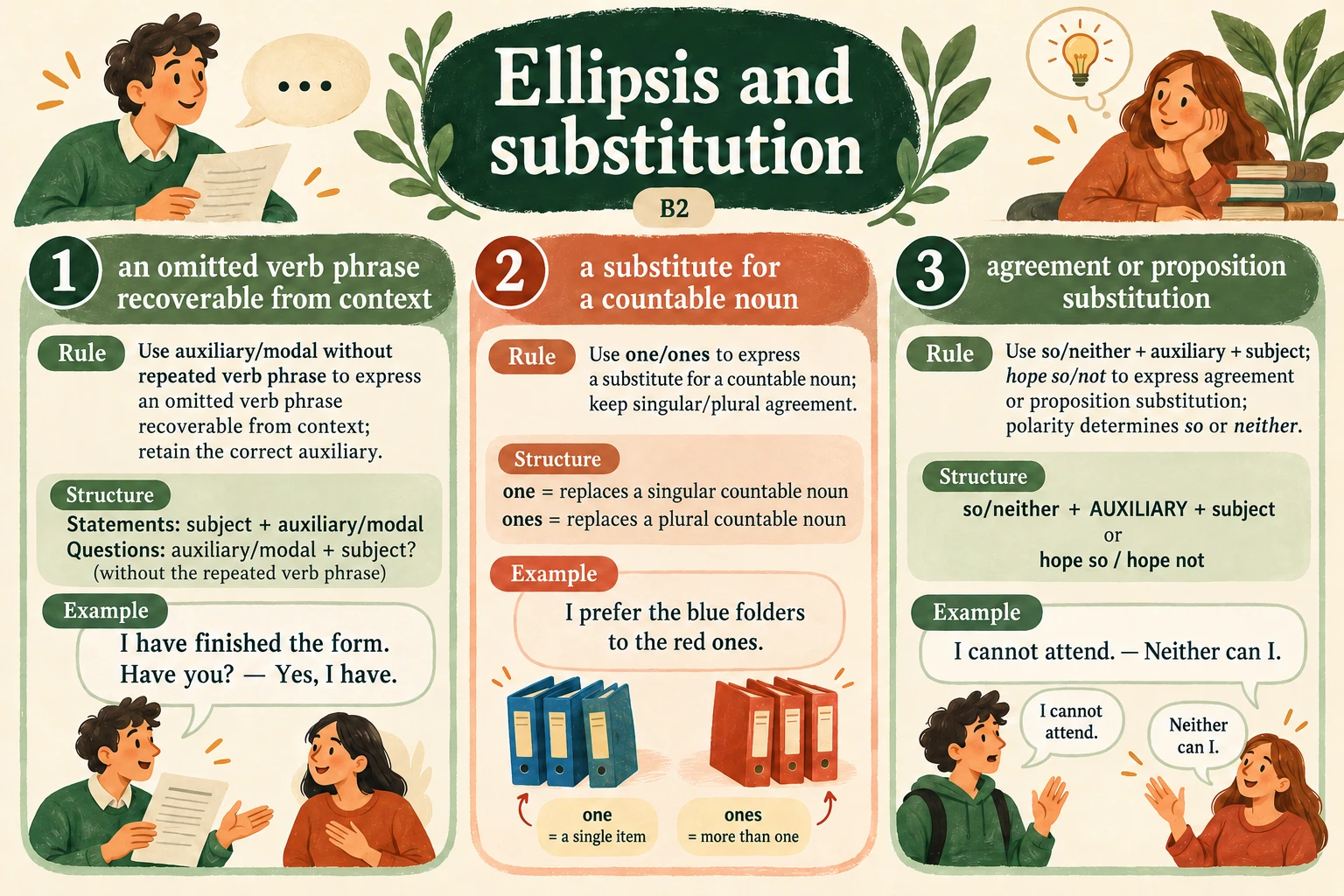
01un groupe verbal omis récupérable dans le contexte ; gardez le bon auxiliaire

Utilisez auxiliary/modal without repeated verb phrase pour exprimer un groupe verbal omis récupérable dans le contexte ; gardez le bon auxiliaire.

I have finished the form. Have you? — Yes, I have.

02un substitut de nom dénombrable ; respectez le nombre

Utilisez one/ones pour exprimer un substitut de nom dénombrable ; respectez le nombre.

I prefer the blue folders to the red ones.

03un accord ou une substitution d’énoncé ; la polarité détermine so ou neither

Utilisez so/neither + auxiliary + subject; hope so/not pour exprimer un accord ou une substitution d’énoncé ; la polarité détermine so ou neither.

I cannot attend. — Neither can I.

Guide illustré

0/12
Questions
01 / 12D01Retrouvez-le dans Ma collection après enregistrement.

Repeat only the appropriate auxiliary instead of have finished the form.

I have finished the form. Have you? — Yes, I ___.

Votre réponse
1 / 12

Votre parcours

01
Étape 1 · Échauffement

Échauffement

0/3
02
Étape 2 · Développer la compétence

un groupe verbal omis récupérable dans le contexte ; gardez le bon auxiliaire

0/2

Utilisez auxiliary/modal without repeated verb phrase pour exprimer un groupe verbal omis récupérable dans le contexte ; gardez le bon auxiliaire.

I have finished the form. Have you? — Yes, I have.
03
Étape 3 · Développer la compétence

un substitut de nom dénombrable ; respectez le nombre

0/1

Utilisez one/ones pour exprimer un substitut de nom dénombrable ; respectez le nombre.

I prefer the blue folders to the red ones.
04
Étape 4 · Développer la compétence

un accord ou une substitution d’énoncé ; la polarité détermine so ou neither

0/1

Utilisez so/neither + auxiliary + subject; hope so/not pour exprimer un accord ou une substitution d’énoncé ; la polarité détermine so ou neither.

I cannot attend. — Neither can I.
05
Étape 5 · Nouveaux contextes

Nouveaux contextes

0/3
06
Étape 6 · Un nouveau défi

Un nouveau défi

0/2
Révisions de cette unité

Apprenez de vos erreurs.

Gardez la première tentative, comprenez le changement et essayez dans une nouvelle situation.

0

Pas encore de notes. Essayez un court échauffement.

Carte de la leçon

Ellipse et substitution

B2
Ellipsis and substitution

Points de la leçon

01

un groupe verbal omis récupérable dans le contexte ; gardez le bon auxiliaire

Utilisez auxiliary/modal without repeated verb phrase pour exprimer un groupe verbal omis récupérable dans le contexte ; gardez le bon auxiliaire.

I have finished the form. Have you? — Yes, I have.
02

un substitut de nom dénombrable ; respectez le nombre

Utilisez one/ones pour exprimer un substitut de nom dénombrable ; respectez le nombre.

I prefer the blue folders to the red ones.
03

un accord ou une substitution d’énoncé ; la polarité détermine so ou neither

Utilisez so/neither + auxiliary + subject; hope so/not pour exprimer un accord ou une substitution d’énoncé ; la polarité détermine so ou neither.

I cannot attend. — Neither can I.

Questions et réponses

Ouvrir une réponse enregistre une aide pour cette question.

D01 · Échauffement

Repeat only the appropriate auxiliary instead of have finished the form.

I have finished the form. Have you? — Yes, I ___.

  1. am
  2. do
  3. have
  4. will
Réponse et explication
have

L’indice décisif est « Repeat only the appropriate auxiliary instead of have finished the form. ». Utilisez auxiliary/modal without repeated verb phrase pour exprimer un groupe verbal omis récupérable dans le contexte ; gardez le bon auxiliaire. Dans cette tâche, la phrase complète est « I have finished the form. Have you? — Yes, I have. ».

D02 · Échauffement

Replace a plural count noun, folders.

I prefer the blue folders to the red ___.

  1. it
  2. so
  3. one
  4. ones
Réponse et explication
ones

L’indice décisif est « Replace a plural count noun, folders. ». Utilisez one/ones pour exprimer un substitut de nom dénombrable ; respectez le nombre. Dans cette tâche, la phrase complète est « I prefer the blue folders to the red ones. ».

D03 · Échauffement

Agree with a negative statement using inversion.

I cannot attend. — Neither ___ I.

  1. am
  2. have
  3. can
  4. do
Réponse et explication
can

L’indice décisif est « Agree with a negative statement using inversion. ». Utilisez so/neither + auxiliary + subject; hope so/not pour exprimer un accord ou une substitution d’énoncé ; la polarité détermine so ou neither. Dans cette tâche, la phrase complète est « I cannot attend. — Neither can I. ».

P01 · Développer la compétence

Avoid repeating the verb phrase can operate the machine.

Ravi cannot operate it, but Leila ___.

  1. can
  2. does
  3. has
  4. is
Réponse et explication
can

L’indice décisif est « Avoid repeating the verb phrase can operate the machine. ». Utilisez auxiliary/modal without repeated verb phrase pour exprimer un groupe verbal omis récupérable dans le contexte ; gardez le bon auxiliaire. Dans cette tâche, la phrase complète est « Ravi cannot operate it, but Leila can. ».

P02 · Développer la compétence

Replace the singular count noun adapter with a substitute word.

This adapter is broken; could I borrow another ___?

Réponse et explication
one

Phrase complète : « This adapter is broken; could I borrow another one? » Utilisez one/ones pour exprimer un substitut de nom dénombrable ; respectez le nombre. Le sujet, le temps et le sens de la consigne déterminent cette forme. Seules les réponses vérifiées sont comparées automatiquement ; toute autre formulation n’est pas automatiquement fausse.

P03 · Développer la compétence

Use so to substitute for the entire hoped-for proposition.

Will the funding continue? — I hope ___.

  1. it to
  2. one
  3. ones
  4. so
Réponse et explication
so

L’indice décisif est « Use so to substitute for the entire hoped-for proposition. ». Utilisez so/neither + auxiliary + subject; hope so/not pour exprimer un accord ou une substitution d’énoncé ; la polarité détermine so ou neither. Dans cette tâche, la phrase complète est « Will the funding continue? — I hope so. ».

P04 · Développer la compétence

Use a past-simple auxiliary to replace submitted a claim last year.

I did not submit a claim last year, but my colleague ___.

Réponse et explication
did

Phrase complète : « I did not submit a claim last year, but my colleague did. » Utilisez auxiliary/modal without repeated verb phrase pour exprimer un groupe verbal omis récupérable dans le contexte ; gardez le bon auxiliaire. Le sujet, le temps et le sens de la consigne déterminent cette forme. Seules les réponses vérifiées sont comparées automatiquement ; toute autre formulation n’est pas automatiquement fausse.

R01 · Nouveaux contextes

The first clause is present perfect; retain have in the elliptical response.

They have not confirmed yet, but we ___.

  1. have
  2. will
  3. are
  4. do
Réponse et explication
have

L’indice décisif est « The first clause is present perfect; retain have in the elliptical response. ». Utilisez auxiliary/modal without repeated verb phrase pour exprimer un groupe verbal omis récupérable dans le contexte ; gardez le bon auxiliaire. Dans cette tâche, la phrase complète est « They have not confirmed yet, but we have. ».

R02 · Nouveaux contextes

Replace plural count noun chairs with a substitute word.

We need larger chairs; these small ___ are unsuitable.

Réponse et explication
ones

Phrase complète : « We need larger chairs; these small ones are unsuitable. » Utilisez one/ones pour exprimer un substitut de nom dénombrable ; respectez le nombre. Le sujet, le temps et le sens de la consigne déterminent cette forme. Seules les réponses vérifiées sont comparées automatiquement ; toute autre formulation n’est pas automatiquement fausse.

R03 · Nouveaux contextes

Agree with a positive statement containing have.

I have read the guidelines. — So ___ I.

  1. do
  2. will
  3. am
  4. have
Réponse et explication
have

L’indice décisif est « Agree with a positive statement containing have. ». Utilisez so/neither + auxiliary + subject; hope so/not pour exprimer un accord ou une substitution d’énoncé ; la polarité détermine so ou neither. Dans cette tâche, la phrase complète est « I have read the guidelines. — So have I. ».

X01 · Un nouveau défi

Replace a singular countable noun, proposal.

Your proposal is detailed; mine is a simpler ___.

  1. ones
  2. so
  3. them
  4. one
Réponse et explication
one

L’indice décisif est « Replace a singular countable noun, proposal. ». Utilisez one/ones pour exprimer un substitut de nom dénombrable ; respectez le nombre. Dans cette tâche, la phrase complète est « Your proposal is detailed; mine is a simpler one. ».

X02 · Un nouveau défi

Agree with the negative present-simple statement using an inverted auxiliary construction.

I do not trust that estimate. — ___.

Réponse et explication
Neither do I

Phrase complète : « I do not trust that estimate. — Neither do I. » Utilisez so/neither + auxiliary + subject; hope so/not pour exprimer un accord ou une substitution d’énoncé ; la polarité détermine so ou neither. Le sujet, le temps et le sens de la consigne déterminent cette forme. Seules les réponses vérifiées sont comparées automatiquement ; toute autre formulation n’est pas automatiquement fausse.

Autres réponses acceptées
  • Nor do I