01une condition irréelle sur un événement passé accompli
Utilisez if + had + past participle pour exprimer une condition irréelle sur un événement passé accompli.
If they had checked the route, they would not have got lost.
Troisième conditionnel · B2. Utilisez if + had + past participle pour exprimer une condition irréelle sur un événement passé accompli.
Réalisez 12 exercices originaux. Appuyez-vous sur la situation pour interpréter le sens, pratiquer la forme et la réutiliser dans un nouveau contexte.
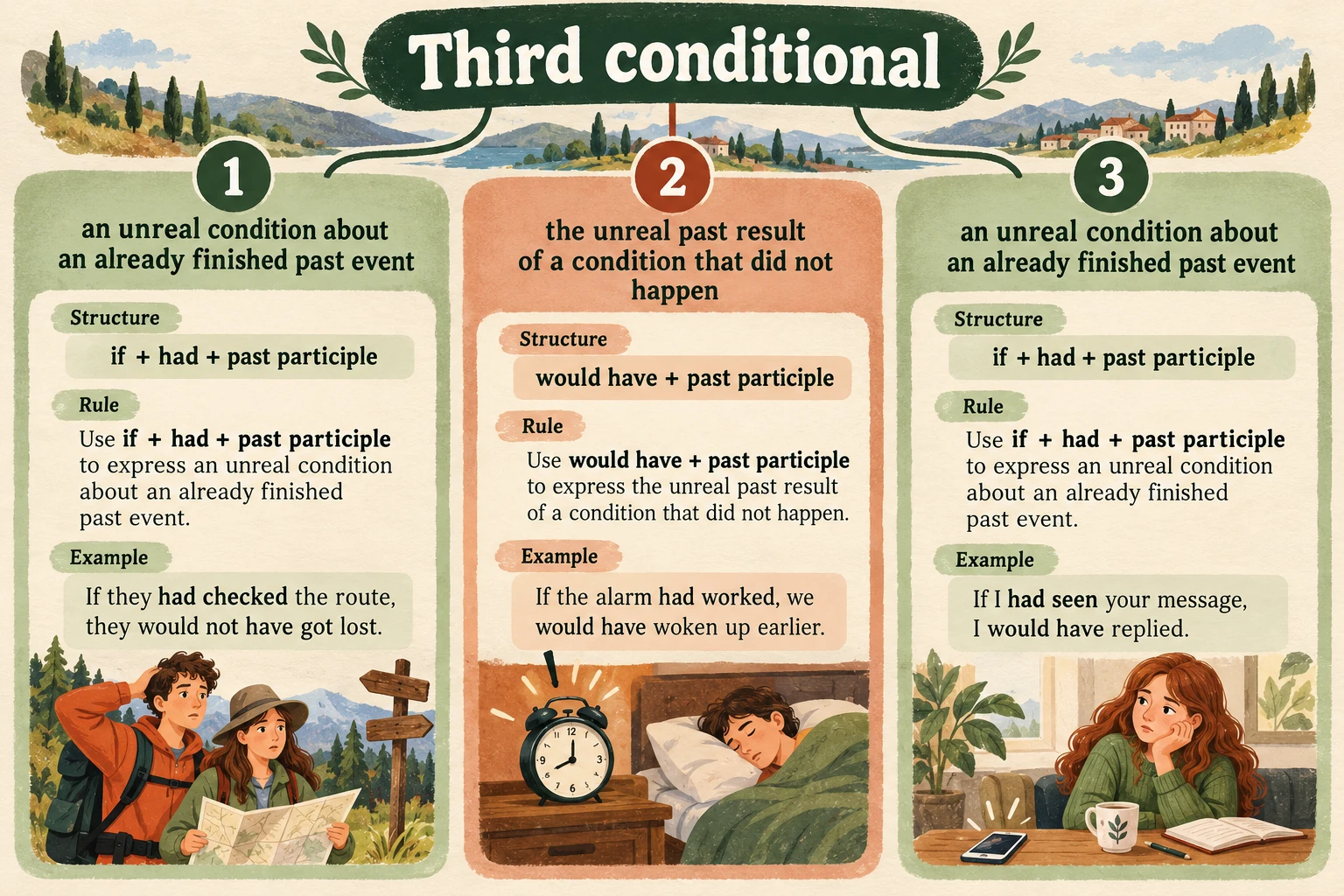
Utilisez if + had + past participle pour exprimer une condition irréelle sur un événement passé accompli.
If they had checked the route, they would not have got lost.Utilisez would have + past participle pour exprimer le résultat passé irréel d’une condition non réalisée.
If the alarm had worked, we would have woken up earlier.Utilisez if + had + past participle pour exprimer une condition irréelle sur un événement passé accompli.
If I had seen your message, I would have replied.
They did not check the route yesterday and got lost. Imagine the opposite past.
Utilisez if + had + past participle pour exprimer une condition irréelle sur un événement passé accompli.
If they had checked the route, they would not have got lost.Utilisez would have + past participle pour exprimer le résultat passé irréel d’une condition non réalisée.
If the alarm had worked, we would have woken up earlier.Utilisez if + had + past participle pour exprimer une condition irréelle sur un événement passé accompli.
If I had seen your message, I would have replied.Gardez la première tentative, comprenez le changement et essayez dans une nouvelle situation.
Pas encore de notes. Essayez un court échauffement.
Utilisez if + had + past participle pour exprimer une condition irréelle sur un événement passé accompli.
If they had checked the route, they would not have got lost.Utilisez would have + past participle pour exprimer le résultat passé irréel d’une condition non réalisée.
If the alarm had worked, we would have woken up earlier.Utilisez if + had + past participle pour exprimer une condition irréelle sur un événement passé accompli.
If I had seen your message, I would have replied.Ouvrir une réponse enregistre une aide pour cette question.
They did not check the route yesterday and got lost. Imagine the opposite past.
L’indice décisif est « They did not check the route yesterday and got lost. Imagine the opposite past. ». Utilisez if + had + past participle pour exprimer une condition irréelle sur un événement passé accompli. Dans cette tâche, la phrase complète est « If they had checked the route, they would not have got lost. ».
The alarm did not work, so nobody woke up in time.
L’indice décisif est « The alarm did not work, so nobody woke up in time. ». Utilisez would have + past participle pour exprimer le résultat passé irréel d’une condition non réalisée. Dans cette tâche, la phrase complète est « If the alarm had worked, we would have woken up earlier. ».
I did not see the message yesterday.
L’indice décisif est « I did not see the message yesterday. ». Utilisez if + had + past participle pour exprimer une condition irréelle sur un événement passé accompli. Dans cette tâche, la phrase complète est « If I had seen your message, I would have replied. ».
The doors were not locked, allowing the theft last night.
L’indice décisif est « The doors were not locked, allowing the theft last night. ». Utilisez if + had + past participle pour exprimer une condition irréelle sur un événement passé accompli. Dans cette tâche, la phrase complète est « If we had locked the doors, the theft would not have happened. ».
Use a would-result with attend for a counterfactual past consequence.
Phrase complète : « If she had received the invitation, she would have attended the ceremony. » Utilisez would have + past participle pour exprimer le résultat passé irréel d’une condition non réalisée. Le sujet, le temps et le sens de la consigne déterminent cette forme. Seules les réponses vérifiées sont comparées automatiquement ; toute autre formulation n’est pas automatiquement fausse.
The engineers did not detect the fault before launch.
L’indice décisif est « The engineers did not detect the fault before launch. ». Utilisez if + had + past participle pour exprimer une condition irréelle sur un événement passé accompli. Dans cette tâche, la phrase complète est « If they had detected the fault, they would have postponed the launch. ».
Use the past perfect of leave for the unreal past condition.
Phrase complète : « If we had left earlier, we would have caught the ferry. » Utilisez if + had + past participle pour exprimer une condition irréelle sur un événement passé accompli. Le sujet, le temps et le sens de la consigne déterminent cette forme. Seules les réponses vérifiées sont comparées automatiquement ; toute autre formulation n’est pas automatiquement fausse.
The backup was absent, so the records were lost.
L’indice décisif est « The backup was absent, so the records were lost. ». Utilisez if + had + past participle pour exprimer une condition irréelle sur un événement passé accompli. Dans cette tâche, la phrase complète est « If a backup had existed, we would have recovered the records. ».
Use a negative would-result with fail for the past result opposite to what actually happened.
Phrase complète : « If the battery had been charged, the device would not have failed. » Utilisez would have + past participle pour exprimer le résultat passé irréel d’une condition non réalisée. Le sujet, le temps et le sens de la consigne déterminent cette forme. Seules les réponses vérifiées sont comparées automatiquement ; toute autre formulation n’est pas automatiquement fausse.
We did not book in advance and paid more last weekend.
L’indice décisif est « We did not book in advance and paid more last weekend. ». Utilisez if + had + past participle pour exprimer une condition irréelle sur un événement passé accompli. Dans cette tâche, la phrase complète est « If we had booked in advance, we would have paid less. ».
A fact about last year is being imagined differently.
L’indice décisif est « A fact about last year is being imagined differently. ». Utilisez would have + past participle pour exprimer le résultat passé irréel d’une condition non réalisée. Dans cette tâche, la phrase complète est « If the museum had extended its hours, more visitors would have visited it. ».
Use the past perfect passive of repair for the unreal condition before yesterday’s accident.
Phrase complète : « If the brakes had been repaired properly, the accident would not have happened. » Utilisez if + had + past participle pour exprimer une condition irréelle sur un événement passé accompli. Le sujet, le temps et le sens de la consigne déterminent cette forme. Seules les réponses vérifiées sont comparées automatiquement ; toute autre formulation n’est pas automatiquement fausse.