
B2

Auslassung und Ersetzung Übungen

Über diese Lektion

Auslassung und Ersetzung · B2. Verwende auxiliary/modal without repeated verb phrase für eine aus dem Kontext erschließbare ausgelassene Verbgruppe; Hilfsverb beibehalten.

Bearbeite 12 neue Aufgaben. Erschließe die beabsichtigte Bedeutung aus der Situation, übe die Form und wende sie in einem neuen Kontext an.

12 Aufgaben
Speichere es für deine Sammlung.
Wissensübersicht

Ellipsis and substitution

Jetzt üben
Ellipsis and substitution — Wissensübersicht

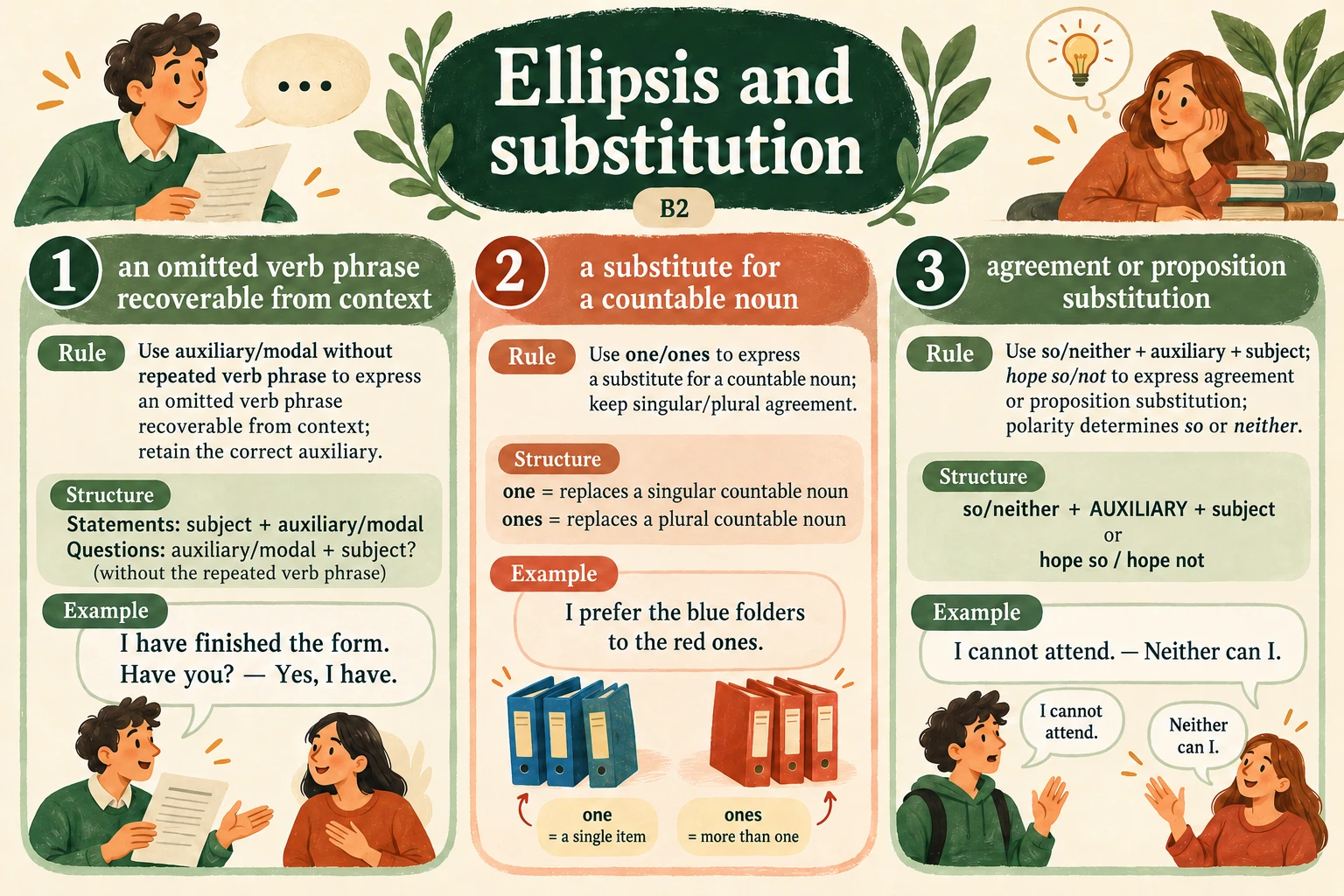
01eine aus dem Kontext erschließbare ausgelassene Verbgruppe; Hilfsverb beibehalten

Verwende auxiliary/modal without repeated verb phrase für eine aus dem Kontext erschließbare ausgelassene Verbgruppe; Hilfsverb beibehalten.

I have finished the form. Have you? — Yes, I have.
02einen Ersatz für ein zählbares Nomen; Singular/Plural beachten

Verwende one/ones für einen Ersatz für ein zählbares Nomen; Singular/Plural beachten.

I prefer the blue folders to the red ones.

03Zustimmung oder Satzersatz; Bejahung/Verneinung bestimmt so oder neither

Verwende so/neither + auxiliary + subject; hope so/not für Zustimmung oder Satzersatz; Bejahung/Verneinung bestimmt so oder neither.

I cannot attend. — Neither can I.

Illustrierte Übersicht

0/12
Aufgaben
01 / 12D01Speichere es für deine Sammlung.

Repeat only the appropriate auxiliary instead of have finished the form.

I have finished the form. Have you? — Yes, I ___.

Deine Antwort
1 / 12

Dein Lernweg

01
Schritt 1 · Einstieg

Einstieg

0/3
02
Schritt 2 · Gezielt üben

eine aus dem Kontext erschließbare ausgelassene Verbgruppe; Hilfsverb beibehalten

0/2

Verwende auxiliary/modal without repeated verb phrase für eine aus dem Kontext erschließbare ausgelassene Verbgruppe; Hilfsverb beibehalten.

I have finished the form. Have you? — Yes, I have.
03
Schritt 3 · Gezielt üben

einen Ersatz für ein zählbares Nomen; Singular/Plural beachten

0/1

Verwende one/ones für einen Ersatz für ein zählbares Nomen; Singular/Plural beachten.

I prefer the blue folders to the red ones.
04
Schritt 4 · Gezielt üben

Zustimmung oder Satzersatz; Bejahung/Verneinung bestimmt so oder neither

0/1

Verwende so/neither + auxiliary + subject; hope so/not für Zustimmung oder Satzersatz; Bejahung/Verneinung bestimmt so oder neither.

I cannot attend. — Neither can I.
05
Schritt 5 · Neue Situationen

Neue Situationen

0/3
06
Schritt 6 · Neue Herausforderung

Neue Herausforderung

0/2
Lernnotizen dieser Einheit

Aus Fehlern lernen.

Bewahre den ersten Versuch. Verstehe die Änderung. Prüfe sie in einer neuen Situation.

0

Noch keine Lernnotizen. Starte mit einem kurzen Einstieg.

Lernübersicht

Auslassung und Ersetzung

B2
Ellipsis and substitution

Lektionspunkte

01

eine aus dem Kontext erschließbare ausgelassene Verbgruppe; Hilfsverb beibehalten

Verwende auxiliary/modal without repeated verb phrase für eine aus dem Kontext erschließbare ausgelassene Verbgruppe; Hilfsverb beibehalten.

I have finished the form. Have you? — Yes, I have.
02

einen Ersatz für ein zählbares Nomen; Singular/Plural beachten

Verwende one/ones für einen Ersatz für ein zählbares Nomen; Singular/Plural beachten.

I prefer the blue folders to the red ones.
03

Zustimmung oder Satzersatz; Bejahung/Verneinung bestimmt so oder neither

Verwende so/neither + auxiliary + subject; hope so/not für Zustimmung oder Satzersatz; Bejahung/Verneinung bestimmt so oder neither.

I cannot attend. — Neither can I.

Fragen & Antworten

Das Öffnen einer Antwort wird für diese Aufgabe als Hilfe erfasst.

D01 · Einstieg

Repeat only the appropriate auxiliary instead of have finished the form.

I have finished the form. Have you? — Yes, I ___.

  1. am
  2. do
  3. have
  4. will
Antwort und Erklärung
have

Entscheidend ist der Hinweis „Repeat only the appropriate auxiliary instead of have finished the form.“. Verwende auxiliary/modal without repeated verb phrase für eine aus dem Kontext erschließbare ausgelassene Verbgruppe; Hilfsverb beibehalten. In dieser Aufgabe lautet der vollständige Satz „I have finished the form. Have you? — Yes, I have.“.

D02 · Einstieg

Replace a plural count noun, folders.

I prefer the blue folders to the red ___.

  1. it
  2. so
  3. one
  4. ones
Antwort und Erklärung
ones

Entscheidend ist der Hinweis „Replace a plural count noun, folders.“. Verwende one/ones für einen Ersatz für ein zählbares Nomen; Singular/Plural beachten. In dieser Aufgabe lautet der vollständige Satz „I prefer the blue folders to the red ones.“.

D03 · Einstieg

Agree with a negative statement using inversion.

I cannot attend. — Neither ___ I.

  1. am
  2. have
  3. can
  4. do
Antwort und Erklärung
can

Entscheidend ist der Hinweis „Agree with a negative statement using inversion.“. Verwende so/neither + auxiliary + subject; hope so/not für Zustimmung oder Satzersatz; Bejahung/Verneinung bestimmt so oder neither. In dieser Aufgabe lautet der vollständige Satz „I cannot attend. — Neither can I.“.

P01 · Gezielt üben

Avoid repeating the verb phrase can operate the machine.

Ravi cannot operate it, but Leila ___.

  1. can
  2. does
  3. has
  4. is
Antwort und Erklärung
can

Entscheidend ist der Hinweis „Avoid repeating the verb phrase can operate the machine.“. Verwende auxiliary/modal without repeated verb phrase für eine aus dem Kontext erschließbare ausgelassene Verbgruppe; Hilfsverb beibehalten. In dieser Aufgabe lautet der vollständige Satz „Ravi cannot operate it, but Leila can.“.

P02 · Gezielt üben

Replace the singular count noun adapter with a substitute word.

This adapter is broken; could I borrow another ___?

Antwort und Erklärung
one

Vollständiger Satz: „This adapter is broken; could I borrow another one?“ Verwende one/ones für einen Ersatz für ein zählbares Nomen; Singular/Plural beachten. Subjekt, Zeit und Bedeutung der Aufgabe bestimmen diese Form. Nur geprüfte Antworten werden automatisch abgeglichen; andere Formulierungen sind nicht automatisch falsch.

P03 · Gezielt üben

Use so to substitute for the entire hoped-for proposition.

Will the funding continue? — I hope ___.

  1. it to
  2. one
  3. ones
  4. so
Antwort und Erklärung
so

Entscheidend ist der Hinweis „Use so to substitute for the entire hoped-for proposition.“. Verwende so/neither + auxiliary + subject; hope so/not für Zustimmung oder Satzersatz; Bejahung/Verneinung bestimmt so oder neither. In dieser Aufgabe lautet der vollständige Satz „Will the funding continue? — I hope so.“.

P04 · Gezielt üben

Use a past-simple auxiliary to replace submitted a claim last year.

I did not submit a claim last year, but my colleague ___.

Antwort und Erklärung
did

Vollständiger Satz: „I did not submit a claim last year, but my colleague did.“ Verwende auxiliary/modal without repeated verb phrase für eine aus dem Kontext erschließbare ausgelassene Verbgruppe; Hilfsverb beibehalten. Subjekt, Zeit und Bedeutung der Aufgabe bestimmen diese Form. Nur geprüfte Antworten werden automatisch abgeglichen; andere Formulierungen sind nicht automatisch falsch.

R01 · Neue Situationen

The first clause is present perfect; retain have in the elliptical response.

They have not confirmed yet, but we ___.

  1. have
  2. will
  3. are
  4. do
Antwort und Erklärung
have

Entscheidend ist der Hinweis „The first clause is present perfect; retain have in the elliptical response.“. Verwende auxiliary/modal without repeated verb phrase für eine aus dem Kontext erschließbare ausgelassene Verbgruppe; Hilfsverb beibehalten. In dieser Aufgabe lautet der vollständige Satz „They have not confirmed yet, but we have.“.

R02 · Neue Situationen

Replace plural count noun chairs with a substitute word.

We need larger chairs; these small ___ are unsuitable.

Antwort und Erklärung
ones

Vollständiger Satz: „We need larger chairs; these small ones are unsuitable.“ Verwende one/ones für einen Ersatz für ein zählbares Nomen; Singular/Plural beachten. Subjekt, Zeit und Bedeutung der Aufgabe bestimmen diese Form. Nur geprüfte Antworten werden automatisch abgeglichen; andere Formulierungen sind nicht automatisch falsch.

R03 · Neue Situationen

Agree with a positive statement containing have.

I have read the guidelines. — So ___ I.

  1. do
  2. will
  3. am
  4. have
Antwort und Erklärung
have

Entscheidend ist der Hinweis „Agree with a positive statement containing have.“. Verwende so/neither + auxiliary + subject; hope so/not für Zustimmung oder Satzersatz; Bejahung/Verneinung bestimmt so oder neither. In dieser Aufgabe lautet der vollständige Satz „I have read the guidelines. — So have I.“.

X01 · Neue Herausforderung

Replace a singular countable noun, proposal.

Your proposal is detailed; mine is a simpler ___.

  1. ones
  2. so
  3. them
  4. one
Antwort und Erklärung
one

Entscheidend ist der Hinweis „Replace a singular countable noun, proposal.“. Verwende one/ones für einen Ersatz für ein zählbares Nomen; Singular/Plural beachten. In dieser Aufgabe lautet der vollständige Satz „Your proposal is detailed; mine is a simpler one.“.

X02 · Neue Herausforderung

Agree with the negative present-simple statement using an inverted auxiliary construction.

I do not trust that estimate. — ___.

Antwort und Erklärung
Neither do I

Vollständiger Satz: „I do not trust that estimate. — Neither do I.“ Verwende so/neither + auxiliary + subject; hope so/not für Zustimmung oder Satzersatz; Bejahung/Verneinung bestimmt so oder neither. Subjekt, Zeit und Bedeutung der Aufgabe bestimmen diese Form. Nur geprüfte Antworten werden automatisch abgeglichen; andere Formulierungen sind nicht automatisch falsch.

Weitere gültige Antworten
  • Nor do I