01uma dedução forte sobre o passado com evidências disponíveis agora
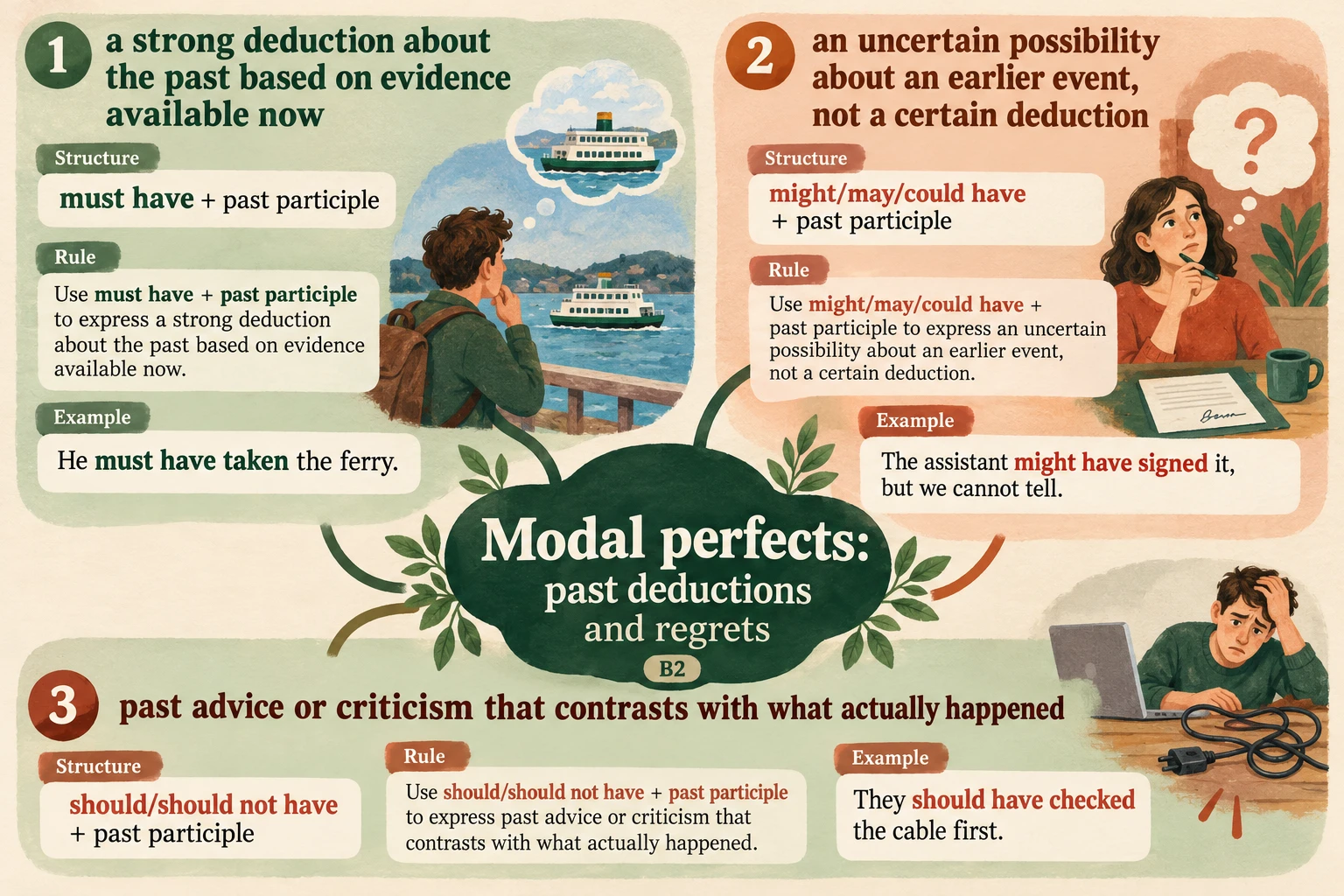
Use must have + past participle para expressar uma dedução forte sobre o passado com evidências disponíveis agora.
He must have taken the ferry.
Modais perfeitos · B2. Use must have + past participle para expressar uma dedução forte sobre o passado com evidências disponíveis agora.
Resolva 12 tarefas originais. Use a situação para interpretar o sentido, praticar a estrutura e aplicá-la em um novo contexto.
Use must have + past participle para expressar uma dedução forte sobre o passado com evidências disponíveis agora.
He must have taken the ferry.Use might/may/could have + past participle para expressar uma possibilidade incerta sobre um evento anterior, não uma certeza.
The assistant might have signed it, but we cannot tell.Use should/should not have + past participle para expressar um conselho ou crítica retrospectiva em contraste com os fatos.
They should have checked the cable first.
The only bridge was closed all day, yet he reached the island; strong past deduction.
Use must have + past participle para expressar uma dedução forte sobre o passado com evidências disponíveis agora.
He must have taken the ferry.Use might/may/could have + past participle para expressar uma possibilidade incerta sobre um evento anterior, não uma certeza.
The assistant might have signed it, but we cannot tell.Use should/should not have + past participle para expressar um conselho ou crítica retrospectiva em contraste com os fatos.
They should have checked the cable first.Guarde a primeira tentativa, entenda a mudança e confira em outra situação.
Ainda não há revisões. Faça um aquecimento curto.
Use must have + past participle para expressar uma dedução forte sobre o passado com evidências disponíveis agora.
He must have taken the ferry.Use might/may/could have + past participle para expressar uma possibilidade incerta sobre um evento anterior, não uma certeza.
The assistant might have signed it, but we cannot tell.Use should/should not have + past participle para expressar um conselho ou crítica retrospectiva em contraste com os fatos.
They should have checked the cable first.Abrir uma resposta registra ajuda para essa questão.
The only bridge was closed all day, yet he reached the island; strong past deduction.
A pista decisiva é “The only bridge was closed all day, yet he reached the island; strong past deduction.”. Use must have + past participle para expressar uma dedução forte sobre o passado com evidências disponíveis agora. Nesta tarefa, a frase completa é “He must have taken the ferry.”.
The signature is unclear; there is only an uncertain possibility.
A pista decisiva é “The signature is unclear; there is only an uncertain possibility.”. Use might/may/could have + past participle para expressar uma possibilidade incerta sobre um evento anterior, não uma certeza. Nesta tarefa, a frase completa é “The assistant might have signed it, but we cannot tell.”.
They ignored an available safety check and an avoidable accident followed.
A pista decisiva é “They ignored an available safety check and an avoidable accident followed.”. Use should/should not have + past participle para expressar um conselho ou crítica retrospectiva em contraste com os fatos. Nesta tarefa, a frase completa é “They should have checked the cable first.”.
The sealed envelope is empty now and no one else could access it; strong deduction.
A pista decisiva é “The sealed envelope is empty now and no one else could access it; strong deduction.”. Use must have + past participle para expressar uma dedução forte sobre o passado com evidências disponíveis agora. Nesta tarefa, a frase completa é “Someone must have removed the letter before sealing it.”.
Use a perfect possibility modal with take: the cause is possible, not established.
Frase completa: “The visitor might have taken the wrong corridor; we are not sure.” Use might/may/could have + past participle para expressar uma possibilidade incerta sobre um evento anterior, não uma certeza. O sujeito, o tempo e o sentido da tarefa determinam esta forma. Só as respostas revisadas são comparadas automaticamente; outras formulações não estão automaticamente erradas.
You shared a confidential file, contrary to good advice.
A pista decisiva é “You shared a confidential file, contrary to good advice.”. Use should/should not have + past participle para expressar um conselho ou crítica retrospectiva em contraste com os fatos. Nesta tarefa, a frase completa é “You should not have sent that file outside the company.”.
Use a perfect strong-deduction modal with misunderstand for a past conversation.
Frase completa: “He arrived two hours early; he must have misunderstood the time.” Use must have + past participle para expressar uma dedução forte sobre o passado com evidências disponíveis agora. O sujeito, o tempo e o sentido da tarefa determinam esta forma. Só as respostas revisadas são comparadas automaticamente; outras formulações não estão automaticamente erradas.
All the food is gone and the guests have left; strong evidence of a completed meal.
A pista decisiva é “All the food is gone and the guests have left; strong evidence of a completed meal.”. Use must have + past participle para expressar uma dedução forte sobre o passado com evidências disponíveis agora. Nesta tarefa, a frase completa é “They must have eaten already.”.
Use a perfect possibility modal with overlook for an uncertain past event.
Frase completa: “The committee may have overlooked the attachment; we cannot be certain.” Use might/may/could have + past participle para expressar uma possibilidade incerta sobre um evento anterior, não uma certeza. O sujeito, o tempo e o sentido da tarefa determinam esta forma. Só as respostas revisadas são comparadas automaticamente; outras formulações não estão automaticamente erradas.
The driver failed to rest before a long journey; retrospective criticism.
A pista decisiva é “The driver failed to rest before a long journey; retrospective criticism.”. Use should/should not have + past participle para expressar um conselho ou crítica retrospectiva em contraste com os fatos. Nesta tarefa, a frase completa é “He should have taken a break before setting off.”.
An earlier cause is possible, but the records are missing.
A pista decisiva é “An earlier cause is possible, but the records are missing.”. Use might/may/could have + past participle para expressar uma possibilidade incerta sobre um evento anterior, não uma certeza. Nesta tarefa, a frase completa é “The figures might have been entered twice.”.
Use a negative perfect advice modal with reveal to criticise a completed disclosure.
Frase completa: “You should not have revealed the witness’s identity.” Use should/should not have + past participle para expressar um conselho ou crítica retrospectiva em contraste com os fatos. O sujeito, o tempo e o sentido da tarefa determinam esta forma. Só as respostas revisadas são comparadas automaticamente; outras formulações não estão automaticamente erradas.