01um serviço feito no objeto por outra pessoa, não pelo sujeito
Use have/get + object + past participle para expressar um serviço feito no objeto por outra pessoa, não pelo sujeito.
I had my camera repaired yesterday.
Causativos have e get · B2. Use have/get + object + past participle para expressar um serviço feito no objeto por outra pessoa, não pelo sujeito.
Resolva 12 tarefas originais. Use a situação para interpretar o sentido, praticar a estrutura e aplicá-la em um novo contexto.
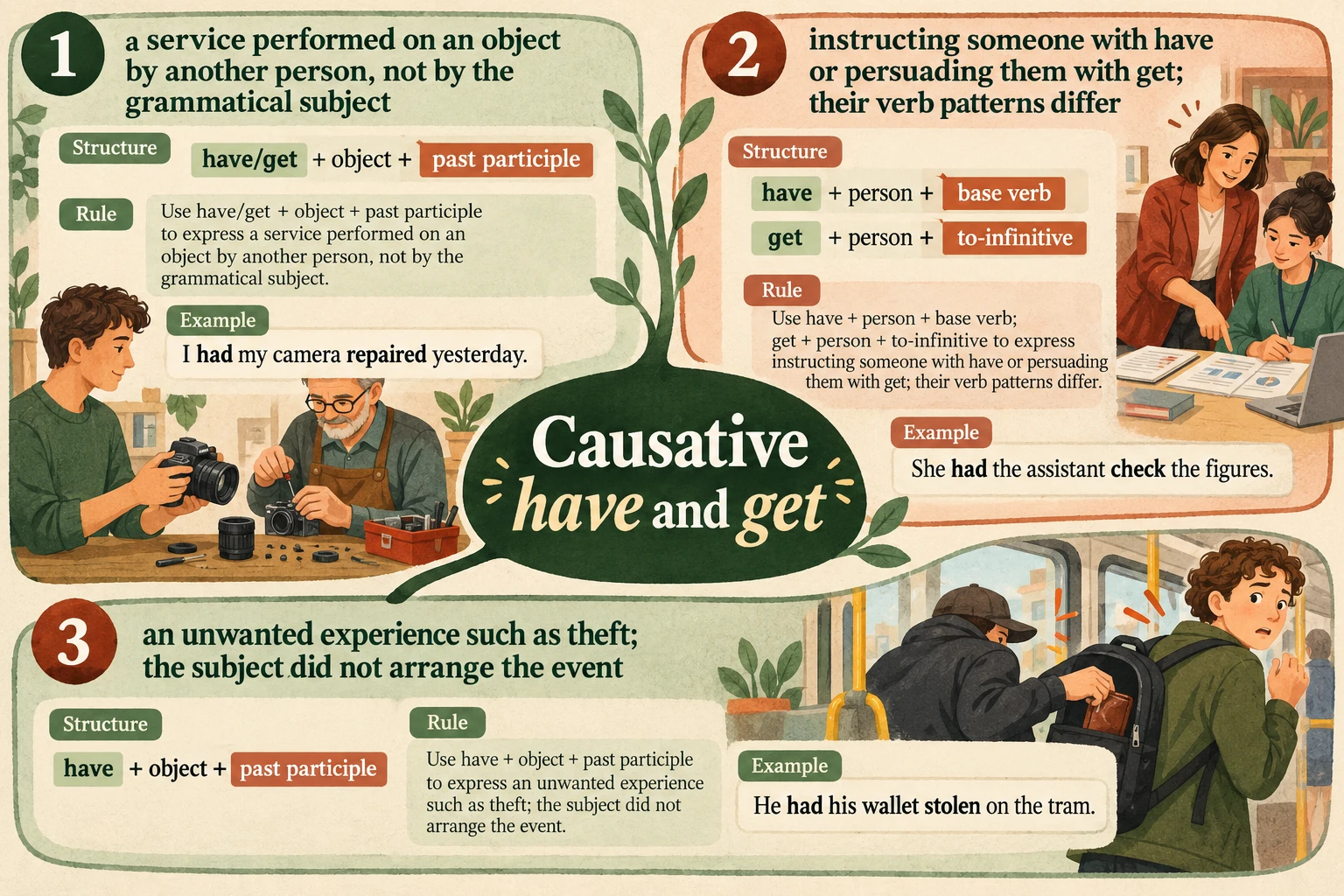
Use have/get + object + past participle para expressar um serviço feito no objeto por outra pessoa, não pelo sujeito.
I had my camera repaired yesterday.Use have + person + base verb; get + person + to-infinitive para expressar instruir com have ou convencer com get; as estruturas diferem.
She had the assistant check the figures.Use have + object + past participle para expressar uma experiência indesejada, como furto, não organizada pelo sujeito.
He had his wallet stolen on the tram.
A specialist repaired the camera for me; I did not do it myself.
Use have/get + object + past participle para expressar um serviço feito no objeto por outra pessoa, não pelo sujeito.
I had my camera repaired yesterday.Use have + person + base verb; get + person + to-infinitive para expressar instruir com have ou convencer com get; as estruturas diferem.
She had the assistant check the figures.Use have + object + past participle para expressar uma experiência indesejada, como furto, não organizada pelo sujeito.
He had his wallet stolen on the tram.Guarde a primeira tentativa, entenda a mudança e confira em outra situação.
Ainda não há revisões. Faça um aquecimento curto.
Use have/get + object + past participle para expressar um serviço feito no objeto por outra pessoa, não pelo sujeito.
I had my camera repaired yesterday.Use have + person + base verb; get + person + to-infinitive para expressar instruir com have ou convencer com get; as estruturas diferem.
She had the assistant check the figures.Use have + object + past participle para expressar uma experiência indesejada, como furto, não organizada pelo sujeito.
He had his wallet stolen on the tram.Abrir uma resposta registra ajuda para essa questão.
A specialist repaired the camera for me; I did not do it myself.
A pista decisiva é “A specialist repaired the camera for me; I did not do it myself.”. Use have/get + object + past participle para expressar um serviço feito no objeto por outra pessoa, não pelo sujeito. Nesta tarefa, a frase completa é “I had my camera repaired yesterday.”.
Use the have + person + bare-infinitive instruction pattern for a complete task, rather than the alternative have + person + -ing pattern for an ongoing situation.
A pista decisiva é “Use the have + person + bare-infinitive instruction pattern for a complete task, rather than the alternative have + person + -ing pattern for an ongoing situation.”. Use have + person + base verb; get + person + to-infinitive para expressar instruir com have ou convencer com get; as estruturas diferem. Nesta tarefa, a frase completa é “She had the assistant check the figures.”.
This was an unwanted theft, not an arranged service.
A pista decisiva é “This was an unwanted theft, not an arranged service.”. Use have + object + past participle para expressar uma experiência indesejada, como furto, não organizada pelo sujeito. Nesta tarefa, a frase completa é “He had his wallet stolen on the tram.”.
A professional is shortening the curtains for us.
A pista decisiva é “A professional is shortening the curtains for us.”. Use have/get + object + past participle para expressar um serviço feito no objeto por outra pessoa, não pelo sujeito. Nesta tarefa, a frase completa é “We are having the curtains shortened.”.
Use a to-infinitive of inspect after get the engineer, meaning arrange for that person to act.
Frase completa: “We got the engineer to inspect the roof.” Use have + person + base verb; get + person + to-infinitive para expressar instruir com have ou convencer com get; as estruturas diferem. O sujeito, o tempo e o sentido da tarefa determinam esta forma. Só as respostas revisadas são comparadas automaticamente; outras formulações não estão automaticamente erradas.
The burglar damaged our window without our consent.
A pista decisiva é “The burglar damaged our window without our consent.”. Use have + object + past participle para expressar uma experiência indesejada, como furto, não organizada pelo sujeito. Nesta tarefa, a frase completa é “We had a window smashed during the break-in.”.
Use the appropriate form of test after have the water; a laboratory performs the service.
Frase completa: “We need to have the water tested.” Use have/get + object + past participle para expressar um serviço feito no objeto por outra pessoa, não pelo sujeito. O sujeito, o tempo e o sentido da tarefa determinam esta forma. Só as respostas revisadas são comparadas automaticamente; outras formulações não estão automaticamente erradas.
The dentist will perform the treatment on my tooth.
A pista decisiva é “The dentist will perform the treatment on my tooth.”. Use have/get + object + past participle para expressar um serviço feito no objeto por outra pessoa, não pelo sujeito. Nesta tarefa, a frase completa é “I am getting a tooth filled tomorrow.”.
Use the bare infinitive (base form without to) of RECHECK after had the clerk; the clerk performs the action.
Frase completa: “The supervisor had the clerk recheck the address.” Use have + person + base verb; get + person + to-infinitive para expressar instruir com have ou convencer com get; as estruturas diferem. O sujeito, o tempo e o sentido da tarefa determinam esta forma. Só as respostas revisadas são comparadas automaticamente; outras formulações não estão automaticamente erradas.
An unwanted damage event happened to the cyclist.
A pista decisiva é “An unwanted damage event happened to the cyclist.”. Use have + object + past participle para expressar uma experiência indesejada, como furto, não organizada pelo sujeito. Nesta tarefa, a frase completa é “She had her bicycle damaged by a falling branch.”.
Get plus a person requires a to-infinitive for persuasion.
A pista decisiva é “Get plus a person requires a to-infinitive for persuasion.”. Use have + person + base verb; get + person + to-infinitive para expressar instruir com have ou convencer com get; as estruturas diferem. Nesta tarefa, a frase completa é “I finally got him to acknowledge the mistake.”.
Use the correct form of steal for an unwanted theft of the company’s tools.
Frase completa: “The firm had several tools stolen overnight.” Use have + object + past participle para expressar uma experiência indesejada, como furto, não organizada pelo sujeito. O sujeito, o tempo e o sentido da tarefa determinam esta forma. Só as respostas revisadas são comparadas automaticamente; outras formulações não estão automaticamente erradas.