01un service réalisé sur l’objet par quelqu’un d’autre
Utilisez have/get + object + past participle pour exprimer un service réalisé sur l’objet par quelqu’un d’autre.
I had my camera repaired yesterday.
Faire faire avec have et get · B2. Utilisez have/get + object + past participle pour exprimer un service réalisé sur l’objet par quelqu’un d’autre.
Réalisez 12 exercices originaux. Appuyez-vous sur la situation pour interpréter le sens, pratiquer la forme et la réutiliser dans un nouveau contexte.
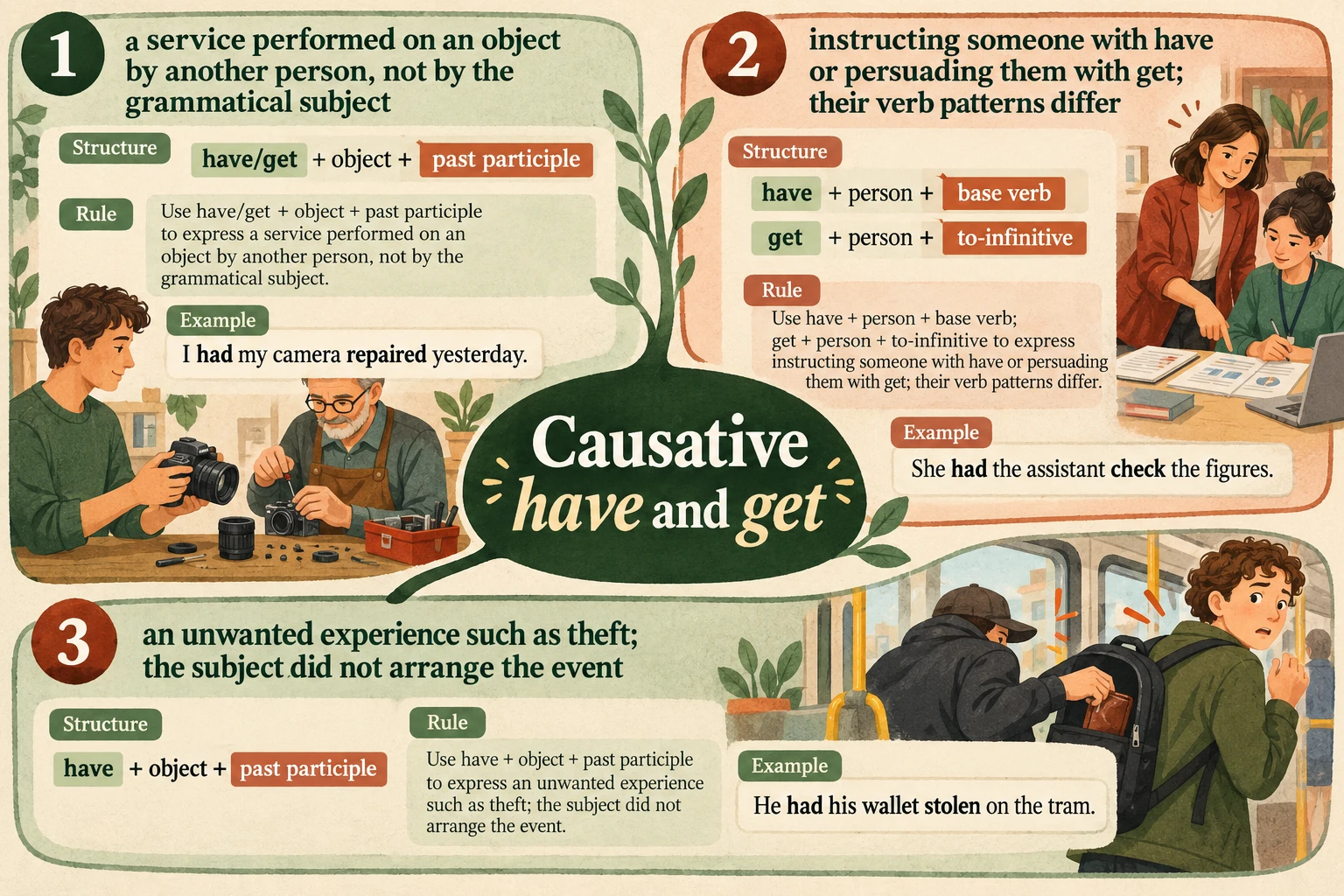
Utilisez have/get + object + past participle pour exprimer un service réalisé sur l’objet par quelqu’un d’autre.
I had my camera repaired yesterday.Utilisez have + person + base verb; get + person + to-infinitive pour exprimer une instruction avec have ou une persuasion avec get ; les constructions diffèrent.
She had the assistant check the figures.Utilisez have + object + past participle pour exprimer une expérience subie telle qu’un vol, non organisée par le sujet.
He had his wallet stolen on the tram.
A specialist repaired the camera for me; I did not do it myself.
Utilisez have/get + object + past participle pour exprimer un service réalisé sur l’objet par quelqu’un d’autre.
I had my camera repaired yesterday.Utilisez have + person + base verb; get + person + to-infinitive pour exprimer une instruction avec have ou une persuasion avec get ; les constructions diffèrent.
She had the assistant check the figures.Utilisez have + object + past participle pour exprimer une expérience subie telle qu’un vol, non organisée par le sujet.
He had his wallet stolen on the tram.Gardez la première tentative, comprenez le changement et essayez dans une nouvelle situation.
Pas encore de notes. Essayez un court échauffement.
Utilisez have/get + object + past participle pour exprimer un service réalisé sur l’objet par quelqu’un d’autre.
I had my camera repaired yesterday.Utilisez have + person + base verb; get + person + to-infinitive pour exprimer une instruction avec have ou une persuasion avec get ; les constructions diffèrent.
She had the assistant check the figures.Utilisez have + object + past participle pour exprimer une expérience subie telle qu’un vol, non organisée par le sujet.
He had his wallet stolen on the tram.Ouvrir une réponse enregistre une aide pour cette question.
A specialist repaired the camera for me; I did not do it myself.
L’indice décisif est « A specialist repaired the camera for me; I did not do it myself. ». Utilisez have/get + object + past participle pour exprimer un service réalisé sur l’objet par quelqu’un d’autre. Dans cette tâche, la phrase complète est « I had my camera repaired yesterday. ».
Use the have + person + bare-infinitive instruction pattern for a complete task, rather than the alternative have + person + -ing pattern for an ongoing situation.
L’indice décisif est « Use the have + person + bare-infinitive instruction pattern for a complete task, rather than the alternative have + person + -ing pattern for an ongoing situation. ». Utilisez have + person + base verb; get + person + to-infinitive pour exprimer une instruction avec have ou une persuasion avec get ; les constructions diffèrent. Dans cette tâche, la phrase complète est « She had the assistant check the figures. ».
This was an unwanted theft, not an arranged service.
L’indice décisif est « This was an unwanted theft, not an arranged service. ». Utilisez have + object + past participle pour exprimer une expérience subie telle qu’un vol, non organisée par le sujet. Dans cette tâche, la phrase complète est « He had his wallet stolen on the tram. ».
A professional is shortening the curtains for us.
L’indice décisif est « A professional is shortening the curtains for us. ». Utilisez have/get + object + past participle pour exprimer un service réalisé sur l’objet par quelqu’un d’autre. Dans cette tâche, la phrase complète est « We are having the curtains shortened. ».
Use a to-infinitive of inspect after get the engineer, meaning arrange for that person to act.
Phrase complète : « We got the engineer to inspect the roof. » Utilisez have + person + base verb; get + person + to-infinitive pour exprimer une instruction avec have ou une persuasion avec get ; les constructions diffèrent. Le sujet, le temps et le sens de la consigne déterminent cette forme. Seules les réponses vérifiées sont comparées automatiquement ; toute autre formulation n’est pas automatiquement fausse.
The burglar damaged our window without our consent.
L’indice décisif est « The burglar damaged our window without our consent. ». Utilisez have + object + past participle pour exprimer une expérience subie telle qu’un vol, non organisée par le sujet. Dans cette tâche, la phrase complète est « We had a window smashed during the break-in. ».
Use the appropriate form of test after have the water; a laboratory performs the service.
Phrase complète : « We need to have the water tested. » Utilisez have/get + object + past participle pour exprimer un service réalisé sur l’objet par quelqu’un d’autre. Le sujet, le temps et le sens de la consigne déterminent cette forme. Seules les réponses vérifiées sont comparées automatiquement ; toute autre formulation n’est pas automatiquement fausse.
The dentist will perform the treatment on my tooth.
L’indice décisif est « The dentist will perform the treatment on my tooth. ». Utilisez have/get + object + past participle pour exprimer un service réalisé sur l’objet par quelqu’un d’autre. Dans cette tâche, la phrase complète est « I am getting a tooth filled tomorrow. ».
Use the bare infinitive (base form without to) of RECHECK after had the clerk; the clerk performs the action.
Phrase complète : « The supervisor had the clerk recheck the address. » Utilisez have + person + base verb; get + person + to-infinitive pour exprimer une instruction avec have ou une persuasion avec get ; les constructions diffèrent. Le sujet, le temps et le sens de la consigne déterminent cette forme. Seules les réponses vérifiées sont comparées automatiquement ; toute autre formulation n’est pas automatiquement fausse.
An unwanted damage event happened to the cyclist.
L’indice décisif est « An unwanted damage event happened to the cyclist. ». Utilisez have + object + past participle pour exprimer une expérience subie telle qu’un vol, non organisée par le sujet. Dans cette tâche, la phrase complète est « She had her bicycle damaged by a falling branch. ».
Get plus a person requires a to-infinitive for persuasion.
L’indice décisif est « Get plus a person requires a to-infinitive for persuasion. ». Utilisez have + person + base verb; get + person + to-infinitive pour exprimer une instruction avec have ou une persuasion avec get ; les constructions diffèrent. Dans cette tâche, la phrase complète est « I finally got him to acknowledge the mistake. ».
Use the correct form of steal for an unwanted theft of the company’s tools.
Phrase complète : « The firm had several tools stolen overnight. » Utilisez have + object + past participle pour exprimer une expérience subie telle qu’un vol, non organisée par le sujet. Le sujet, le temps et le sens de la consigne déterminent cette forme. Seules les réponses vérifiées sont comparées automatiquement ; toute autre formulation n’est pas automatiquement fausse.