01a past habit or state that is no longer true; did takes use without d
Use used to + base verb to express a past habit or state that is no longer true; did takes use without d.
There used to be a cinema on this corner.
Used to, be used to, get used to · B1. Use used to + base verb to express a past habit or state that is no longer true; did takes use without d.
Complete 12 original tasks. Use the situation to choose the intended meaning, practise the form, then apply it in a fresh context.
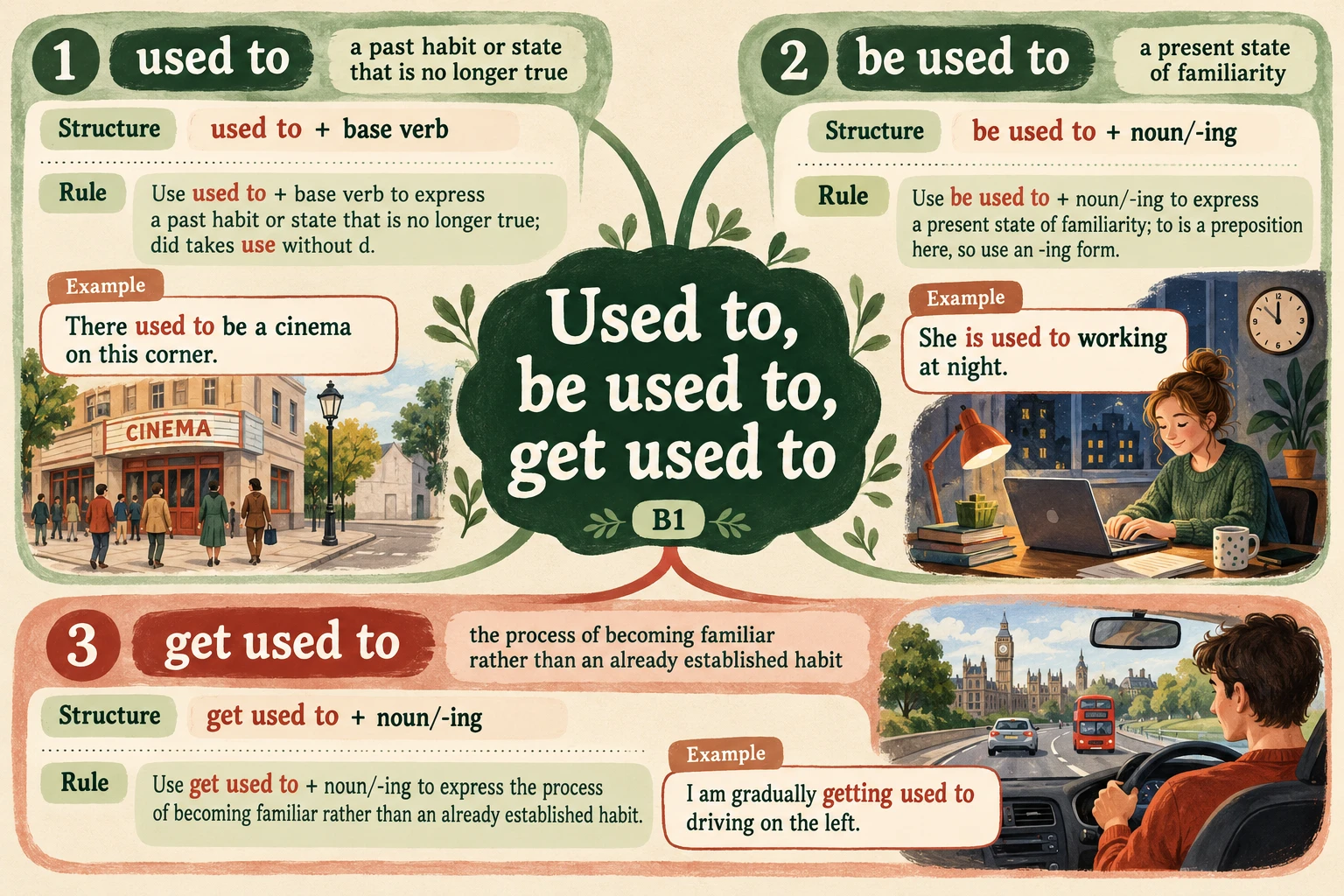
Use used to + base verb to express a past habit or state that is no longer true; did takes use without d.
There used to be a cinema on this corner.Use be used to + noun/-ing to express a present state of familiarity; to is a preposition here, so use an -ing form.
She is used to working at night.Use get used to + noun/-ing to express the process of becoming familiar rather than an already established habit.
I am gradually getting used to driving on the left.
The cinema closed years ago; it no longer operates here.
Use used to + base verb to express a past habit or state that is no longer true; did takes use without d.
There used to be a cinema on this corner.Use be used to + noun/-ing to express a present state of familiarity; to is a preposition here, so use an -ing form.
She is used to working at night.Use get used to + noun/-ing to express the process of becoming familiar rather than an already established habit.
I am gradually getting used to driving on the left.Keep the first try. Understand the change. Check it in a fresh situation.
No practice notes yet. Try a short warm-up.
Use used to + base verb to express a past habit or state that is no longer true; did takes use without d.
There used to be a cinema on this corner.Use be used to + noun/-ing to express a present state of familiarity; to is a preposition here, so use an -ing form.
She is used to working at night.Use get used to + noun/-ing to express the process of becoming familiar rather than an already established habit.
I am gradually getting used to driving on the left.Opening an answer records help for that question.
The cinema closed years ago; it no longer operates here.
Look at “There ___ be a cinema on this corner.”. Use used to + base verb to express a past habit or state that is no longer true; did takes use without d. Complete sentence: “There used to be a cinema on this corner.”.
Working at night is already familiar to her.
Look at “She is used to ___ at night.”. Use be used to + noun/-ing to express a present state of familiarity; to is a preposition here, so use an -ing form. Complete sentence: “She is used to working at night.”.
The adjustment is still in progress.
Look at “I am gradually getting used to ___ on the left.”. Use get used to + noun/-ing to express the process of becoming familiar rather than an already established habit. Complete sentence: “I am gradually getting used to driving on the left.”.
He was shy as a child, but is sociable now.
Look at “He ___ be very shy.”. Use used to + base verb to express a past habit or state that is no longer true; did takes use without d. Complete sentence: “He used to be very shy.”.
Complete with the correct form of be after the preposition in be used to; the state is already familiar.
Complete sentence: “I am used to being interrupted during my shift.” Use be used to + noun/-ing to express a present state of familiarity; to is a preposition here, so use an -ing form. The subject, time and meaning in the task determine this form. Only reviewed responses are matched automatically; other wording is not automatically wrong.
They are still adapting, rather than describing an old habit.
Look at “They are getting used to ___ the new software.”. Use get used to + noun/-ing to express the process of becoming familiar rather than an already established habit. Complete sentence: “They are getting used to using the new software.”.
Use the past-habit construction with live for a state that has changed.
Complete sentence: “We used to live above a bakery, but we moved last year.” Use used to + base verb to express a past habit or state that is no longer true; did takes use without d. The subject, time and meaning in the task determine this form. Only reviewed responses are matched automatically; other wording is not automatically wrong.
This old routine no longer happens.
Look at “My grandfather ___ deliver milk before dawn.”. Use used to + base verb to express a past habit or state that is no longer true; did takes use without d. Complete sentence: “My grandfather used to deliver milk before dawn.”.
Complete with the correct form of wait after be used to, expressing established familiarity.
Complete sentence: “Commuters here are used to waiting in long queues.” Use be used to + noun/-ing to express a present state of familiarity; to is a preposition here, so use an -ing form. The subject, time and meaning in the task determine this form. Only reviewed responses are matched automatically; other wording is not automatically wrong.
The speaker is becoming accustomed to the climate now.
Look at “I am getting used to ___ in the heat.”. Use get used to + noun/-ing to express the process of becoming familiar rather than an already established habit. Complete sentence: “I am getting used to exercising in the heat.”.
The adaptation was a gradual process.
Look at “It took months to get used to ___ alone.”. Use be used to + noun/-ing to express a present state of familiarity; to is a preposition here, so use an -ing form. Complete sentence: “It took months to get used to living alone.”.
Complete with the correct form of wake after get used to, describing adaptation.
Complete sentence: “It may take time to get used to waking before sunrise.” Use get used to + noun/-ing to express the process of becoming familiar rather than an already established habit. The subject, time and meaning in the task determine this form. Only reviewed responses are matched automatically; other wording is not automatically wrong.