01a preference about another person’s present or future action
Use would rather + subject + past simple to express a preference about another person’s present or future action.
I would rather you called me before visiting tomorrow.
Unreal past: would rather and it's time · B2. Use would rather + subject + past simple to express a preference about another person’s present or future action.
Complete 12 original tasks. Use the situation to choose the intended meaning, practise the form, then apply it in a fresh context.
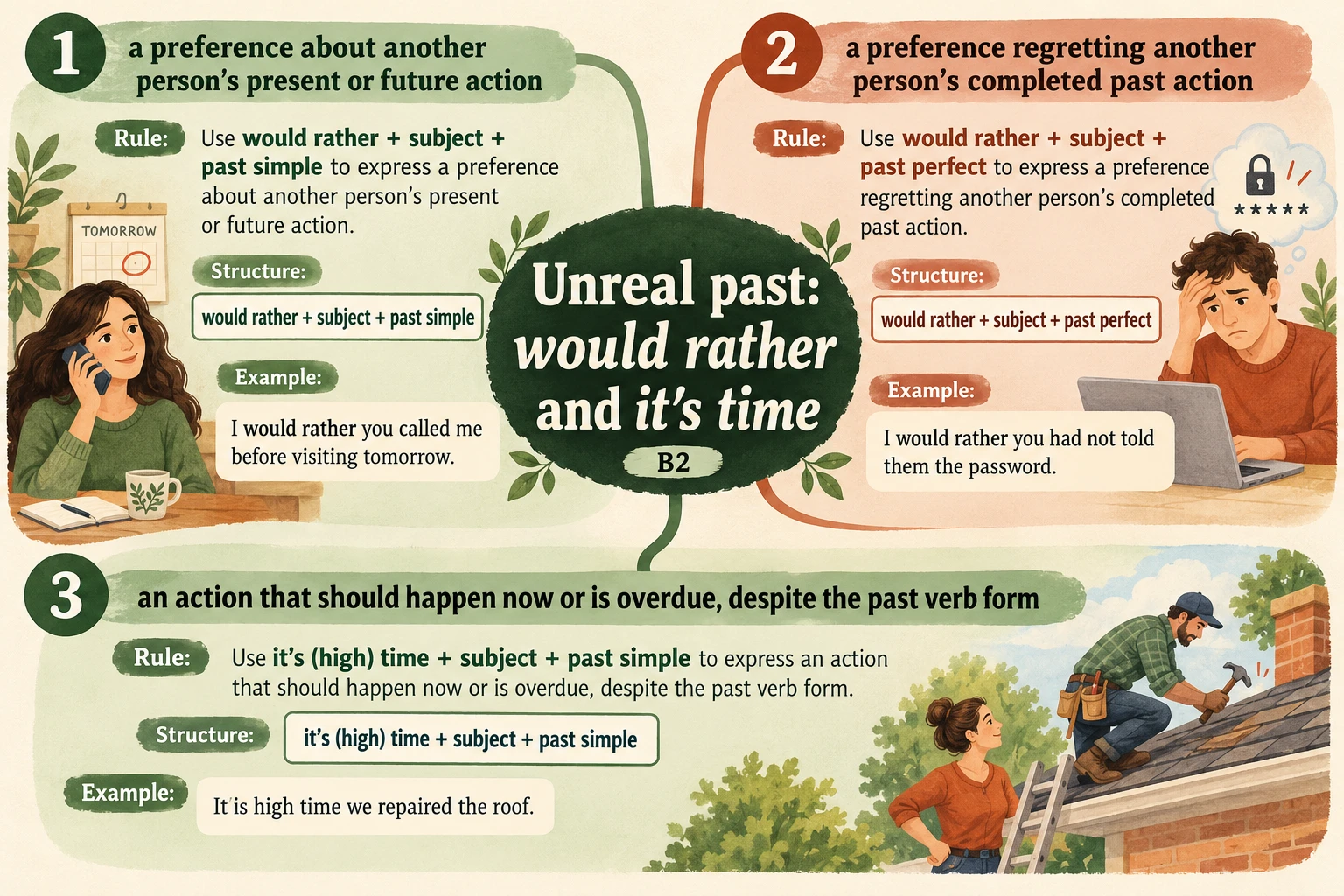
Use would rather + subject + past simple to express a preference about another person’s present or future action.
I would rather you called me before visiting tomorrow.Use would rather + subject + past perfect to express a preference regretting another person’s completed past action.
I would rather you had not told them the password.Use it's (high) time + subject + past simple to express an action that should happen now or is overdue, despite the past verb form.
It is high time we repaired the roof.
This is a preference about someone else’s future behaviour.
Use would rather + subject + past simple to express a preference about another person’s present or future action.
I would rather you called me before visiting tomorrow.Use would rather + subject + past perfect to express a preference regretting another person’s completed past action.
I would rather you had not told them the password.Use it's (high) time + subject + past simple to express an action that should happen now or is overdue, despite the past verb form.
It is high time we repaired the roof.Keep the first try. Understand the change. Check it in a fresh situation.
No practice notes yet. Try a short warm-up.
Use would rather + subject + past simple to express a preference about another person’s present or future action.
I would rather you called me before visiting tomorrow.Use would rather + subject + past perfect to express a preference regretting another person’s completed past action.
I would rather you had not told them the password.Use it's (high) time + subject + past simple to express an action that should happen now or is overdue, despite the past verb form.
It is high time we repaired the roof.Opening an answer records help for that question.
This is a preference about someone else’s future behaviour.
The deciding clue is “This is a preference about someone else’s future behaviour.”. Use would rather + subject + past simple to express a preference about another person’s present or future action. In this task, the completed sentence is “I would rather you called me before visiting tomorrow.”.
The disclosure happened yesterday and the speaker regrets it.
The deciding clue is “The disclosure happened yesterday and the speaker regrets it.”. Use would rather + subject + past perfect to express a preference regretting another person’s completed past action. In this task, the completed sentence is “I would rather you had not told them the password.”.
The action is overdue now, although the verb has a past form.
The deciding clue is “The action is overdue now, although the verb has a past form.”. Use it's (high) time + subject + past simple to express an action that should happen now or is overdue, despite the past verb form. In this task, the completed sentence is “It is high time we repaired the roof.”.
A preference about another person attending next week.
The deciding clue is “A preference about another person attending next week.”. Use would rather + subject + past simple to express a preference about another person’s present or future action. In this task, the completed sentence is “I would rather she attended the meeting next week.”.
Use the past perfect of consult for a preference about a completed past decision.
Complete sentence: “I would rather they had consulted us before signing last month.” Use would rather + subject + past perfect to express a preference regretting another person’s completed past action. The subject, time and meaning in the task determine this form. Only reviewed responses are matched automatically; other wording is not automatically wrong.
The action should begin now; it is already late.
The deciding clue is “The action should begin now; it is already late.”. Use it's (high) time + subject + past simple to express an action that should happen now or is overdue, despite the past verb form. In this task, the completed sentence is “It is time the council took responsibility.”.
Use the past simple of stay for another person’s action tonight.
Complete sentence: “I would rather you stayed here tonight.” Use would rather + subject + past simple to express a preference about another person’s present or future action. The subject, time and meaning in the task determine this form. Only reviewed responses are matched automatically; other wording is not automatically wrong.
The speaker wants someone else to refrain from an action tomorrow.
The deciding clue is “The speaker wants someone else to refrain from an action tomorrow.”. Use would rather + subject + past simple to express a preference about another person’s present or future action. In this task, the completed sentence is “I would rather you did not announce the results tomorrow.”.
Use the past perfect of check for regret about yesterday’s completed process.
Complete sentence: “I would rather the editor had checked the names before publication yesterday.” Use would rather + subject + past perfect to express a preference regretting another person’s completed past action. The subject, time and meaning in the task determine this form. Only reviewed responses are matched automatically; other wording is not automatically wrong.
An overdue present need is expressed with it is high time.
The deciding clue is “An overdue present need is expressed with it is high time.”. Use it's (high) time + subject + past simple to express an action that should happen now or is overdue, despite the past verb form. In this task, the completed sentence is “It is high time management took the complaints seriously.”.
A missed past action is being regretted now.
The deciding clue is “A missed past action is being regretted now.”. Use would rather + subject + past perfect to express a preference regretting another person’s completed past action. In this task, the completed sentence is “I would rather you had warned me about the cancellation yesterday.”.
Use the past simple of replace after it is time for an overdue present action.
Complete sentence: “It is time we replaced this obsolete system.” Use it's (high) time + subject + past simple to express an action that should happen now or is overdue, despite the past verb form. The subject, time and meaning in the task determine this form. Only reviewed responses are matched automatically; other wording is not automatically wrong.