01At for precise times
Use at for clock times and fixed expressions such as at night and at noon.
Meet me at ten.
Prepositions of time · A1. Use at for clock times and fixed expressions such as at night and at noon.
Practise Prepositions of time in short situations. Read the clue, choose or write a form, then check the reason. The level is an editorial guide.
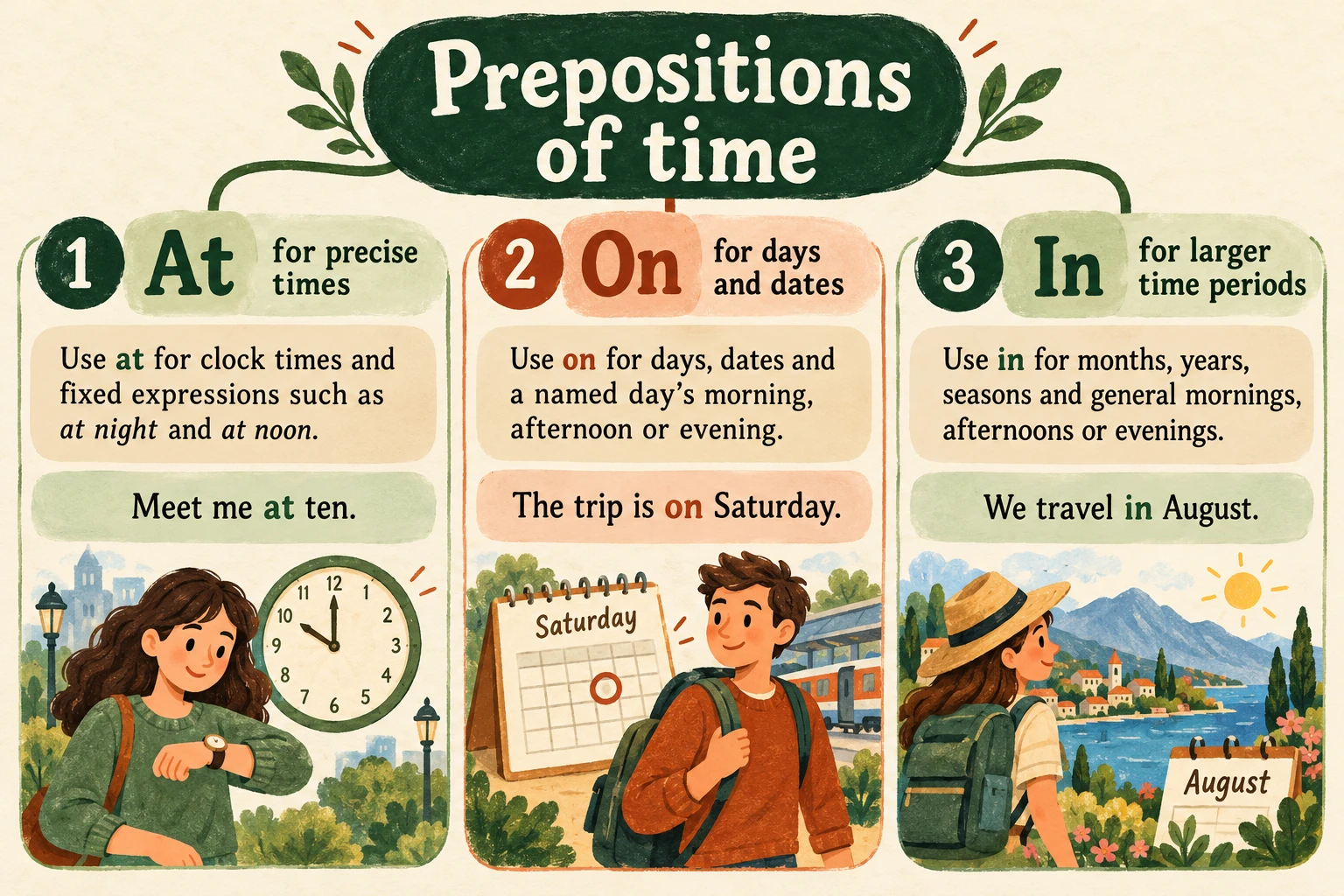
Use at for clock times and fixed expressions such as at night and at noon.
Meet me at ten.Use on for days, dates and a named day’s morning, afternoon or evening.
The trip is on Saturday.Use in for months, years, seasons and general mornings, afternoons or evenings.
We travel in August.
The lesson starts ___ 8:30.
Use at for clock times and fixed expressions such as at night and at noon.
Meet me at ten.Use on for days, dates and a named day’s morning, afternoon or evening.
The trip is on Saturday.Use in for months, years, seasons and general mornings, afternoons or evenings.
We travel in August.Keep the first try. Understand the change. Check it in a fresh situation.
No practice notes yet. Try a short warm-up.
Use at for clock times and fixed expressions such as at night and at noon.
Meet me at ten.Use on for days, dates and a named day’s morning, afternoon or evening.
The trip is on Saturday.Use in for months, years, seasons and general mornings, afternoons or evenings.
We travel in August.Opening an answer records help for that question.
The lesson starts ___ 8:30.
Look at “The lesson starts ___ 8:30.”. Use at for clock times and fixed expressions such as at night and at noon. Complete sentence: “The lesson starts at 8:30.”.
We will meet ___ Tuesday.
Look at “We will meet ___ Tuesday.”. Use on for days, dates and a named day’s morning, afternoon or evening. Complete sentence: “We will meet on Tuesday.”.
My birthday is ___ September.
Look at “My birthday is ___ September.”. Use in for months, years, seasons and general mornings, afternoons or evenings. Complete sentence: “My birthday is in September.”.
The café closes ___ noon.
Reference completion: “The café closes at noon.”. Use at for clock times and fixed expressions such as at night and at noon.
The concert is ___ 14 May.
Look at “The concert is ___ 14 May.”. Use on for days, dates and a named day’s morning, afternoon or evening. Complete sentence: “The concert is on 14 May.”.
We moved here ___ 2021.
Look at “We moved here ___ 2021.”. Use in for months, years, seasons and general mornings, afternoons or evenings. Complete sentence: “We moved here in 2021.”.
I often wake up ___ night.
Reference completion: “I often wake up at night.”. Use at for clock times and fixed expressions such as at night and at noon. Also accepted in this task: in the / throughout the. These are reviewed alternatives, not an exhaustive list of all possible English.
The next train leaves ___ six o’clock.
Look at “The next train leaves ___ six o’clock.”. Use at for clock times and fixed expressions such as at night and at noon. Complete sentence: “The next train leaves at six o’clock.”.
The team practises ___ Friday evenings.
Look at “The team practises ___ Friday evenings.”. Use on for days, dates and a named day’s morning, afternoon or evening. Complete sentence: “The team practises on Friday evenings.”.
It is usually cold here ___ winter.
Reference completion: “It is usually cold here in winter.”. Use in for months, years, seasons and general mornings, afternoons or evenings. Also accepted in this task: during / throughout / during the / throughout the. These are reviewed alternatives, not an exhaustive list of all possible English.
The appointment is ___ Monday morning.
Look at “The appointment is ___ Monday morning.”. Use on for days, dates and a named day’s morning, afternoon or evening. Complete sentence: “The appointment is on Monday morning.”.
I read the news ___ the morning.
Reference completion: “I read the news in the morning.”. Use in for months, years, seasons and general mornings, afternoons or evenings. Also accepted in this task: throughout. These are reviewed alternatives, not an exhaustive list of all possible English.