01general ability over a past period, rather than a particular successful attempt
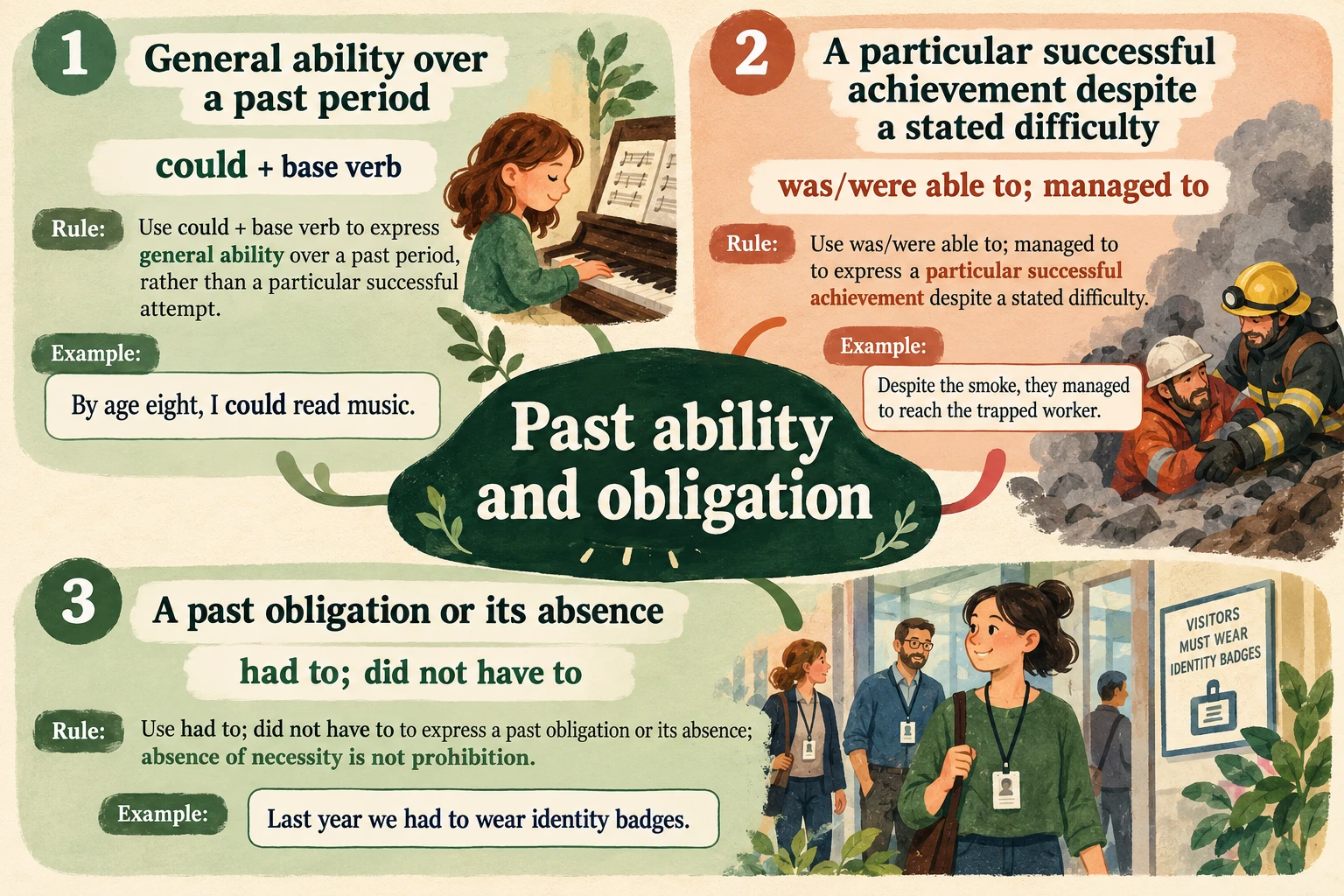
Use could + base verb to express general ability over a past period, rather than a particular successful attempt.
By age eight, I could read music.
Past ability and obligation · B1. Use could + base verb to express general ability over a past period, rather than a particular successful attempt.
Complete 12 original tasks. Use the situation to choose the intended meaning, practise the form, then apply it in a fresh context.
Use could + base verb to express general ability over a past period, rather than a particular successful attempt.
By age eight, I could read music.Use was/were able to; managed to to express a particular successful achievement despite a stated difficulty.
Despite the smoke, they managed to reach the trapped worker.Use had to; did not have to to express a past obligation or its absence; absence of necessity is not prohibition.
Last year we had to wear identity badges.
Describe a general childhood ability, not a single achievement.
Use could + base verb to express general ability over a past period, rather than a particular successful attempt.
By age eight, I could read music.Use was/were able to; managed to to express a particular successful achievement despite a stated difficulty.
Despite the smoke, they managed to reach the trapped worker.Use had to; did not have to to express a past obligation or its absence; absence of necessity is not prohibition.
Last year we had to wear identity badges.Keep the first try. Understand the change. Check it in a fresh situation.
No practice notes yet. Try a short warm-up.
Use could + base verb to express general ability over a past period, rather than a particular successful attempt.
By age eight, I could read music.Use was/were able to; managed to to express a particular successful achievement despite a stated difficulty.
Despite the smoke, they managed to reach the trapped worker.Use had to; did not have to to express a past obligation or its absence; absence of necessity is not prohibition.
Last year we had to wear identity badges.Opening an answer records help for that question.
Describe a general childhood ability, not a single achievement.
Look at “By age eight, I ___ read music.”. Use could + base verb to express general ability over a past period, rather than a particular successful attempt. Complete sentence: “By age eight, I could read music.”.
One successful rescue followed a difficult attempt.
Look at “Despite the smoke, they ___ reach the trapped worker.”. Use was/were able to; managed to to express a particular successful achievement despite a stated difficulty. Complete sentence: “Despite the smoke, they managed to reach the trapped worker.”.
A rule required this last year.
Look at “Last year we ___ wear identity badges.”. Use had to; did not have to to express a past obligation or its absence; absence of necessity is not prohibition. Complete sentence: “Last year we had to wear identity badges.”.
General ability throughout a past period.
Look at “When she lived there, she ___ understand the local dialect.”. Use could + base verb to express general ability over a past period, rather than a particular successful attempt. Complete sentence: “When she lived there, she could understand the local dialect.”.
Use manage in the past with recover for this single difficult success.
Complete sentence: “After six hours of work, the technician managed to recover the deleted files.” Use was/were able to; managed to to express a particular successful achievement despite a stated difficulty. The subject, time and meaning in the task determine this form. Only reviewed responses are matched automatically; other wording is not automatically wrong.
No payment was required because admission was free.
Look at “We ___ pay to enter.”. Use had to; did not have to to express a past obligation or its absence; absence of necessity is not prohibition. Complete sentence: “We did not have to pay to enter.”.
Use a past-form ability modal for Jo’s general ability then.
Complete sentence: “As a teenager, Jo could run ten kilometres without stopping.” Use could + base verb to express general ability over a past period, rather than a particular successful attempt. The subject, time and meaning in the task determine this form. Only reviewed responses are matched automatically; other wording is not automatically wrong.
A general skill possessed during a previous job.
Look at “As an interpreter, she ___ switch between three languages easily.”. Use could + base verb to express general ability over a past period, rather than a particular successful attempt. Complete sentence: “As an interpreter, she could switch between three languages easily.”.
Use the past form of be able with escape for one successful escape despite a jammed door.
Complete sentence: “After forcing the lock, he was able to escape.” Use was/were able to; managed to to express a particular successful achievement despite a stated difficulty. The subject, time and meaning in the task determine this form. Only reviewed responses are matched automatically; other wording is not automatically wrong.
The employer made the training compulsory at the time.
Look at “All recruits ___ attend the course last spring.”. Use had to; did not have to to express a past obligation or its absence; absence of necessity is not prohibition. Complete sentence: “All recruits had to attend the course last spring.”.
This reports a particular successful repair, not general ability.
Look at “After several attempts, I ___ restart the server.”. Use was/were able to; managed to to express a particular successful achievement despite a stated difficulty. Complete sentence: “After several attempts, I managed to restart the server.”.
Use a negative past form of have to with submit: the form was optional.
Complete sentence: “We did not have to submit the form yesterday because it was optional.” Use had to; did not have to to express a past obligation or its absence; absence of necessity is not prohibition. The subject, time and meaning in the task determine this form. Only reviewed responses are matched automatically; other wording is not automatically wrong.