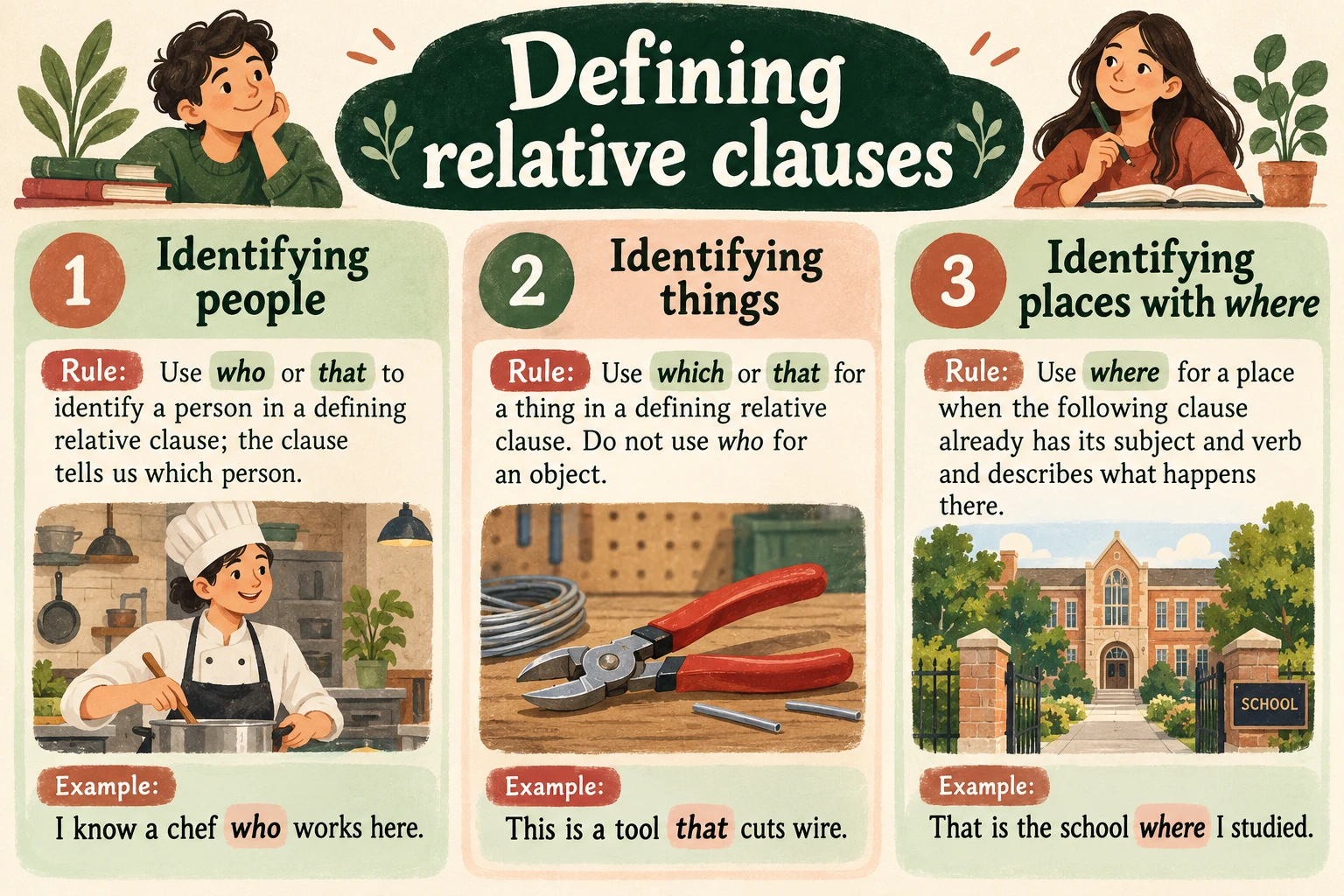
01Identifying people
Use who or that to identify a person in a defining relative clause; the clause tells us which person.
I know a chef who works here.
Defining relative clauses · A2. Use who or that to identify a person in a defining relative clause; the clause tells us which person.
Practise Defining relative clauses in short situations. Read the clue, choose or write a form, then check the reason. The level is an editorial guide.
Use who or that to identify a person in a defining relative clause; the clause tells us which person.
I know a chef who works here.Use which or that for a thing in a defining relative clause. Do not use who for an object.
This is a tool that cuts wire.Use where for a place when the following clause already has its subject and verb and describes what happens there.
That is the school where I studied.
The woman ___ lives next door is a nurse.
Use who or that to identify a person in a defining relative clause; the clause tells us which person.
I know a chef who works here.Use which or that for a thing in a defining relative clause. Do not use who for an object.
This is a tool that cuts wire.Use where for a place when the following clause already has its subject and verb and describes what happens there.
That is the school where I studied.Keep the first try. Understand the change. Check it in a fresh situation.
No practice notes yet. Try a short warm-up.
Use who or that to identify a person in a defining relative clause; the clause tells us which person.
I know a chef who works here.Use which or that for a thing in a defining relative clause. Do not use who for an object.
This is a tool that cuts wire.Use where for a place when the following clause already has its subject and verb and describes what happens there.
That is the school where I studied.Opening an answer records help for that question.
The woman ___ lives next door is a nurse.
Look at “The woman ___ lives next door is a nurse.”. Use who or that to identify a person in a defining relative clause; the clause tells us which person. Complete sentence: “The woman who lives next door is a nurse.”.
I need a bag ___ can hold my laptop.
Look at “I need a bag ___ can hold my laptop.”. Use which or that for a thing in a defining relative clause. Do not use who for an object. Complete sentence: “I need a bag which can hold my laptop.”.
This is the café ___ we first met.
Look at “This is the café ___ we first met.”. Use where for a place when the following clause already has its subject and verb and describes what happens there. Complete sentence: “This is the café where we first met.”.
The man ___ fixed the boiler has arrived.
Reference completion: “The man who fixed the boiler has arrived.”. Use who or that to identify a person in a defining relative clause; the clause tells us which person.
The book ___ is on the table belongs to me.
Look at “The book ___ is on the table belongs to me.”. Use which or that for a thing in a defining relative clause. Do not use who for an object. Complete sentence: “The book which is on the table belongs to me.”.
That is the village ___ my grandparents live.
Look at “That is the village ___ my grandparents live.”. Use where for a place when the following clause already has its subject and verb and describes what happens there. Complete sentence: “That is the village where my grandparents live.”.
The students ___ won the prize are here.
Reference completion: “The students who won the prize are here.”. Use who or that to identify a person in a defining relative clause; the clause tells us which person.
We thanked the driver ___ helped us.
Look at “We thanked the driver ___ helped us.”. Use who or that to identify a person in a defining relative clause; the clause tells us which person. Complete sentence: “We thanked the driver who helped us.”.
The phone ___ fell into the sink is broken.
Look at “The phone ___ fell into the sink is broken.”. Use which or that for a thing in a defining relative clause. Do not use who for an object. Complete sentence: “The phone which fell into the sink is broken.”.
Is this the room ___ the team holds its meetings?
Reference completion: “Is this the room where the team holds its meetings?”. Use where for a place when the following clause already has its subject and verb and describes what happens there. Also accepted in this task: in which / at which. These are reviewed alternatives, not an exhaustive list of all possible English.
Show me the key ___ opens this door.
Look at “Show me the key ___ opens this door.”. Use which or that for a thing in a defining relative clause. Do not use who for an object. Complete sentence: “Show me the key which opens this door.”.
That is the park ___ the children play football.
Reference completion: “That is the park where the children play football.”. Use where for a place when the following clause already has its subject and verb and describes what happens there. Also accepted in this task: in which / at which. These are reviewed alternatives, not an exhaustive list of all possible English.