01Identificar personas
Usa who o that para identificar personas; la relativa especifica de qué persona se trata.
I know a chef who works here.
Oraciones de relativo especificativas · A2. Usa who o that para identificar personas; la relativa especifica de qué persona se trata.
Practica Oraciones de relativo especificativas en situaciones breves. Lee la pista, elige o escribe una forma y revisa la explicación. El nivel es una orientación editorial.
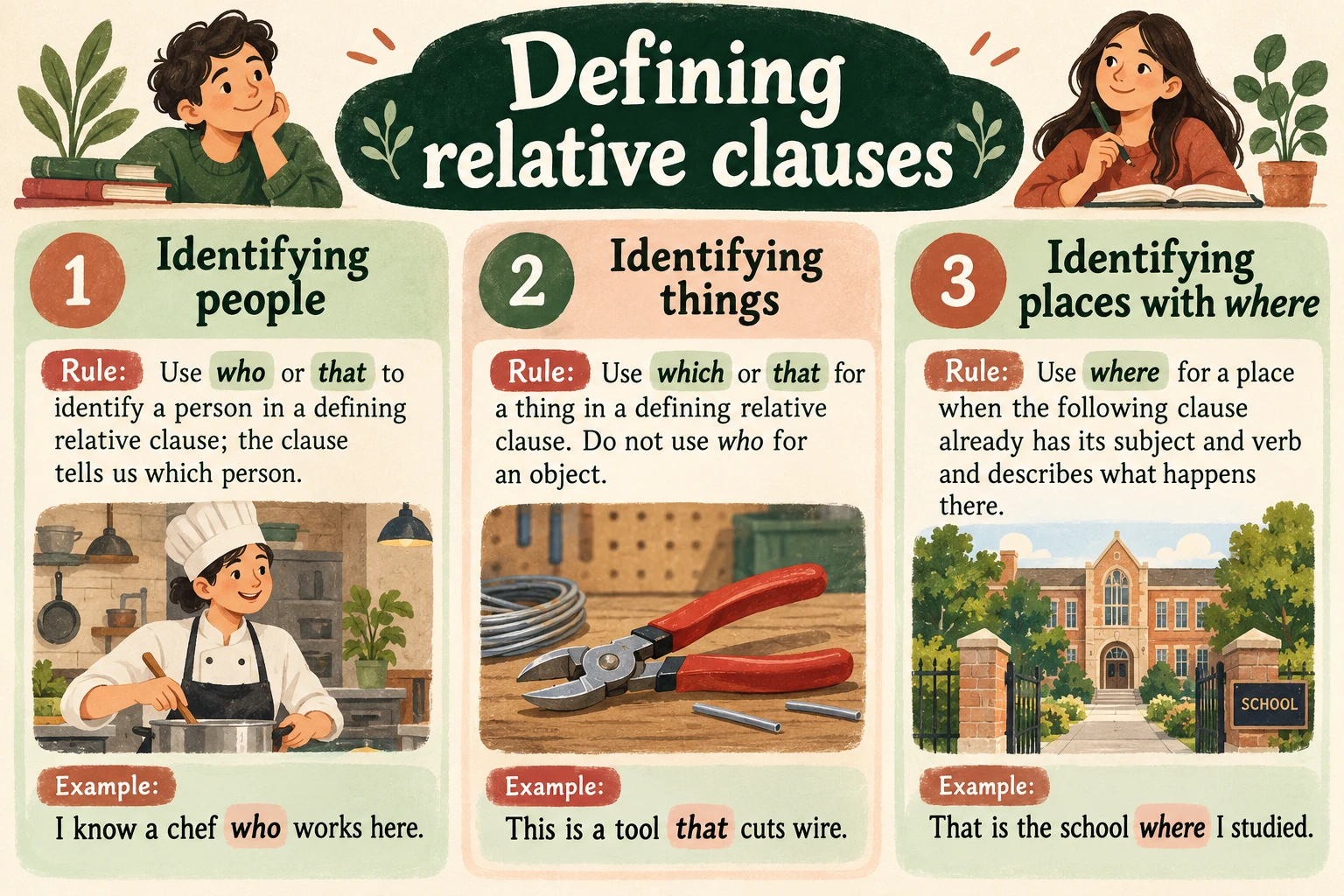
Usa who o that para identificar personas; la relativa especifica de qué persona se trata.
I know a chef who works here.Usa which o that para cosas; no uses who para objetos.
This is a tool that cuts wire.Usa where para un lugar cuando la cláusula siguiente ya tiene sujeto y verbo y cuenta qué ocurre allí.
That is the school where I studied.
The woman ___ lives next door is a nurse.
Usa who o that para identificar personas; la relativa especifica de qué persona se trata.
I know a chef who works here.Usa which o that para cosas; no uses who para objetos.
This is a tool that cuts wire.Usa where para un lugar cuando la cláusula siguiente ya tiene sujeto y verbo y cuenta qué ocurre allí.
That is the school where I studied.Conserva el primer intento, entiende el cambio y compruébalo en otra situación.
Aún no hay repasos. Prueba un calentamiento corto.
Usa who o that para identificar personas; la relativa especifica de qué persona se trata.
I know a chef who works here.Usa which o that para cosas; no uses who para objetos.
This is a tool that cuts wire.Usa where para un lugar cuando la cláusula siguiente ya tiene sujeto y verbo y cuenta qué ocurre allí.
That is the school where I studied.Abrir una respuesta registra ayuda para esa pregunta.
The woman ___ lives next door is a nurse.
Mira «The woman ___ lives next door is a nurse.». Usa who o that para identificar personas; la relativa especifica de qué persona se trata. Oración completa: «The woman who lives next door is a nurse.».
I need a bag ___ can hold my laptop.
Mira «I need a bag ___ can hold my laptop.». Usa which o that para cosas; no uses who para objetos. Oración completa: «I need a bag which can hold my laptop.».
This is the café ___ we first met.
Mira «This is the café ___ we first met.». Usa where para un lugar cuando la cláusula siguiente ya tiene sujeto y verbo y cuenta qué ocurre allí. Oración completa: «This is the café where we first met.».
The man ___ fixed the boiler has arrived.
Oración de referencia: «The man who fixed the boiler has arrived.». Usa who o that para identificar personas; la relativa especifica de qué persona se trata.
The book ___ is on the table belongs to me.
Mira «The book ___ is on the table belongs to me.». Usa which o that para cosas; no uses who para objetos. Oración completa: «The book which is on the table belongs to me.».
That is the village ___ my grandparents live.
Mira «That is the village ___ my grandparents live.». Usa where para un lugar cuando la cláusula siguiente ya tiene sujeto y verbo y cuenta qué ocurre allí. Oración completa: «That is the village where my grandparents live.».
The students ___ won the prize are here.
Oración de referencia: «The students who won the prize are here.». Usa who o that para identificar personas; la relativa especifica de qué persona se trata.
We thanked the driver ___ helped us.
Mira «We thanked the driver ___ helped us.». Usa who o that para identificar personas; la relativa especifica de qué persona se trata. Oración completa: «We thanked the driver who helped us.».
The phone ___ fell into the sink is broken.
Mira «The phone ___ fell into the sink is broken.». Usa which o that para cosas; no uses who para objetos. Oración completa: «The phone which fell into the sink is broken.».
Is this the room ___ the team holds its meetings?
Oración de referencia: «Is this the room where the team holds its meetings?». Usa where para un lugar cuando la cláusula siguiente ya tiene sujeto y verbo y cuenta qué ocurre allí. También se admiten estas variantes revisadas: in which / at which. No es una lista de todas las expresiones posibles.
Show me the key ___ opens this door.
Mira «Show me the key ___ opens this door.». Usa which o that para cosas; no uses who para objetos. Oración completa: «Show me the key which opens this door.».
That is the park ___ the children play football.
Oración de referencia: «That is the park where the children play football.». Usa where para un lugar cuando la cláusula siguiente ya tiene sujeto y verbo y cuenta qué ocurre allí. También se admiten estas variantes revisadas: in which / at which. No es una lista de todas las expresiones posibles.