01Reasons with because
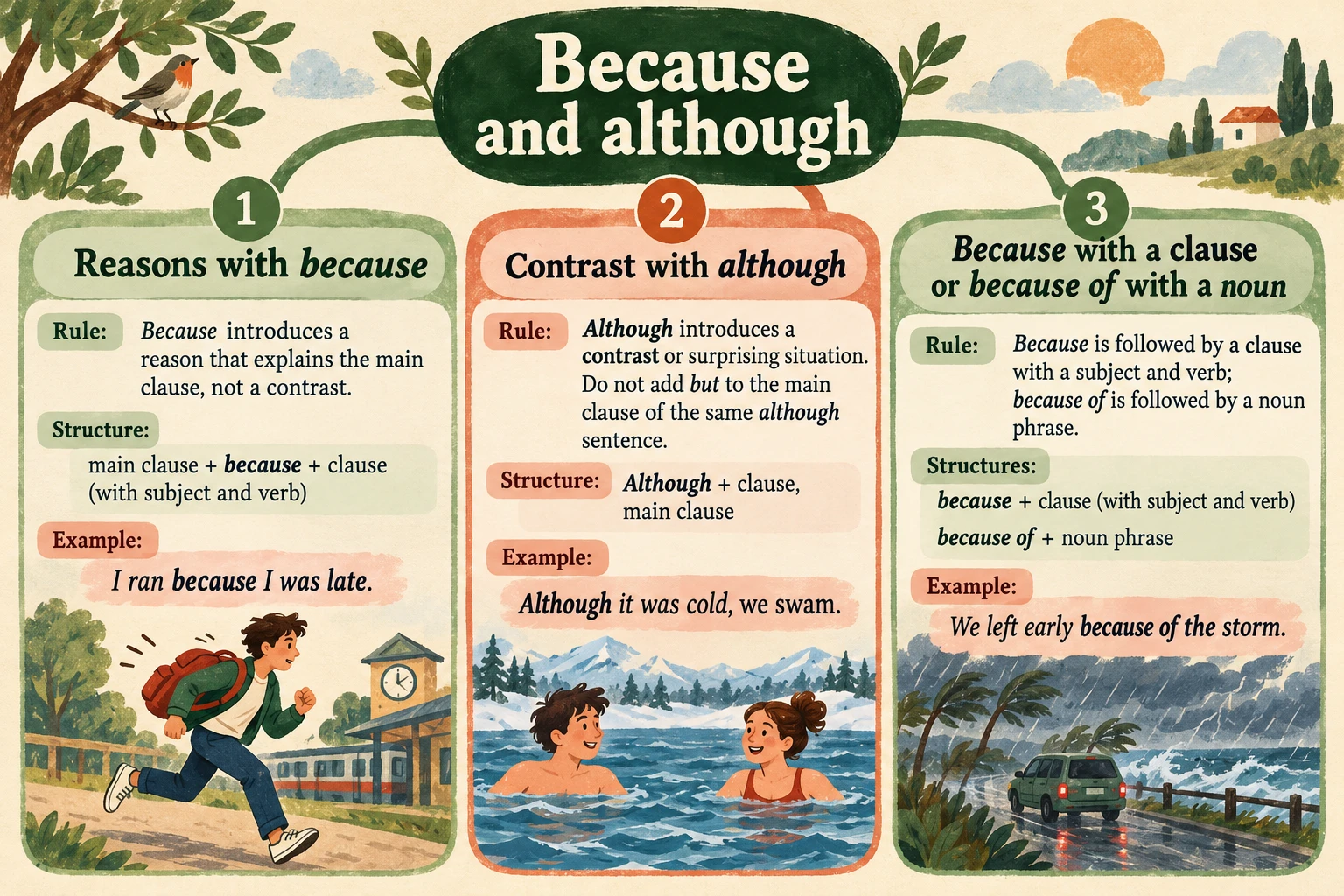
Because introduces a reason that explains the main clause, not a contrast.
I ran because I was late.
Because and although · A2. Because introduces a reason that explains the main clause, not a contrast.
Practise Because and although in short situations. Read the clue, choose or write a form, then check the reason. The level is an editorial guide.
Because introduces a reason that explains the main clause, not a contrast.
I ran because I was late.Although introduces a contrast or surprising situation. Do not add but to the main clause of the same although sentence.
Although it was cold, we swam.Because is followed by a clause with a subject and verb; because of is followed by a noun phrase.
We left early because of the storm.
The road was icy; that was the reason we drove slowly. We drove slowly ___ it was icy.
Because introduces a reason that explains the main clause, not a contrast.
I ran because I was late.Although introduces a contrast or surprising situation. Do not add but to the main clause of the same although sentence.
Although it was cold, we swam.Because is followed by a clause with a subject and verb; because of is followed by a noun phrase.
We left early because of the storm.Keep the first try. Understand the change. Check it in a fresh situation.
No practice notes yet. Try a short warm-up.
Because introduces a reason that explains the main clause, not a contrast.
I ran because I was late.Although introduces a contrast or surprising situation. Do not add but to the main clause of the same although sentence.
Although it was cold, we swam.Because is followed by a clause with a subject and verb; because of is followed by a noun phrase.
We left early because of the storm.Opening an answer records help for that question.
The road was icy; that was the reason we drove slowly. We drove slowly ___ it was icy.
Look at “The road was icy; that was the reason we drove slowly. We drove slowly ___ it was icy.”. Because introduces a reason that explains the main clause, not a contrast. Complete sentence: “The road was icy; that was the reason we drove slowly. We drove slowly because it was icy.”.
He was tired, but he still finished. ___ he was tired, he finished.
Look at “He was tired, but he still finished. ___ he was tired, he finished.”. Although introduces a contrast or surprising situation. Do not add but to the main clause of the same although sentence. Complete sentence: “He was tired, but he still finished. Although he was tired, he finished.”.
The match was cancelled ___ the heavy rain. (reason + noun phrase)
Look at “The match was cancelled ___ the heavy rain. (reason + noun phrase)”. Because is followed by a clause with a subject and verb; because of is followed by a noun phrase. Complete sentence: “The match was cancelled because of the heavy rain. (reason + noun phrase)”.
I stayed home ___ I had a fever. (give the reason)
Reference completion: “I stayed home because I had a fever. (give the reason)”. Because introduces a reason that explains the main clause, not a contrast. Also accepted in this task: as / since / given that / seeing that. These are reviewed alternatives, not an exhaustive list of all possible English.
Choose the complete contrast: Although it was expensive, ___.
Look at “Choose the complete contrast: Although it was expensive, ___.”. Although introduces a contrast or surprising situation. Do not add but to the main clause of the same although sentence. Complete sentence: “Choose the complete contrast: Although it was expensive, we bought it.”.
The train stopped ___ a fallen tree. (reason + noun phrase)
Look at “The train stopped ___ a fallen tree. (reason + noun phrase)”. Because is followed by a clause with a subject and verb; because of is followed by a noun phrase. Complete sentence: “The train stopped because of a fallen tree. (reason + noun phrase)”.
She wore a coat ___ the wind was cold. (give the reason)
Reference completion: “She wore a coat because the wind was cold. (give the reason)”. Because introduces a reason that explains the main clause, not a contrast. Also accepted in this task: as / since / given that / seeing that. These are reviewed alternatives, not an exhaustive list of all possible English.
We used a torch ___ the room was dark. (give the reason)
Look at “We used a torch ___ the room was dark. (give the reason)”. Because introduces a reason that explains the main clause, not a contrast. Complete sentence: “We used a torch because the room was dark. (give the reason)”.
It was raining, yet they played. ___ it was raining, they played.
Look at “It was raining, yet they played. ___ it was raining, they played.”. Although introduces a contrast or surprising situation. Do not add but to the main clause of the same although sentence. Complete sentence: “It was raining, yet they played. Although it was raining, they played.”.
We were late ___ the traffic. (reason + noun phrase)
Reference completion: “We were late because of the traffic. (reason + noun phrase)”. Because is followed by a clause with a subject and verb; because of is followed by a noun phrase. Also accepted in this task: due to / owing to / as a result of / on account of. These are reviewed alternatives, not an exhaustive list of all possible English.
Choose the complete contrast: Although she is young, ___.
Look at “Choose the complete contrast: Although she is young, ___.”. Although introduces a contrast or surprising situation. Do not add but to the main clause of the same although sentence. Complete sentence: “Choose the complete contrast: Although she is young, she has much experience.”.
The flight was delayed ___ there was fog. (reason + full clause)
Reference completion: “The flight was delayed because there was fog. (reason + full clause)”. Because is followed by a clause with a subject and verb; because of is followed by a noun phrase. Also accepted in this task: as / since / given that / seeing that. These are reviewed alternatives, not an exhaustive list of all possible English.