01Gründe mit because
Because leitet den Grund für den Hauptsatz ein, keinen Gegensatz.
I ran because I was late.
Because und although · A2. Because leitet den Grund für den Hauptsatz ein, keinen Gegensatz.
Übe Because und although in kurzen Situationen. Lies den Hinweis, wähle oder schreibe eine Form und prüfe die Begründung. Die Stufe dient der redaktionellen Orientierung.
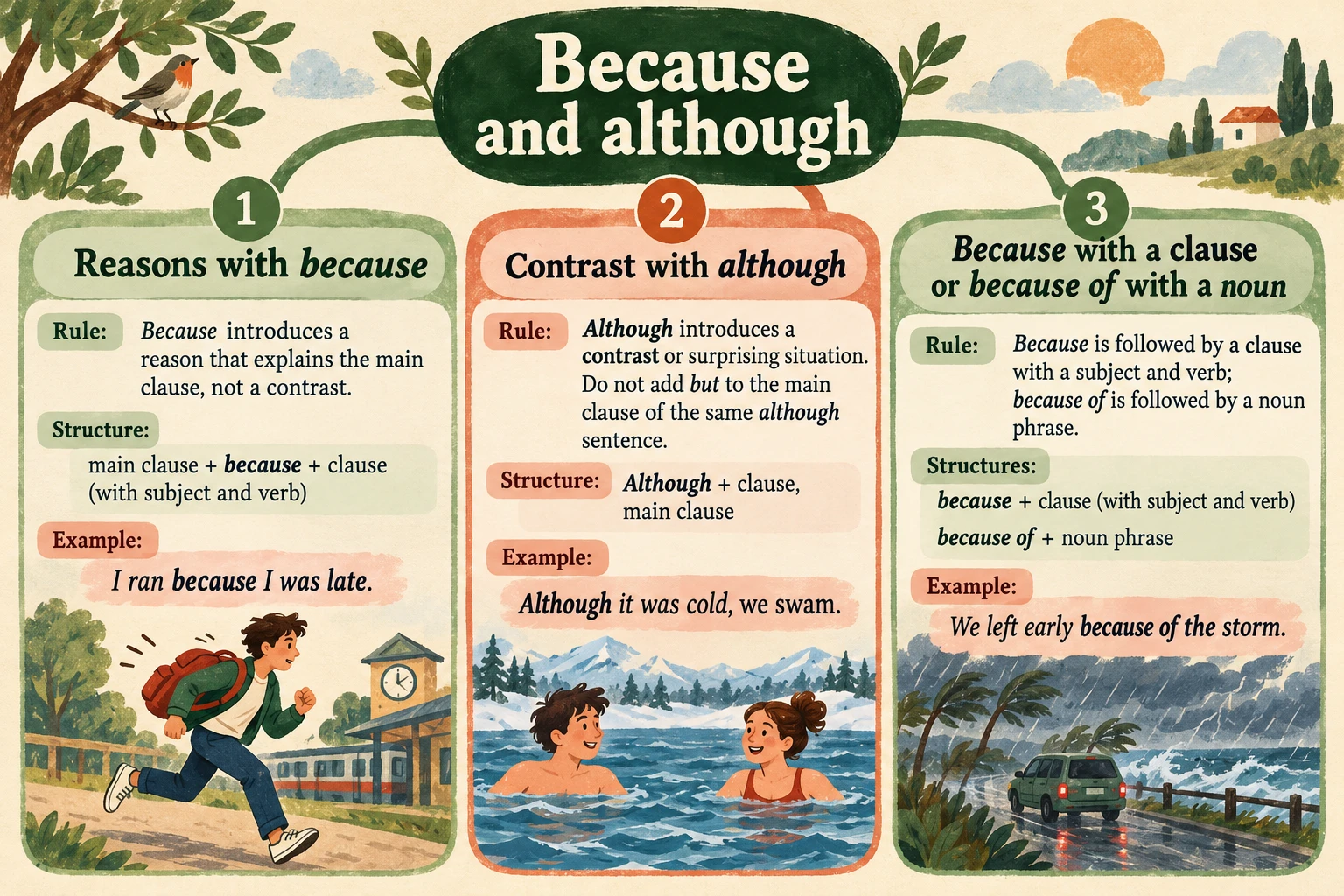
Because leitet den Grund für den Hauptsatz ein, keinen Gegensatz.
I ran because I was late.Although leitet einen Gegensatz oder Überraschendes ein. Ergänze im selben Satz kein but im Hauptsatz.
Although it was cold, we swam.Nach because steht ein Satz mit Subjekt und Verb; nach because of eine Nominalgruppe.
We left early because of the storm.
The road was icy; that was the reason we drove slowly. We drove slowly ___ it was icy.
Because leitet den Grund für den Hauptsatz ein, keinen Gegensatz.
I ran because I was late.Although leitet einen Gegensatz oder Überraschendes ein. Ergänze im selben Satz kein but im Hauptsatz.
Although it was cold, we swam.Nach because steht ein Satz mit Subjekt und Verb; nach because of eine Nominalgruppe.
We left early because of the storm.Bewahre den ersten Versuch. Verstehe die Änderung. Prüfe sie in einer neuen Situation.
Noch keine Lernnotizen. Starte mit einem kurzen Einstieg.
Because leitet den Grund für den Hauptsatz ein, keinen Gegensatz.
I ran because I was late.Although leitet einen Gegensatz oder Überraschendes ein. Ergänze im selben Satz kein but im Hauptsatz.
Although it was cold, we swam.Nach because steht ein Satz mit Subjekt und Verb; nach because of eine Nominalgruppe.
We left early because of the storm.Das Öffnen einer Antwort wird für diese Aufgabe als Hilfe erfasst.
The road was icy; that was the reason we drove slowly. We drove slowly ___ it was icy.
Achte auf „The road was icy; that was the reason we drove slowly. We drove slowly ___ it was icy.“. Because leitet den Grund für den Hauptsatz ein, keinen Gegensatz. Vollständiger Satz: „The road was icy; that was the reason we drove slowly. We drove slowly because it was icy.“.
He was tired, but he still finished. ___ he was tired, he finished.
Achte auf „He was tired, but he still finished. ___ he was tired, he finished.“. Although leitet einen Gegensatz oder Überraschendes ein. Ergänze im selben Satz kein but im Hauptsatz. Vollständiger Satz: „He was tired, but he still finished. Although he was tired, he finished.“.
The match was cancelled ___ the heavy rain. (reason + noun phrase)
Achte auf „The match was cancelled ___ the heavy rain. (reason + noun phrase)“. Nach because steht ein Satz mit Subjekt und Verb; nach because of eine Nominalgruppe. Vollständiger Satz: „The match was cancelled because of the heavy rain. (reason + noun phrase)“.
I stayed home ___ I had a fever. (give the reason)
Vollständiger Beispielsatz: „I stayed home because I had a fever. (give the reason)“. Because leitet den Grund für den Hauptsatz ein, keinen Gegensatz. In dieser Aufgabe sind auch diese Formen geprüft: as / since / given that / seeing that. Die Liste ist nicht vollständig.
Choose the complete contrast: Although it was expensive, ___.
Achte auf „Choose the complete contrast: Although it was expensive, ___.“. Although leitet einen Gegensatz oder Überraschendes ein. Ergänze im selben Satz kein but im Hauptsatz. Vollständiger Satz: „Choose the complete contrast: Although it was expensive, we bought it.“.
The train stopped ___ a fallen tree. (reason + noun phrase)
Achte auf „The train stopped ___ a fallen tree. (reason + noun phrase)“. Nach because steht ein Satz mit Subjekt und Verb; nach because of eine Nominalgruppe. Vollständiger Satz: „The train stopped because of a fallen tree. (reason + noun phrase)“.
She wore a coat ___ the wind was cold. (give the reason)
Vollständiger Beispielsatz: „She wore a coat because the wind was cold. (give the reason)“. Because leitet den Grund für den Hauptsatz ein, keinen Gegensatz. In dieser Aufgabe sind auch diese Formen geprüft: as / since / given that / seeing that. Die Liste ist nicht vollständig.
We used a torch ___ the room was dark. (give the reason)
Achte auf „We used a torch ___ the room was dark. (give the reason)“. Because leitet den Grund für den Hauptsatz ein, keinen Gegensatz. Vollständiger Satz: „We used a torch because the room was dark. (give the reason)“.
It was raining, yet they played. ___ it was raining, they played.
Achte auf „It was raining, yet they played. ___ it was raining, they played.“. Although leitet einen Gegensatz oder Überraschendes ein. Ergänze im selben Satz kein but im Hauptsatz. Vollständiger Satz: „It was raining, yet they played. Although it was raining, they played.“.
We were late ___ the traffic. (reason + noun phrase)
Vollständiger Beispielsatz: „We were late because of the traffic. (reason + noun phrase)“. Nach because steht ein Satz mit Subjekt und Verb; nach because of eine Nominalgruppe. In dieser Aufgabe sind auch diese Formen geprüft: due to / owing to / as a result of / on account of. Die Liste ist nicht vollständig.
Choose the complete contrast: Although she is young, ___.
Achte auf „Choose the complete contrast: Although she is young, ___.“. Although leitet einen Gegensatz oder Überraschendes ein. Ergänze im selben Satz kein but im Hauptsatz. Vollständiger Satz: „Choose the complete contrast: Although she is young, she has much experience.“.
The flight was delayed ___ there was fog. (reason + full clause)
Vollständiger Beispielsatz: „The flight was delayed because there was fog. (reason + full clause)“. Nach because steht ein Satz mit Subjekt und Verb; nach because of eine Nominalgruppe. In dieser Aufgabe sind auch diese Formen geprüft: as / since / given that / seeing that. Die Liste ist nicht vollständig.