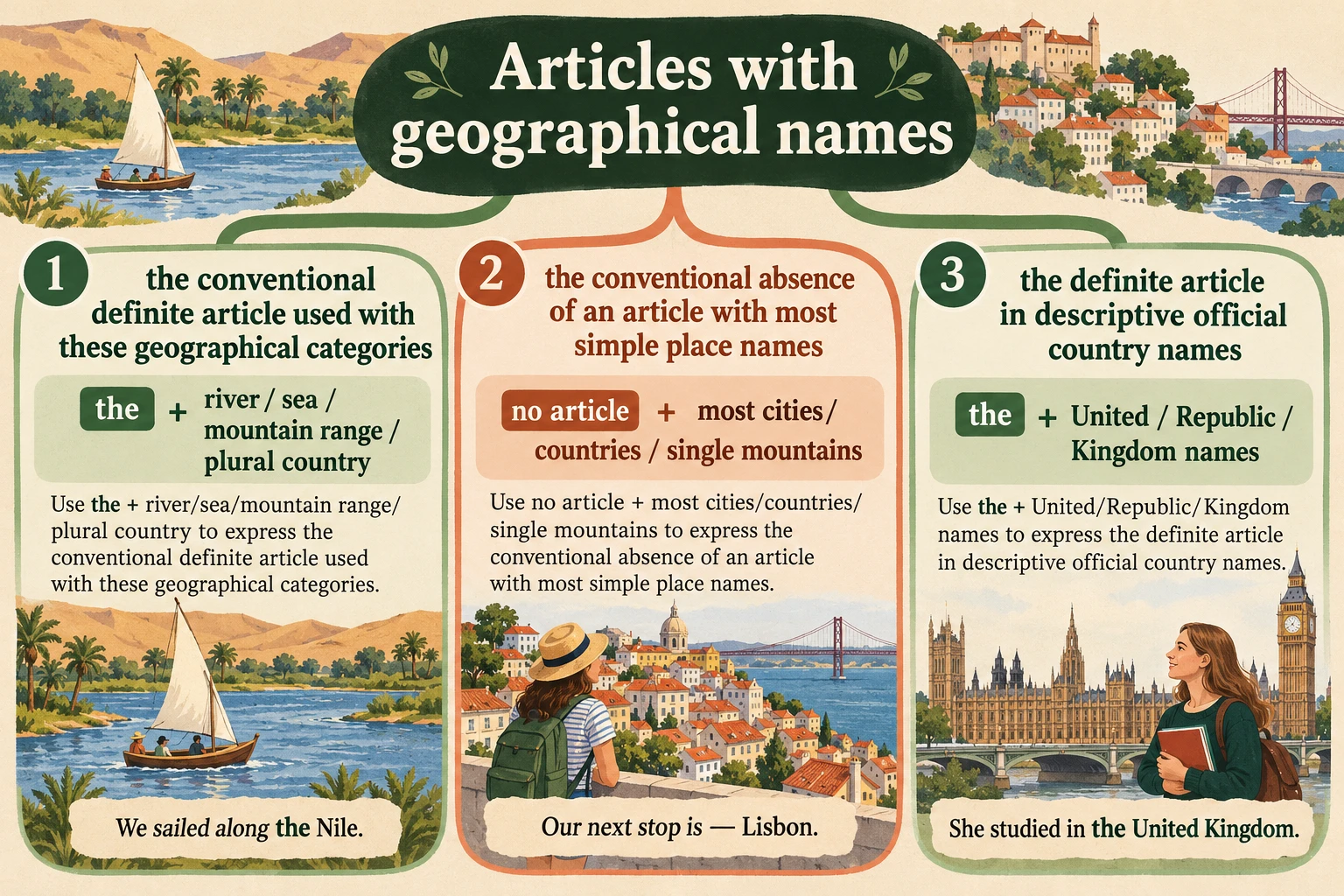
01the conventional definite article used with these geographical categories
Use the + river/sea/mountain range/plural country to express the conventional definite article used with these geographical categories.
We sailed along the Nile.
Articles with geographical names · B1. Use the + river/sea/mountain range/plural country to express the conventional definite article used with these geographical categories.
Complete 12 original tasks. Use the situation to choose the intended meaning, practise the form, then apply it in a fresh context.
Use the + river/sea/mountain range/plural country to express the conventional definite article used with these geographical categories.
We sailed along the Nile.Use no article + most cities/countries/single mountains to express the conventional absence of an article with most simple place names.
Our next stop is — Lisbon.Use the + United/Republic/Kingdom names to express the definite article in descriptive official country names.
She studied in the United Kingdom.
Choose the conventional article for the river.
Use the + river/sea/mountain range/plural country to express the conventional definite article used with these geographical categories.
We sailed along the Nile.Use no article + most cities/countries/single mountains to express the conventional absence of an article with most simple place names.
Our next stop is — Lisbon.Use the + United/Republic/Kingdom names to express the definite article in descriptive official country names.
She studied in the United Kingdom.Keep the first try. Understand the change. Check it in a fresh situation.
No practice notes yet. Try a short warm-up.
Use the + river/sea/mountain range/plural country to express the conventional definite article used with these geographical categories.
We sailed along the Nile.Use no article + most cities/countries/single mountains to express the conventional absence of an article with most simple place names.
Our next stop is — Lisbon.Use the + United/Republic/Kingdom names to express the definite article in descriptive official country names.
She studied in the United Kingdom.Opening an answer records help for that question.
Choose the conventional article for the river.
Look at “We sailed along ___ Nile.”. Use the + river/sea/mountain range/plural country to express the conventional definite article used with these geographical categories. Complete sentence: “We sailed along the Nile.”.
The dash means no article; this is a city name.
Look at “Our next stop is ___ Lisbon.”. Use no article + most cities/countries/single mountains to express the conventional absence of an article with most simple place names. Complete sentence: “Our next stop is — Lisbon.”.
Use the conventional article for the official descriptive country name.
Look at “She studied in ___ United Kingdom.”. Use the + United/Republic/Kingdom names to express the definite article in descriptive official country names. Complete sentence: “She studied in the United Kingdom.”.
A mountain range takes the definite article.
Look at “They crossed ___ Alps by train.”. Use the + river/sea/mountain range/plural country to express the conventional definite article used with these geographical categories. Complete sentence: “They crossed the Alps by train.”.
Complete with an article if needed. For no article, enter — or no article; do not leave the answer empty.
Complete sentence: “They hope to climb Mount Fuji.” Use no article + most cities/countries/single mountains to express the conventional absence of an article with most simple place names. The subject, time and meaning in the task determine this form. Only reviewed responses are matched automatically; other wording is not automatically wrong. No article is written before this geographical name. The dash or no article is only a way to enter an empty grammatical slot in the form; it is not a word in the completed sentence.
The formal name contains Republic.
Look at “He travelled to ___ Czech Republic.”. Use the + United/Republic/Kingdom names to express the definite article in descriptive official country names. Complete sentence: “He travelled to the Czech Republic.”.
Write the conventional article before this sea name.
Complete sentence: “The ship entered the Mediterranean.” Use the + river/sea/mountain range/plural country to express the conventional definite article used with these geographical categories. The subject, time and meaning in the task determine this form. Only reviewed responses are matched automatically; other wording is not automatically wrong.
The geographical name is a plural country name.
Look at “We spent a week in ___ Netherlands.”. Use the + river/sea/mountain range/plural country to express the conventional definite article used with these geographical categories. Complete sentence: “We spent a week in the Netherlands.”.
Complete with an article if needed. For no article, enter — or no article; do not leave the answer empty.
Complete sentence: “Our partner office is in Japan.” Use no article + most cities/countries/single mountains to express the conventional absence of an article with most simple place names. The subject, time and meaning in the task determine this form. Only reviewed responses are matched automatically; other wording is not automatically wrong. No article is written before this geographical name. The dash or no article is only a way to enter an empty grammatical slot in the form; it is not a word in the completed sentence.
Use the conventional article before United States.
Look at “She works in ___ United States.”. Use the + United/Republic/Kingdom names to express the definite article in descriptive official country names. Complete sentence: “She works in the United States.”.
A simple country name normally takes no article.
Look at “The exhibition will tour ___ Brazil.”. Use no article + most cities/countries/single mountains to express the conventional absence of an article with most simple place names. Complete sentence: “The exhibition will tour — Brazil.”.
Write the conventional article before this descriptive official country name.
Complete sentence: “The delegation arrived from the United Arab Emirates.” Use the + United/Republic/Kingdom names to express the definite article in descriptive official country names. The subject, time and meaning in the task determine this form. Only reviewed responses are matched automatically; other wording is not automatically wrong.