01Adjectives for nouns and states
An adjective describes a noun or follows a linking verb such as be, look or feel to describe the subject.
It is a noisy street.
Adjectives and adverbs · A2. An adjective describes a noun or follows a linking verb such as be, look or feel to describe the subject.
Practise Adjectives and adverbs in short situations. Read the clue, choose or write a form, then check the reason. The level is an editorial guide.
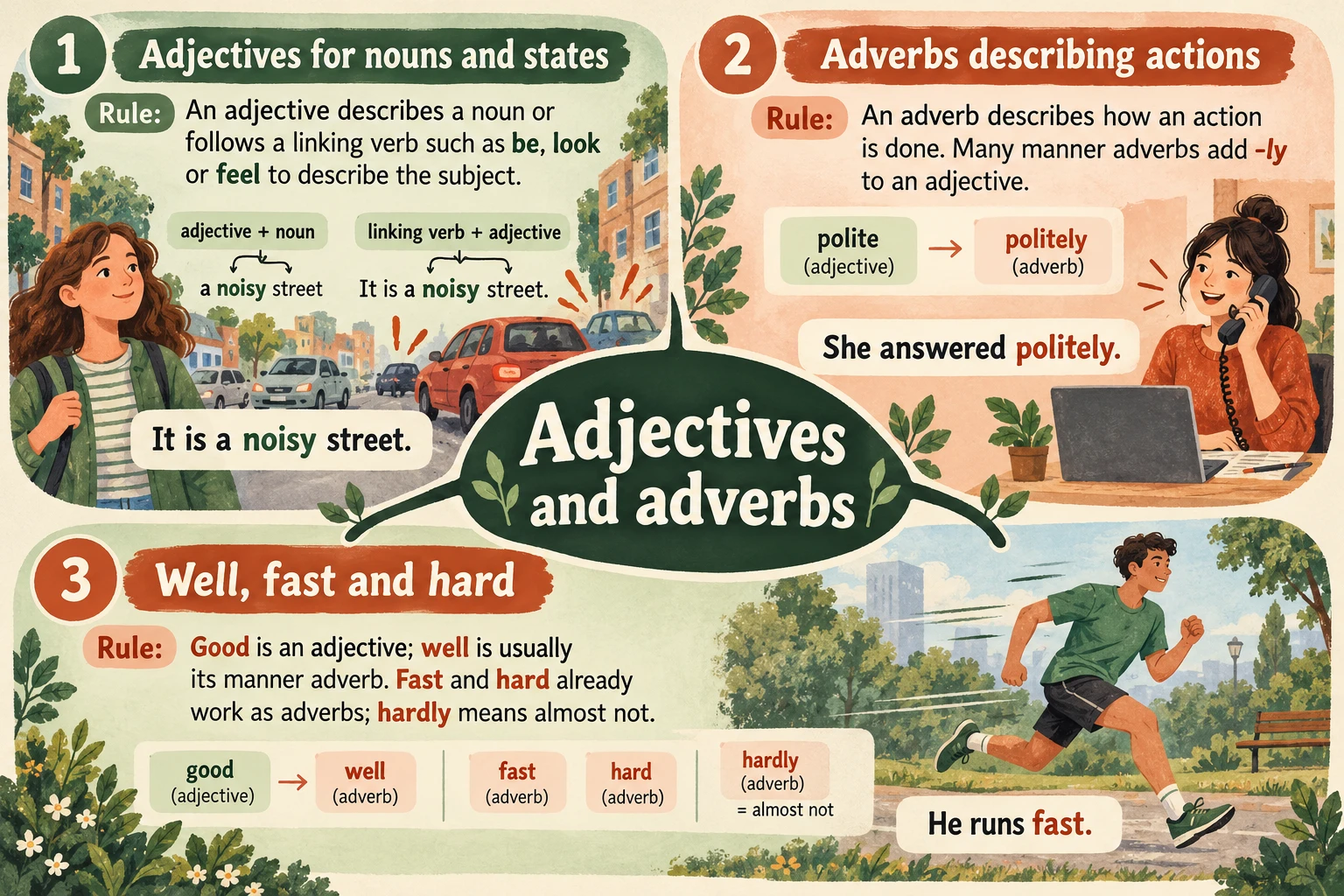
An adjective describes a noun or follows a linking verb such as be, look or feel to describe the subject.
It is a noisy street.An adverb describes how an action is done. Many manner adverbs add -ly to an adjective.
She answered politely.Good is an adjective; well is usually its manner adverb. Fast and hard already work as adverbs; hardly means almost not.
He runs fast.
She is a ___ driver; she checks every mirror. (careful)
An adjective describes a noun or follows a linking verb such as be, look or feel to describe the subject.
It is a noisy street.An adverb describes how an action is done. Many manner adverbs add -ly to an adjective.
She answered politely.Good is an adjective; well is usually its manner adverb. Fast and hard already work as adverbs; hardly means almost not.
He runs fast.Keep the first try. Understand the change. Check it in a fresh situation.
No practice notes yet. Try a short warm-up.
An adjective describes a noun or follows a linking verb such as be, look or feel to describe the subject.
It is a noisy street.An adverb describes how an action is done. Many manner adverbs add -ly to an adjective.
She answered politely.Good is an adjective; well is usually its manner adverb. Fast and hard already work as adverbs; hardly means almost not.
He runs fast.Opening an answer records help for that question.
She is a ___ driver; she checks every mirror. (careful)
Look at “She is a ___ driver; she checks every mirror. (careful)”. An adjective describes a noun or follows a linking verb such as be, look or feel to describe the subject. Complete sentence: “She is a careful driver; she checks every mirror. (careful)”.
Please speak ___ so that everyone can hear. (clear)
Look at “Please speak ___ so that everyone can hear. (clear)”. An adverb describes how an action is done. Many manner adverbs add -ly to an adjective. Complete sentence: “Please speak clearly so that everyone can hear. (clear)”.
He plays the piano very ___. (good)
Look at “He plays the piano very ___. (good)”. Good is an adjective; well is usually its manner adverb. Fast and hard already work as adverbs; hardly means almost not. Complete sentence: “He plays the piano very well. (good)”.
The children look ___ after the long walk. (tired)
“The children look tired after the long walk.” Here look means seem and links the children to the adjective tired. Look tiredly can describe an action of looking in another context; it is not the linking-verb meaning requested here.
The nurse spoke ___ to the frightened child. (gentle)
Look at “The nurse spoke ___ to the frightened child. (gentle)”. An adverb describes how an action is done. Many manner adverbs add -ly to an adjective. Complete sentence: “The nurse spoke gently to the frightened child. (gentle)”.
She works ___ to finish every order. (hard)
Look at “She works ___ to finish every order. (hard)”. Good is an adjective; well is usually its manner adverb. Fast and hard already work as adverbs; hardly means almost not. Complete sentence: “She works hard to finish every order. (hard)”.
It was a ___ decision. (quick)
Reference completion: “It was a quick decision. (quick)”. An adjective describes a noun or follows a linking verb such as be, look or feel to describe the subject.
The room feels ___ today. (cold)
Look at “The room feels ___ today. (cold)”. An adjective describes a noun or follows a linking verb such as be, look or feel to describe the subject. Complete sentence: “The room feels cold today. (cold)”.
He closed the door ___ because the baby was asleep. (quiet)
Look at “He closed the door ___ because the baby was asleep. (quiet)”. An adverb describes how an action is done. Many manner adverbs add -ly to an adjective. Complete sentence: “He closed the door quietly because the baby was asleep. (quiet)”.
That bird can fly very ___. (fast)
Reference completion: “That bird can fly very fast. (fast)”. Good is an adjective; well is usually its manner adverb. Fast and hard already work as adverbs; hardly means almost not.
Please carry the glass ___. (careful)
Look at “Please carry the glass ___. (careful)”. An adverb describes how an action is done. Many manner adverbs add -ly to an adjective. Complete sentence: “Please carry the glass carefully. (careful)”.
They dance very ___. (good)
Reference completion: “They dance very well. (good)”. Good is an adjective; well is usually its manner adverb. Fast and hard already work as adverbs; hardly means almost not.