01Adjectifs pour noms et états
Un adjectif décrit un nom ou suit un verbe attributif comme be, look ou feel pour décrire le sujet.
It is a noisy street.
Adjectifs et adverbes · A2. Un adjectif décrit un nom ou suit un verbe attributif comme be, look ou feel pour décrire le sujet.
Travaille Adjectifs et adverbes dans de courtes situations. Lis l’indice, choisis ou écris une forme, puis vérifie l’explication. Le niveau est une indication éditoriale.
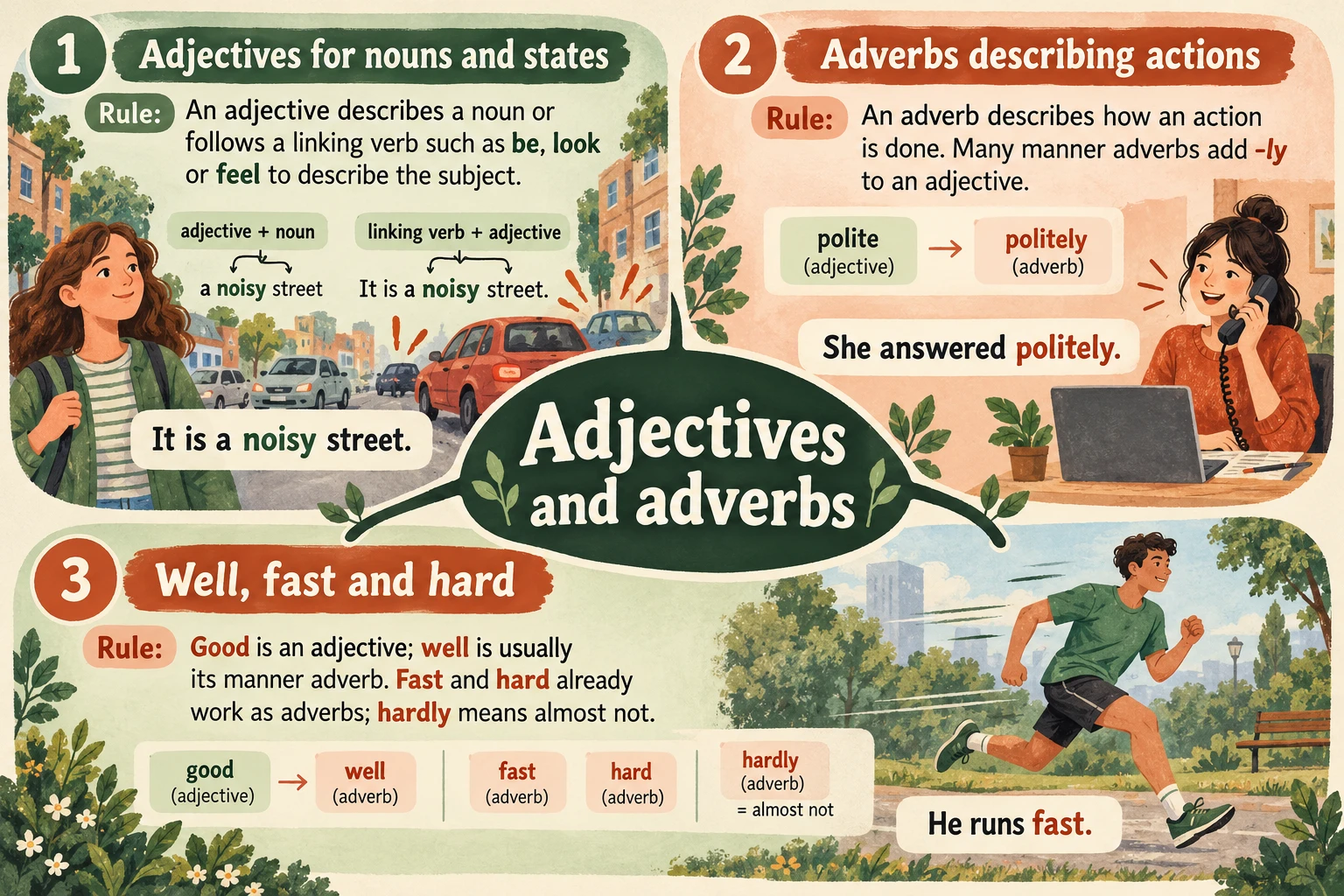
Un adjectif décrit un nom ou suit un verbe attributif comme be, look ou feel pour décrire le sujet.
It is a noisy street.Un adverbe décrit comment une action est faite ; beaucoup ajoutent -ly à l’adjectif.
She answered politely.Good est adjectif, well est généralement son adverbe. Fast et hard sont déjà adverbes ; hardly signifie presque pas.
He runs fast.
She is a ___ driver; she checks every mirror. (careful)
Un adjectif décrit un nom ou suit un verbe attributif comme be, look ou feel pour décrire le sujet.
It is a noisy street.Un adverbe décrit comment une action est faite ; beaucoup ajoutent -ly à l’adjectif.
She answered politely.Good est adjectif, well est généralement son adverbe. Fast et hard sont déjà adverbes ; hardly signifie presque pas.
He runs fast.Gardez la première tentative, comprenez le changement et essayez dans une nouvelle situation.
Pas encore de notes. Essayez un court échauffement.
Un adjectif décrit un nom ou suit un verbe attributif comme be, look ou feel pour décrire le sujet.
It is a noisy street.Un adverbe décrit comment une action est faite ; beaucoup ajoutent -ly à l’adjectif.
She answered politely.Good est adjectif, well est généralement son adverbe. Fast et hard sont déjà adverbes ; hardly signifie presque pas.
He runs fast.Ouvrir une réponse enregistre une aide pour cette question.
She is a ___ driver; she checks every mirror. (careful)
Observe « She is a ___ driver; she checks every mirror. (careful) ». Un adjectif décrit un nom ou suit un verbe attributif comme be, look ou feel pour décrire le sujet. Phrase complète : « She is a careful driver; she checks every mirror. (careful) ».
Please speak ___ so that everyone can hear. (clear)
Observe « Please speak ___ so that everyone can hear. (clear) ». Un adverbe décrit comment une action est faite ; beaucoup ajoutent -ly à l’adjectif. Phrase complète : « Please speak clearly so that everyone can hear. (clear) ».
He plays the piano very ___. (good)
Observe « He plays the piano very ___. (good) ». Good est adjectif, well est généralement son adverbe. Fast et hard sont déjà adverbes ; hardly signifie presque pas. Phrase complète : « He plays the piano very well. (good) ».
The children look ___ after the long walk. (tired)
« The children look tired after the long walk. » Ici look signifie sembler et relie the children à l’adjectif tired. Look tiredly peut décrire une manière de regarder dans un autre contexte ; ce n’est pas le sens attributif demandé.
The nurse spoke ___ to the frightened child. (gentle)
Observe « The nurse spoke ___ to the frightened child. (gentle) ». Un adverbe décrit comment une action est faite ; beaucoup ajoutent -ly à l’adjectif. Phrase complète : « The nurse spoke gently to the frightened child. (gentle) ».
She works ___ to finish every order. (hard)
Observe « She works ___ to finish every order. (hard) ». Good est adjectif, well est généralement son adverbe. Fast et hard sont déjà adverbes ; hardly signifie presque pas. Phrase complète : « She works hard to finish every order. (hard) ».
It was a ___ decision. (quick)
Phrase de référence : « It was a quick decision. (quick) ». Un adjectif décrit un nom ou suit un verbe attributif comme be, look ou feel pour décrire le sujet.
The room feels ___ today. (cold)
Observe « The room feels ___ today. (cold) ». Un adjectif décrit un nom ou suit un verbe attributif comme be, look ou feel pour décrire le sujet. Phrase complète : « The room feels cold today. (cold) ».
He closed the door ___ because the baby was asleep. (quiet)
Observe « He closed the door ___ because the baby was asleep. (quiet) ». Un adverbe décrit comment une action est faite ; beaucoup ajoutent -ly à l’adjectif. Phrase complète : « He closed the door quietly because the baby was asleep. (quiet) ».
That bird can fly very ___. (fast)
Phrase de référence : « That bird can fly very fast. (fast) ». Good est adjectif, well est généralement son adverbe. Fast et hard sont déjà adverbes ; hardly signifie presque pas.
Please carry the glass ___. (careful)
Observe « Please carry the glass ___. (careful) ». Un adverbe décrit comment une action est faite ; beaucoup ajoutent -ly à l’adjectif. Phrase complète : « Please carry the glass carefully. (careful) ».
They dance very ___. (good)
Phrase de référence : « They dance very well. (good) ». Good est adjectif, well est généralement son adverbe. Fast et hard sont déjà adverbes ; hardly signifie presque pas.