01concession followed by a noun or gerund, not a bare finite clause
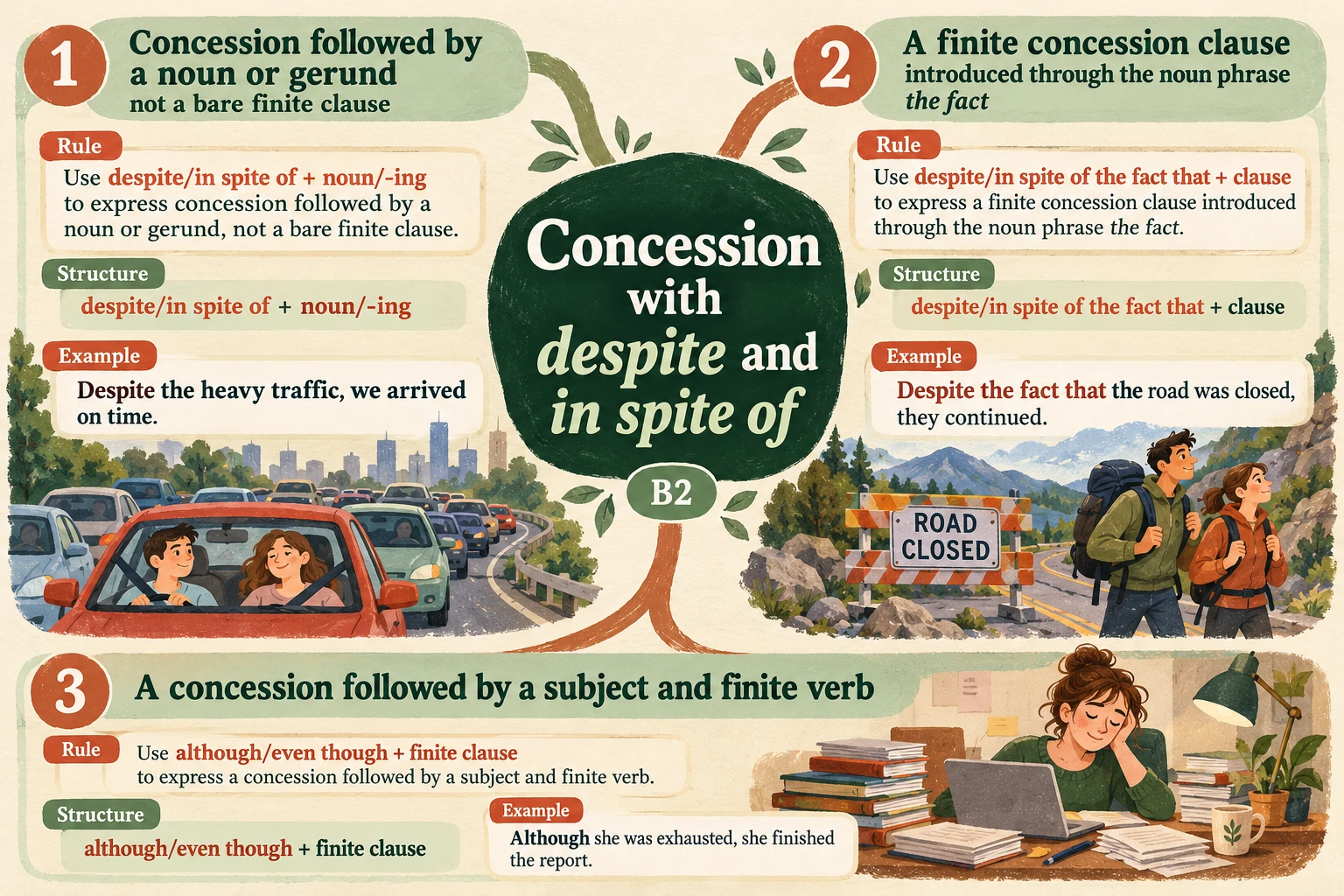
Use despite/in spite of + noun/-ing to express concession followed by a noun or gerund, not a bare finite clause.
Despite the heavy traffic, we arrived on time.
Concession with despite and in spite of · B2. Use despite/in spite of + noun/-ing to express concession followed by a noun or gerund, not a bare finite clause.
Complete 12 original tasks. Use the situation to choose the intended meaning, practise the form, then apply it in a fresh context.
Use despite/in spite of + noun/-ing to express concession followed by a noun or gerund, not a bare finite clause.
Despite the heavy traffic, we arrived on time.Use despite/in spite of the fact that + clause to express a finite concession clause introduced through the noun phrase the fact.
Despite the fact that the road was closed, they continued.Use although/even though + finite clause to express a concession followed by a subject and finite verb.
Although she was exhausted, she finished the report.
A noun phrase follows the gap.
Use despite/in spite of + noun/-ing to express concession followed by a noun or gerund, not a bare finite clause.
Despite the heavy traffic, we arrived on time.Use despite/in spite of the fact that + clause to express a finite concession clause introduced through the noun phrase the fact.
Despite the fact that the road was closed, they continued.Use although/even though + finite clause to express a concession followed by a subject and finite verb.
Although she was exhausted, she finished the report.Keep the first try. Understand the change. Check it in a fresh situation.
No practice notes yet. Try a short warm-up.
Use despite/in spite of + noun/-ing to express concession followed by a noun or gerund, not a bare finite clause.
Despite the heavy traffic, we arrived on time.Use despite/in spite of the fact that + clause to express a finite concession clause introduced through the noun phrase the fact.
Despite the fact that the road was closed, they continued.Use although/even though + finite clause to express a concession followed by a subject and finite verb.
Although she was exhausted, she finished the report.Opening an answer records help for that question.
A noun phrase follows the gap.
The deciding clue is “A noun phrase follows the gap.”. Use despite/in spite of + noun/-ing to express concession followed by a noun or gerund, not a bare finite clause. In this task, the completed sentence is “Despite the heavy traffic, we arrived on time.”.
A finite clause follows through the fact that.
The deciding clue is “A finite clause follows through the fact that.”. Use despite/in spite of the fact that + clause to express a finite concession clause introduced through the noun phrase the fact. In this task, the completed sentence is “Despite the fact that the road was closed, they continued.”.
A complete finite clause follows the connector.
The deciding clue is “A complete finite clause follows the connector.”. Use although/even though + finite clause to express a concession followed by a subject and finite verb. In this task, the completed sentence is “Although she was exhausted, she finished the report.”.
A gerund follows the concessive preposition.
The deciding clue is “A gerund follows the concessive preposition.”. Use despite/in spite of + noun/-ing to express concession followed by a noun or gerund, not a bare finite clause. In this task, the completed sentence is “In spite of having little experience, he performed well.”.
Add a noun phrase that allows a complete finite clause to follow despite.
Complete sentence: “They persisted despite the fact that the funding had ended.” Use despite/in spite of the fact that + clause to express a finite concession clause introduced through the noun phrase the fact. The subject, time and meaning in the task determine this form. Only reviewed responses are matched automatically; other wording is not automatically wrong.
A finite clause with subject and verb follows directly.
The deciding clue is “A finite clause with subject and verb follows directly.”. Use although/even though + finite clause to express a concession followed by a subject and finite verb. In this task, the completed sentence is “Even though the evidence was disputed, the inquiry continued.”.
Supply a concessive preposition or prepositional expression before the noun phrase.
Complete sentence: “Despite repeated warnings, the company failed to act.” Use despite/in spite of + noun/-ing to express concession followed by a noun or gerund, not a bare finite clause. The subject, time and meaning in the task determine this form. Only reviewed responses are matched automatically; other wording is not automatically wrong.
Choose a concessive preposition followed directly by the passive -ing phrase. This is a preposition-pattern exercise, not a test of all possible concessive clauses.
The deciding clue is “Choose a concessive preposition followed directly by the passive -ing phrase. This is a preposition-pattern exercise, not a test of all possible concessive clauses.”. This task specifically requests a concessive preposition followed by the passive -ing phrase, so Despite is the key for that construction. Although being warned is also grammatical as a reduced concessive clause; it is a conjunction construction, not the preposition pattern requested here. In this task, the completed sentence is “Despite being warned twice, he entered the restricted area.”.
Add a noun phrase that allows a complete finite clause to follow in spite of.
Complete sentence: “She kept working in spite of the fact that her contract had expired.” Use despite/in spite of the fact that + clause to express a finite concession clause introduced through the noun phrase the fact. The subject, time and meaning in the task determine this form. Only reviewed responses are matched automatically; other wording is not automatically wrong.
A full subject-verb clause follows; a conjunction is required.
The deciding clue is “A full subject-verb clause follows; a conjunction is required.”. Use although/even though + finite clause to express a concession followed by a subject and finite verb. In this task, the completed sentence is “Although the plan was unpopular, it received formal approval.”.
A complete clause follows the noun phrase the fact.
The deciding clue is “A complete clause follows the noun phrase the fact.”. Use despite/in spite of the fact that + clause to express a finite concession clause introduced through the noun phrase the fact. In this task, the completed sentence is “Despite the fact that the sample was small, the pattern was clear.”.
Supply a concessive conjunction before the complete finite clause.
Complete sentence: “Although the deadline had passed, the panel accepted the late evidence.” Use although/even though + finite clause to express a concession followed by a subject and finite verb. The subject, time and meaning in the task determine this form. Only reviewed responses are matched automatically; other wording is not automatically wrong.