01an action after a preposition; to can be a preposition in fixed expressions
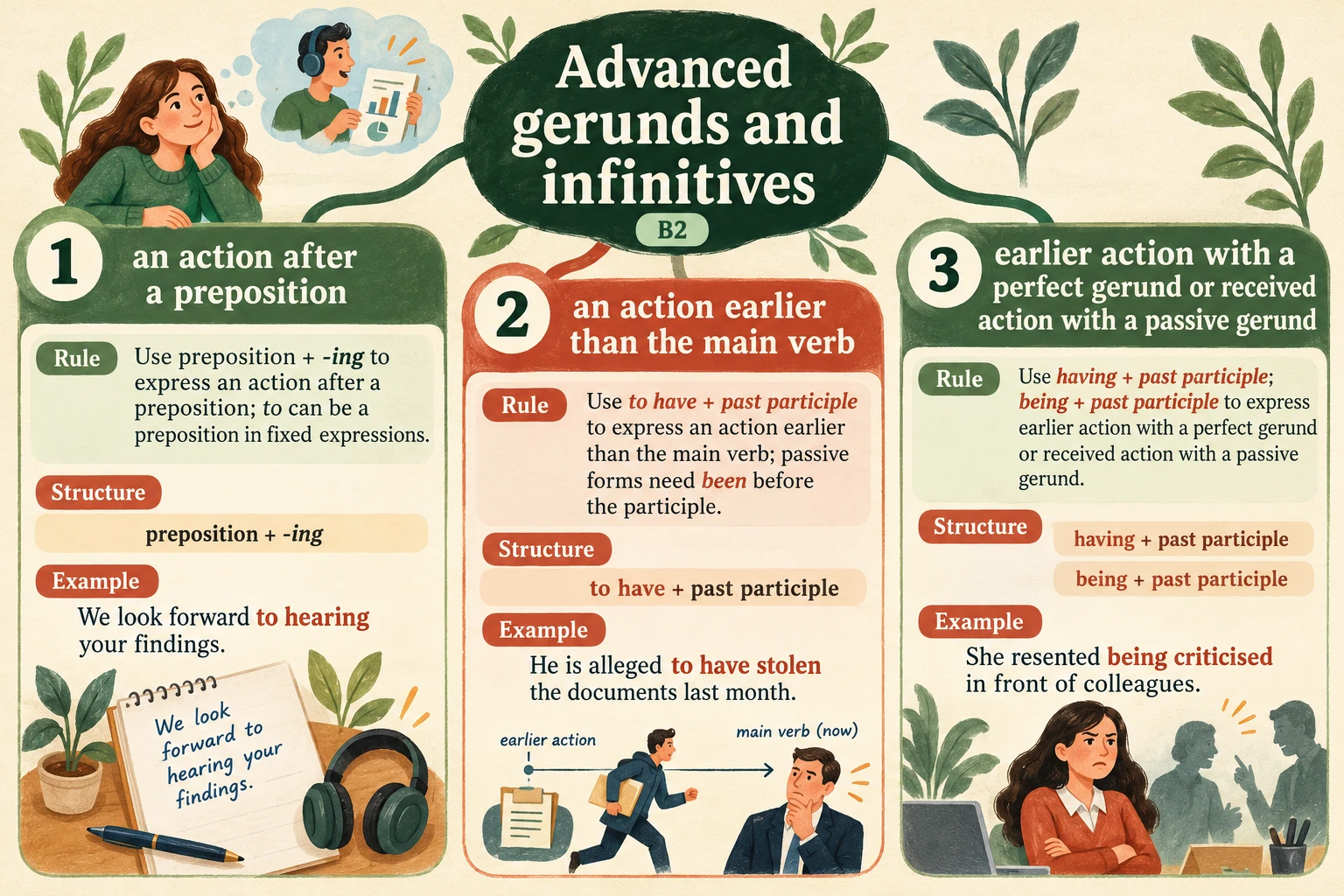
Use preposition + -ing to express an action after a preposition; to can be a preposition in fixed expressions.
We look forward to hearing your findings.
Advanced gerunds and infinitives · B2. Use preposition + -ing to express an action after a preposition; to can be a preposition in fixed expressions.
Complete 12 original tasks. Use the situation to choose the intended meaning, practise the form, then apply it in a fresh context.
Use preposition + -ing to express an action after a preposition; to can be a preposition in fixed expressions.
We look forward to hearing your findings.Use to have + past participle to express an action earlier than the main verb; passive forms need been before the participle.
He is alleged to have stolen the documents last month.Use having + past participle; being + past participle to express earlier action with a perfect gerund or received action with a passive gerund.
She resented being criticised in front of colleagues.
In look forward to, to is a preposition.
Use preposition + -ing to express an action after a preposition; to can be a preposition in fixed expressions.
We look forward to hearing your findings.Use to have + past participle to express an action earlier than the main verb; passive forms need been before the participle.
He is alleged to have stolen the documents last month.Use having + past participle; being + past participle to express earlier action with a perfect gerund or received action with a passive gerund.
She resented being criticised in front of colleagues.Keep the first try. Understand the change. Check it in a fresh situation.
No practice notes yet. Try a short warm-up.
Use preposition + -ing to express an action after a preposition; to can be a preposition in fixed expressions.
We look forward to hearing your findings.Use to have + past participle to express an action earlier than the main verb; passive forms need been before the participle.
He is alleged to have stolen the documents last month.Use having + past participle; being + past participle to express earlier action with a perfect gerund or received action with a passive gerund.
She resented being criticised in front of colleagues.Opening an answer records help for that question.
In look forward to, to is a preposition.
The deciding clue is “In look forward to, to is a preposition.”. Use preposition + -ing to express an action after a preposition; to can be a preposition in fixed expressions. In this task, the completed sentence is “We look forward to hearing your findings.”.
The theft is earlier than the current allegation.
The deciding clue is “The theft is earlier than the current allegation.”. Use to have + past participle to express an action earlier than the main verb; passive forms need been before the participle. In this task, the completed sentence is “He is alleged to have stolen the documents last month.”.
The worker receives criticism; a passive gerund is needed.
The deciding clue is “The worker receives criticism; a passive gerund is needed.”. Use having + past participle; being + past participle to express earlier action with a perfect gerund or received action with a passive gerund. In this task, the completed sentence is “She resented being criticised in front of colleagues.”.
The phrase object to contains a preposition.
The deciding clue is “The phrase object to contains a preposition.”. Use preposition + -ing to express an action after a preposition; to can be a preposition in fixed expressions. In this task, the completed sentence is “They objected to being filmed without consent.”.
Use the perfect infinitive of meet for an earlier encounter claimed now.
Complete sentence: “He claims to have met the inventor years ago.” Use to have + past participle to express an action earlier than the main verb; passive forms need been before the participle. The subject, time and meaning in the task determine this form. Only reviewed responses are matched automatically; other wording is not automatically wrong.
Use the passive gerund after avoid; the patient receives the treatment.
The deciding clue is “Use the passive gerund after avoid; the patient receives the treatment.”. Use having + past participle; being + past participle to express earlier action with a perfect gerund or received action with a passive gerund. In this task, the completed sentence is “He avoided being treated by inexperienced staff.”.
Use the appropriate form of pay after the preposition in addition to.
Complete sentence: “In addition to paying rent, we cover maintenance.” Use preposition + -ing to express an action after a preposition; to can be a preposition in fixed expressions. The subject, time and meaning in the task determine this form. Only reviewed responses are matched automatically; other wording is not automatically wrong.
The fixed expression admits the ing form after to.
The deciding clue is “The fixed expression admits the ing form after to.”. Use preposition + -ing to express an action after a preposition; to can be a preposition in fixed expressions. In this task, the completed sentence is “The funds are devoted to restoring wetlands.”.
Use the perfect passive infinitive of select for a selection preceding the feeling.
Complete sentence: “She was delighted to have been selected for the fellowship.” Use to have + past participle to express an action earlier than the main verb; passive forms need been before the participle. The subject, time and meaning in the task determine this form. Only reviewed responses are matched automatically; other wording is not automatically wrong.
A perfect gerund explicitly marks a completed earlier action.
The deciding clue is “A perfect gerund explicitly marks a completed earlier action.”. Use having + past participle; being + past participle to express earlier action with a perfect gerund or received action with a passive gerund. In this task, the completed sentence is “He denied having seen the documents before the hearing.”.
An earlier event is expressed relative to the current claim.
The deciding clue is “An earlier event is expressed relative to the current claim.”. Use to have + past participle to express an action earlier than the main verb; passive forms need been before the participle. In this task, the completed sentence is “The explorer claims to have reached the summit before dawn.”.
Use the perfect passive gerund of warn for an earlier event after admitted.
Complete sentence: “She admitted having been warned about the defect before the sale.” Use having + past participle; being + past participle to express earlier action with a perfect gerund or received action with a passive gerund. The subject, time and meaning in the task determine this form. Only reviewed responses are matched automatically; other wording is not automatically wrong.