01À l’intérieur ou sur une surface
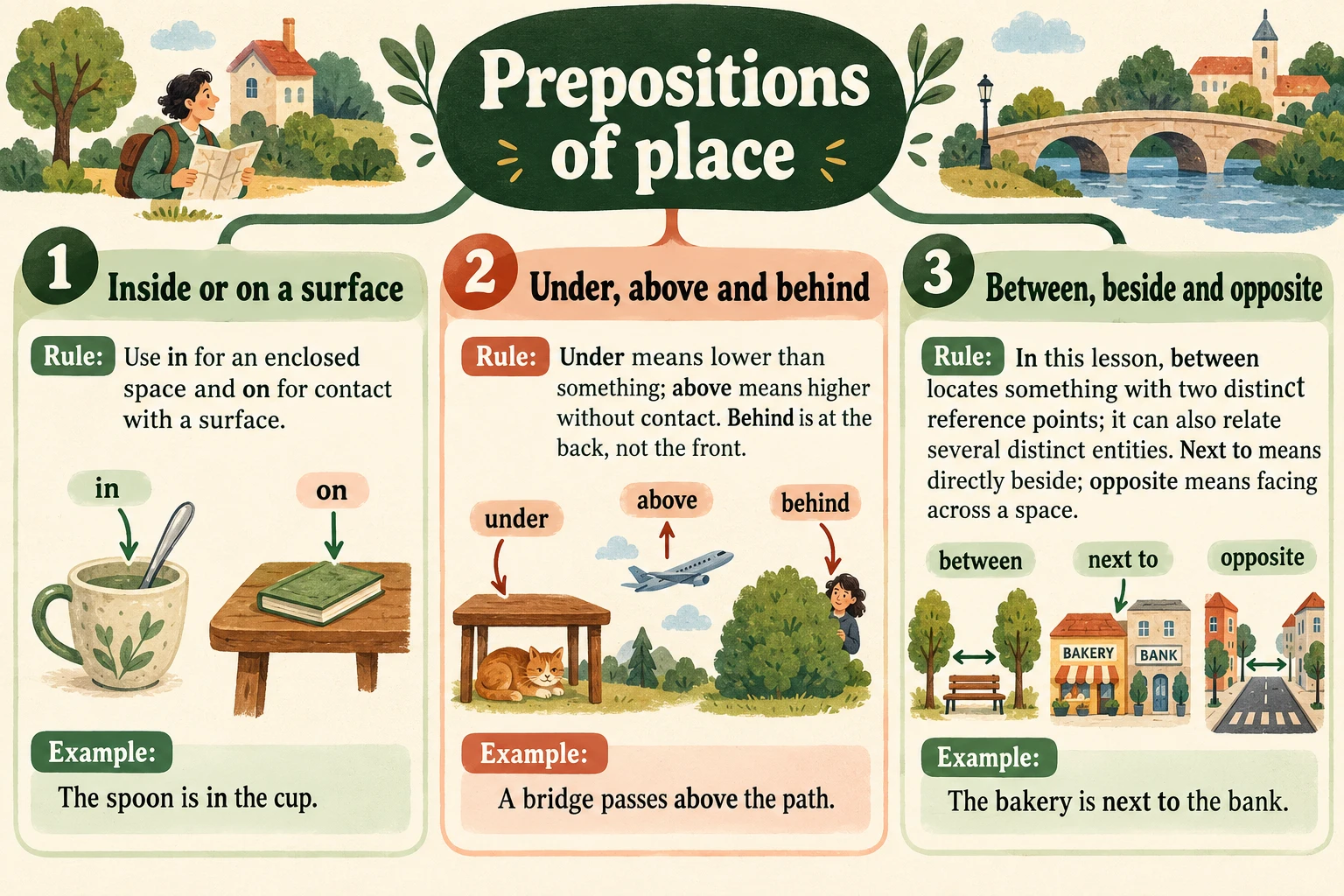
Utilise in pour un espace fermé et on pour le contact avec une surface.
The spoon is in the cup.
Prépositions de lieu · A1. Utilise in pour un espace fermé et on pour le contact avec une surface.
Travaille Prépositions de lieu dans de courtes situations. Lis l’indice, choisis ou écris une forme, puis vérifie l’explication. Le niveau est une indication éditoriale.
Utilise in pour un espace fermé et on pour le contact avec une surface.
The spoon is in the cup.Under signifie en dessous ; above, au-dessus sans contact ; behind, derrière.
A bridge passes above the path.Dans cette leçon, between situe entre deux repères distincts ; il peut aussi relier plusieurs éléments distincts. Next to signifie juste à côté, opposite en face.
The bakery is next to the bank.
The coins are inside a closed box. They are ___ the box.
Utilise in pour un espace fermé et on pour le contact avec une surface.
The spoon is in the cup.Under signifie en dessous ; above, au-dessus sans contact ; behind, derrière.
A bridge passes above the path.Dans cette leçon, between situe entre deux repères distincts ; il peut aussi relier plusieurs éléments distincts. Next to signifie juste à côté, opposite en face.
The bakery is next to the bank.Gardez la première tentative, comprenez le changement et essayez dans une nouvelle situation.
Pas encore de notes. Essayez un court échauffement.
Utilise in pour un espace fermé et on pour le contact avec une surface.
The spoon is in the cup.Under signifie en dessous ; above, au-dessus sans contact ; behind, derrière.
A bridge passes above the path.Dans cette leçon, between situe entre deux repères distincts ; il peut aussi relier plusieurs éléments distincts. Next to signifie juste à côté, opposite en face.
The bakery is next to the bank.Ouvrir une réponse enregistre une aide pour cette question.
The coins are inside a closed box. They are ___ the box.
Observe « The coins are inside a closed box. They are ___ the box. ». Utilise in pour un espace fermé et on pour le contact avec une surface. Phrase complète : « The coins are inside a closed box. They are in the box. ».
The cat is below the table, on the floor. It is ___ the table.
Observe « The cat is below the table, on the floor. It is ___ the table. ». Under signifie en dessous ; above, au-dessus sans contact ; behind, derrière. Phrase complète : « The cat is below the table, on the floor. It is under the table. ».
The café has a bank on its left and a shop on its right. It is ___ them.
Observe « The café has a bank on its left and a shop on its right. It is ___ them. ». Dans cette leçon, between situe entre deux repères distincts ; il peut aussi relier plusieurs éléments distincts. Next to signifie juste à côté, opposite en face. Phrase complète : « The café has a bank on its left and a shop on its right. It is between them. ».
The picture touches the wall surface. It is ___ the wall.
Phrase de référence : « The picture touches the wall surface. It is on the wall. ». Utilise in pour un espace fermé et on pour le contact avec une surface.
The plane is higher than the clouds without touching them. It is ___ them.
Observe « The plane is higher than the clouds without touching them. It is ___ them. ». Under signifie en dessous ; above, au-dessus sans contact ; behind, derrière. Phrase complète : « The plane is higher than the clouds without touching them. It is above them. ».
The pharmacy faces the station across the road. It is ___ the station.
Observe « The pharmacy faces the station across the road. It is ___ the station. ». Dans cette leçon, between situe entre deux repères distincts ; il peut aussi relier plusieurs éléments distincts. Next to signifie juste à côté, opposite en face. Phrase complète : « The pharmacy faces the station across the road. It is opposite the station. ».
The milk is inside the fridge. It is ___ the fridge.
Phrase de référence : « The milk is inside the fridge. It is in the fridge. ». Utilise in pour un espace fermé et on pour le contact avec une surface.
The laptop rests on the desk surface. It is ___ the desk.
Observe « The laptop rests on the desk surface. It is ___ the desk. ». Utilise in pour un espace fermé et on pour le contact avec une surface. Phrase complète : « The laptop rests on the desk surface. It is on the desk. ».
I cannot see the bin because the door hides it at the back. It is ___ the door.
Observe « I cannot see the bin because the door hides it at the back. It is ___ the door. ». Under signifie en dessous ; above, au-dessus sans contact ; behind, derrière. Phrase complète : « I cannot see the bin because the door hides it at the back. It is behind the door. ».
My chair is directly beside yours, with nothing between. It is ___ yours.
Phrase de référence : « My chair is directly beside yours, with nothing between. It is next to yours. ». Dans cette leçon, between situe entre deux repères distincts ; il peut aussi relier plusieurs éléments distincts. Next to signifie juste à côté, opposite en face.
The shoes are below the bed, touching the floor. They are ___ the bed.
Observe « The shoes are below the bed, touching the floor. They are ___ the bed. ». Under signifie en dessous ; above, au-dessus sans contact ; behind, derrière. Phrase complète : « The shoes are below the bed, touching the floor. They are under the bed. ».
The park lies with a school on one side and a library on the other. It is ___ them.
Phrase de référence : « The park lies with a school on one side and a library on the other. It is between them. ». Dans cette leçon, between situe entre deux repères distincts ; il peut aussi relier plusieurs éléments distincts. Next to signifie juste à côté, opposite en face.