01Much oder many
Many steht bei zählbarem Plural, much bei Unzählbarem, besonders in Fragen und Verneinungen.
How many pages are there?
Much, many und a lot · A2. Many steht bei zählbarem Plural, much bei Unzählbarem, besonders in Fragen und Verneinungen.
Übe Much, many und a lot in kurzen Situationen. Lies den Hinweis, wähle oder schreibe eine Form und prüfe die Begründung. Die Stufe dient der redaktionellen Orientierung.
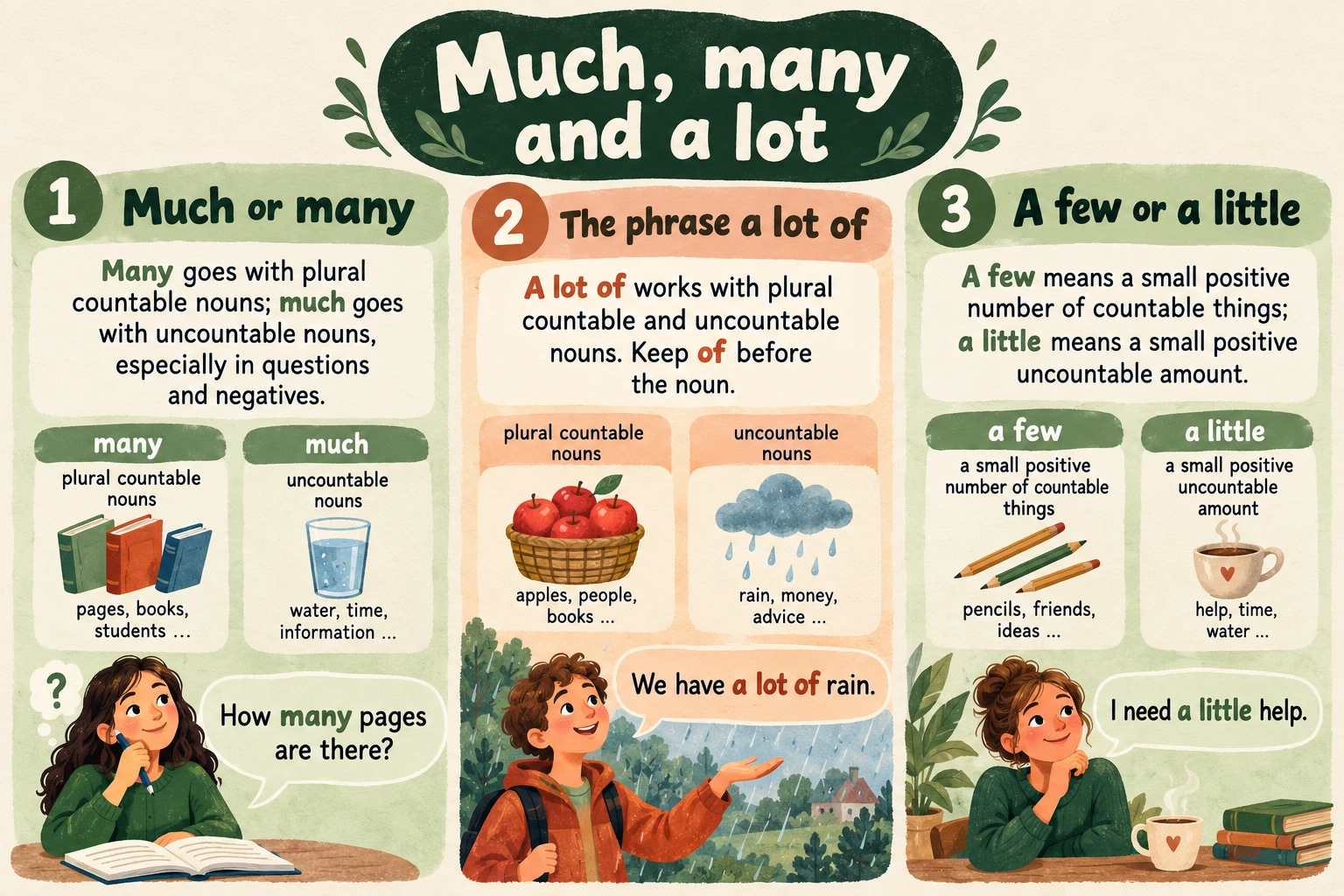
Many steht bei zählbarem Plural, much bei Unzählbarem, besonders in Fragen und Verneinungen.
How many pages are there?A lot of steht bei zählbarem Plural und Unzählbarem; of bleibt vor dem Nomen.
We have a lot of rain.A few bezeichnet eine kleine positive Anzahl zählbarer Dinge; a little eine kleine positive unzählbare Menge.
I need a little help.
How ___ chairs do we need?
Many steht bei zählbarem Plural, much bei Unzählbarem, besonders in Fragen und Verneinungen.
How many pages are there?A lot of steht bei zählbarem Plural und Unzählbarem; of bleibt vor dem Nomen.
We have a lot of rain.A few bezeichnet eine kleine positive Anzahl zählbarer Dinge; a little eine kleine positive unzählbare Menge.
I need a little help.Bewahre den ersten Versuch. Verstehe die Änderung. Prüfe sie in einer neuen Situation.
Noch keine Lernnotizen. Starte mit einem kurzen Einstieg.
Many steht bei zählbarem Plural, much bei Unzählbarem, besonders in Fragen und Verneinungen.
How many pages are there?A lot of steht bei zählbarem Plural und Unzählbarem; of bleibt vor dem Nomen.
We have a lot of rain.A few bezeichnet eine kleine positive Anzahl zählbarer Dinge; a little eine kleine positive unzählbare Menge.
I need a little help.Das Öffnen einer Antwort wird für diese Aufgabe als Hilfe erfasst.
How ___ chairs do we need?
Achte auf „How ___ chairs do we need?“. Many steht bei zählbarem Plural, much bei Unzählbarem, besonders in Fragen und Verneinungen. Vollständiger Satz: „How many chairs do we need?“.
There are a lot ___ people outside.
Achte auf „There are a lot ___ people outside.“. A lot of steht bei zählbarem Plural und Unzählbarem; of bleibt vor dem Nomen. Vollständiger Satz: „There are a lot of people outside.“.
We have ___ minutes left, perhaps three or four.
Achte auf „We have ___ minutes left, perhaps three or four.“. A few bezeichnet eine kleine positive Anzahl zählbarer Dinge; a little eine kleine positive unzählbare Menge. Vollständiger Satz: „We have a few minutes left, perhaps three or four.“.
How ___ flour should I add?
Vollständiger Beispielsatz: „How much flour should I add?“. Many steht bei zählbarem Plural, much bei Unzählbarem, besonders in Fragen und Verneinungen.
He drinks a lot ___ water after exercise.
Achte auf „He drinks a lot ___ water after exercise.“. A lot of steht bei zählbarem Plural und Unzählbarem; of bleibt vor dem Nomen. Vollständiger Satz: „He drinks a lot of water after exercise.“.
There is ___ oil left, enough to fry one egg.
Achte auf „There is ___ oil left, enough to fry one egg.“. A few bezeichnet eine kleine positive Anzahl zählbarer Dinge; a little eine kleine positive unzählbare Menge. Vollständiger Satz: „There is a little oil left, enough to fry one egg.“.
We do not have ___ time before the train leaves.
Vollständiger Beispielsatz: „We do not have much time before the train leaves.“. Many steht bei zählbarem Plural, much bei Unzählbarem, besonders in Fragen und Verneinungen. In dieser Aufgabe sind auch diese Formen geprüft: any / enough / a lot of / lots of / sufficient. Die Liste ist nicht vollständig.
There are not ___ cars on the road today.
Achte auf „There are not ___ cars on the road today.“. Many steht bei zählbarem Plural, much bei Unzählbarem, besonders in Fragen und Verneinungen. Vollständiger Satz: „There are not many cars on the road today.“.
She takes a lot ___ photos on holiday.
Achte auf „She takes a lot ___ photos on holiday.“. A lot of steht bei zählbarem Plural und Unzählbarem; of bleibt vor dem Nomen. Vollständiger Satz: „She takes a lot of photos on holiday.“.
I invited ___ friends, only two.
Vollständiger Beispielsatz: „I invited a few friends, only two.“. A few bezeichnet eine kleine positive Anzahl zählbarer Dinge; a little eine kleine positive unzählbare Menge. In dieser Aufgabe sind auch diese Formen geprüft: some / two / a couple of / few. Die Liste ist nicht vollständig.
The new café sells a lot ___ bread.
Achte auf „The new café sells a lot ___ bread.“. A lot of steht bei zählbarem Plural und Unzählbarem; of bleibt vor dem Nomen. Vollständiger Satz: „The new café sells a lot of bread.“.
Add ___ salt, just a tiny amount.
Vollständiger Beispielsatz: „Add a little salt, just a tiny amount.“. A few bezeichnet eine kleine positive Anzahl zählbarer Dinge; a little eine kleine positive unzählbare Menge. In dieser Aufgabe sind auch diese Formen geprüft: some / a bit of / a tiny amount of / a small amount of / a pinch of / a dash of / a touch of / little. Die Liste ist nicht vollständig.