01余分な目的語を挟まず直接不定詞が続く伝達動詞
agree/offer/refuse + to-infinitive を用います。表す内容:余分な目的語を挟まず直接不定詞が続く伝達動詞。
The supplier agreed to replace the damaged parts.
伝達動詞の文型 · B2. agree/offer/refuse + to-infinitive を用います。表す内容:余分な目的語を挟まず直接不定詞が続く伝達動詞。
12問のオリジナル問題です。状況から意味を読み取り、形を練習して、新しい場面で応用します。
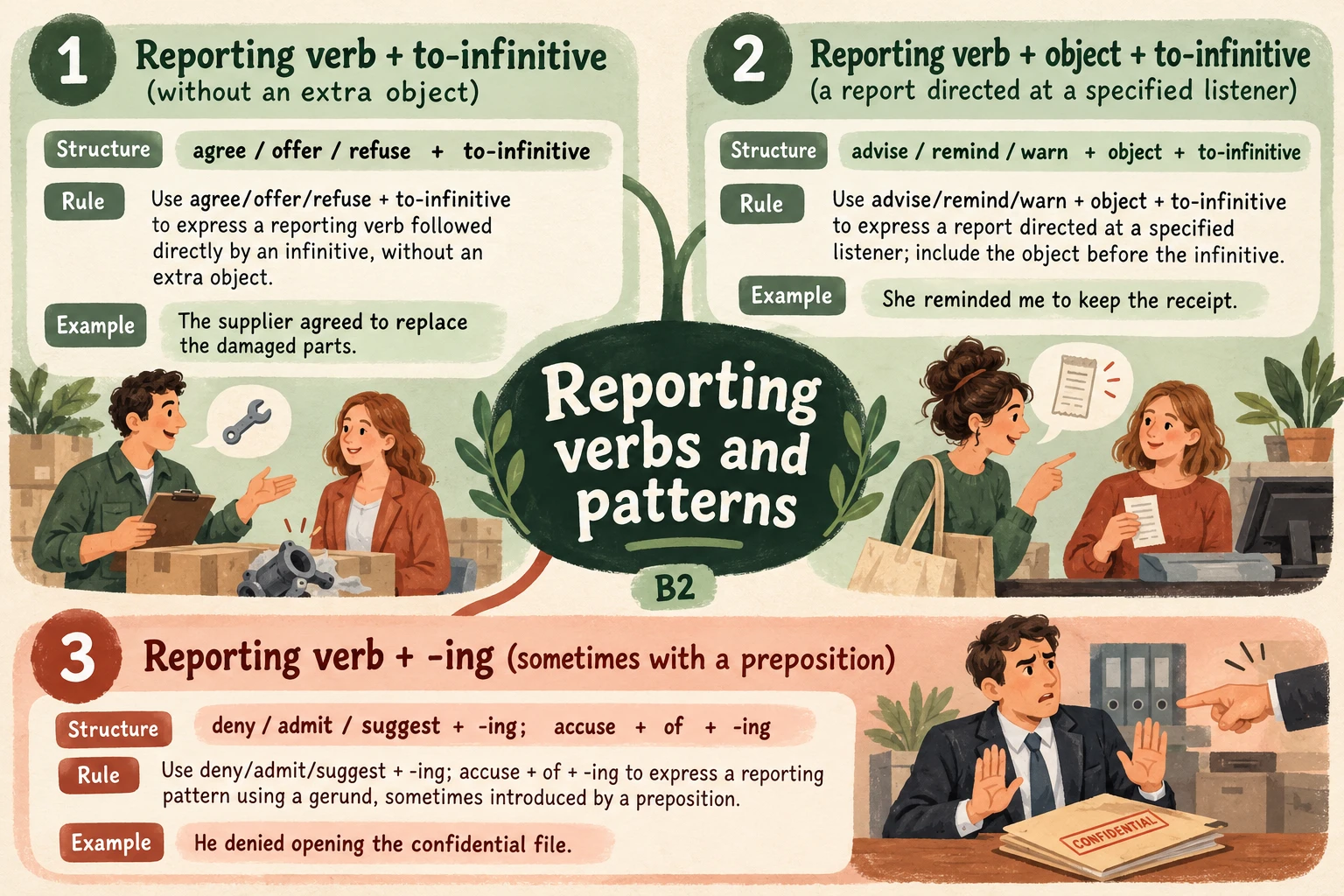
agree/offer/refuse + to-infinitive を用います。表す内容:余分な目的語を挟まず直接不定詞が続く伝達動詞。
The supplier agreed to replace the damaged parts.advise/remind/warn + object + to-infinitive を用います。表す内容:特定の聞き手への伝達。不定詞の前に目的語を置く。
She reminded me to keep the receipt.deny/admit/suggest + -ing; accuse + of + -ing を用います。表す内容:動名詞を用いる伝達表現。前置詞を伴う場合もある。
He denied opening the confidential file.
Agree is followed directly by a to-infinitive.
agree/offer/refuse + to-infinitive を用います。表す内容:余分な目的語を挟まず直接不定詞が続く伝達動詞。
The supplier agreed to replace the damaged parts.advise/remind/warn + object + to-infinitive を用います。表す内容:特定の聞き手への伝達。不定詞の前に目的語を置く。
She reminded me to keep the receipt.deny/admit/suggest + -ing; accuse + of + -ing を用います。表す内容:動名詞を用いる伝達表現。前置詞を伴う場合もある。
He denied opening the confidential file.初回答を残し、変化の理由を理解して、別の場面で確かめます。
まだ復習ノートはありません。まずは短いウォームアップを。
agree/offer/refuse + to-infinitive を用います。表す内容:余分な目的語を挟まず直接不定詞が続く伝達動詞。
The supplier agreed to replace the damaged parts.advise/remind/warn + object + to-infinitive を用います。表す内容:特定の聞き手への伝達。不定詞の前に目的語を置く。
She reminded me to keep the receipt.deny/admit/suggest + -ing; accuse + of + -ing を用います。表す内容:動名詞を用いる伝達表現。前置詞を伴う場合もある。
He denied opening the confidential file.解答を開くと、その問題にヒント利用が記録されます。
Agree is followed directly by a to-infinitive.
判断の手掛かりは「Agree is followed directly by a to-infinitive.」です。agree/offer/refuse + to-infinitive を用います。表す内容:余分な目的語を挟まず直接不定詞が続く伝達動詞。 この課題で完成する文は「The supplier agreed to replace the damaged parts.」です。
A named listener follows reminded; then a to-infinitive is needed.
判断の手掛かりは「A named listener follows reminded; then a to-infinitive is needed.」です。advise/remind/warn + object + to-infinitive を用います。表す内容:特定の聞き手への伝達。不定詞の前に目的語を置く。 この課題で完成する文は「She reminded me to keep the receipt.」です。
Deny takes a gerund for the action denied.
判断の手掛かりは「Deny takes a gerund for the action denied.」です。deny/admit/suggest + -ing; accuse + of + -ing を用います。表す内容:動名詞を用いる伝達表現。前置詞を伴う場合もある。 この課題で完成する文は「He denied opening the confidential file.」です。
Refuse is followed directly by a to-infinitive.
判断の手掛かりは「Refuse is followed directly by a to-infinitive.」です。agree/offer/refuse + to-infinitive を用います。表す内容:余分な目的語を挟まず直接不定詞が続く伝達動詞。 この課題で完成する文は「The witness refused to answer the question.」です。
Report a negative instruction using the infinitive of enter after warned us.
完成文:「The guide warned us not to enter the unstable tunnel.」 advise/remind/warn + object + to-infinitive を用います。表す内容:特定の聞き手への伝達。不定詞の前に目的語を置く。 問題の主語・時間・意味に合わせた形です。確認済みの解答だけを自動照合します。別の表現を自動的に誤りとはしません。
Accuse takes of before the gerund.
判断の手掛かりは「Accuse takes of before the gerund.」です。deny/admit/suggest + -ing; accuse + of + -ing を用います。表す内容:動名詞を用いる伝達表現。前置詞を伴う場合もある。 この課題で完成する文は「They accused the contractor of inflating costs.」です。
Use the to-infinitive of help after offered; practise the verb pattern rather than using help as a noun.
完成文:「She offered to help with the translation.」 agree/offer/refuse + to-infinitive を用います。表す内容:余分な目的語を挟まず直接不定詞が続く伝達動詞。 問題の主語・時間・意味に合わせた形です。確認済みの解答だけを自動照合します。別の表現を自動的に誤りとはしません。
A refusal takes a to-infinitive.
判断の手掛かりは「A refusal takes a to-infinitive.」です。agree/offer/refuse + to-infinitive を用います。表す内容:余分な目的語を挟まず直接不定詞が続く伝達動詞。 この課題で完成する文は「The editor refused to publish the anonymous allegation.」です。
Use the correct form of seek after advised him for advice directed at that person.
完成文:「The lawyer advised him to seek an independent assessment.」 advise/remind/warn + object + to-infinitive を用います。表す内容:特定の聞き手への伝達。不定詞の前に目的語を置く。 問題の主語・時間・意味に合わせた形です。確認済みの解答だけを自動照合します。別の表現を自動的に誤りとはしません。
Suggest takes a gerund when no finite clause is used.
判断の手掛かりは「Suggest takes a gerund when no finite clause is used.」です。deny/admit/suggest + -ing; accuse + of + -ing を用います。表す内容:動名詞を用いる伝達表現。前置詞を伴う場合もある。 この課題で完成する文は「The chair suggested postponing the vote.」です。
The listener comes before the infinitive after remind.
判断の手掛かりは「The listener comes before the infinitive after remind.」です。advise/remind/warn + object + to-infinitive を用います。表す内容:特定の聞き手への伝達。不定詞の前に目的語を置く。 この課題で完成する文は「Please remind the team to check their entries.」です。
Use a perfect gerund of share after admitted for an earlier completed action.
完成文:「She admitted having shared the draft before permission was granted.」 deny/admit/suggest + -ing; accuse + of + -ing を用います。表す内容:動名詞を用いる伝達表現。前置詞を伴う場合もある。 問題の主語・時間・意味に合わせた形です。確認済みの解答だけを自動照合します。別の表現を自動的に誤りとはしません。