01un état simultané au récit rapporté ; l’infinitif est actif
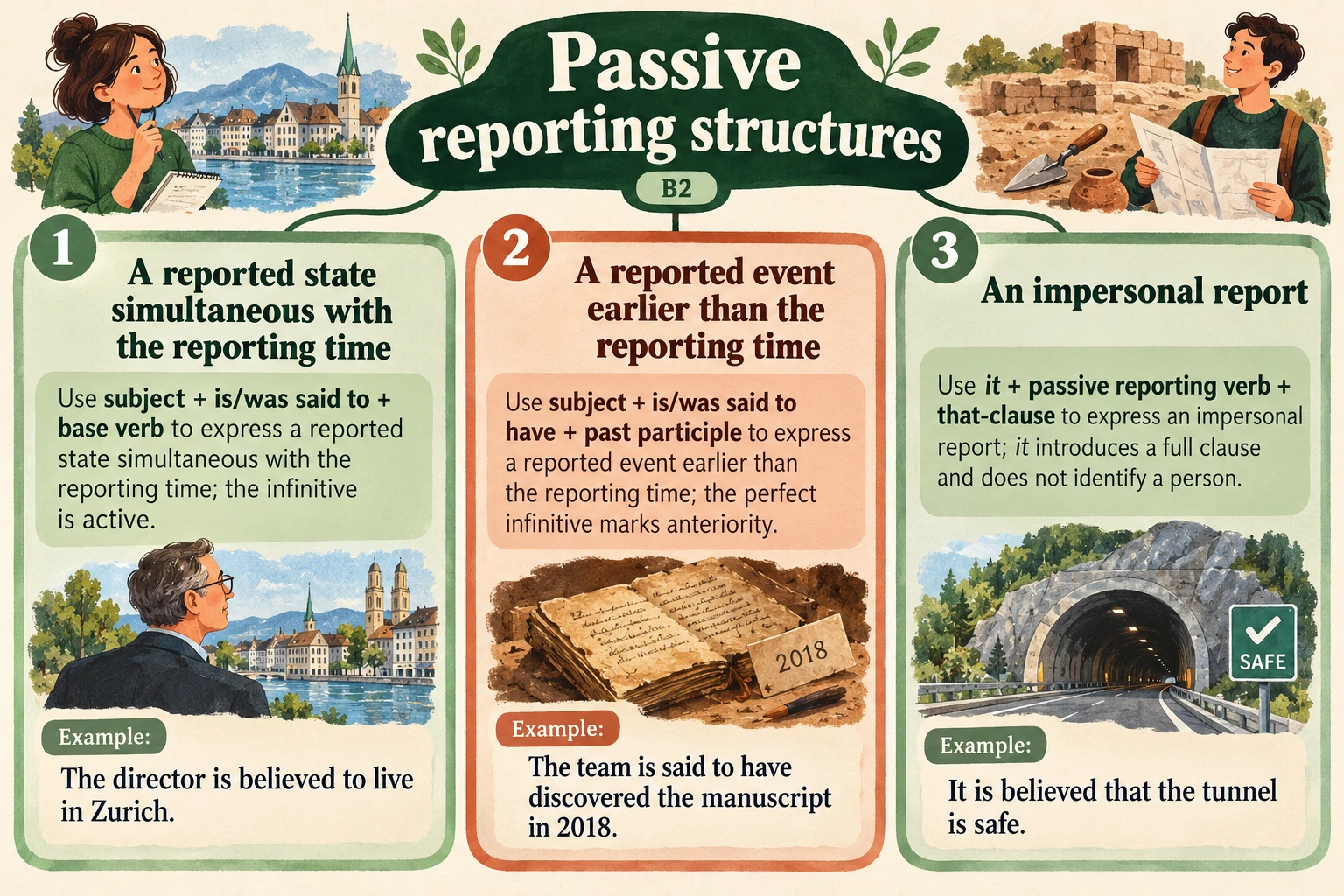
Utilisez subject + is/was said to + base verb pour exprimer un état simultané au récit rapporté ; l’infinitif est actif.
The director is believed to live in Zurich.
Structures passives de compte rendu · B2. Utilisez subject + is/was said to + base verb pour exprimer un état simultané au récit rapporté ; l’infinitif est actif.
Réalisez 12 exercices originaux. Appuyez-vous sur la situation pour interpréter le sens, pratiquer la forme et la réutiliser dans un nouveau contexte.
Utilisez subject + is/was said to + base verb pour exprimer un état simultané au récit rapporté ; l’infinitif est actif.
The director is believed to live in Zurich.Utilisez subject + is/was said to have + past participle pour exprimer un fait antérieur au compte rendu ; l’infinitif parfait marque l’antériorité.
The team is said to have discovered the manuscript in 2018.Utilisez it + passive reporting verb + that-clause pour exprimer un compte rendu impersonnel ; it introduit une proposition complète.
It is believed that the tunnel is safe.
People believe the director currently lives in Zurich.
Utilisez subject + is/was said to + base verb pour exprimer un état simultané au récit rapporté ; l’infinitif est actif.
The director is believed to live in Zurich.Utilisez subject + is/was said to have + past participle pour exprimer un fait antérieur au compte rendu ; l’infinitif parfait marque l’antériorité.
The team is said to have discovered the manuscript in 2018.Utilisez it + passive reporting verb + that-clause pour exprimer un compte rendu impersonnel ; it introduit une proposition complète.
It is believed that the tunnel is safe.Gardez la première tentative, comprenez le changement et essayez dans une nouvelle situation.
Pas encore de notes. Essayez un court échauffement.
Utilisez subject + is/was said to + base verb pour exprimer un état simultané au récit rapporté ; l’infinitif est actif.
The director is believed to live in Zurich.Utilisez subject + is/was said to have + past participle pour exprimer un fait antérieur au compte rendu ; l’infinitif parfait marque l’antériorité.
The team is said to have discovered the manuscript in 2018.Utilisez it + passive reporting verb + that-clause pour exprimer un compte rendu impersonnel ; it introduit une proposition complète.
It is believed that the tunnel is safe.Ouvrir une réponse enregistre une aide pour cette question.
People believe the director currently lives in Zurich.
L’indice décisif est « People believe the director currently lives in Zurich. ». Utilisez subject + is/was said to + base verb pour exprimer un état simultané au récit rapporté ; l’infinitif est actif. Dans cette tâche, la phrase complète est « The director is believed to live in Zurich. ».
The discovery preceded the current report.
L’indice décisif est « The discovery preceded the current report. ». Utilisez subject + is/was said to have + past participle pour exprimer un fait antérieur au compte rendu ; l’infinitif parfait marque l’antériorité. Dans cette tâche, la phrase complète est « The team is said to have discovered the manuscript in 2018. ».
Start an impersonal passive report followed by a complete clause.
L’indice décisif est « Start an impersonal passive report followed by a complete clause. ». Utilisez it + passive reporting verb + that-clause pour exprimer un compte rendu impersonnel ; it introduit une proposition complète. Dans cette tâche, la phrase complète est « It is believed that the tunnel is safe. ».
The reported state is simultaneous with the past belief.
L’indice décisif est « The reported state is simultaneous with the past belief. ». Utilisez subject + is/was said to + base verb pour exprimer un état simultané au récit rapporté ; l’infinitif est actif. Dans cette tâche, la phrase complète est « The painting was thought to be genuine at the time. ».
Use the perfect infinitive of leave for a departure earlier than the report.
Phrase complète : « The suspect is reported to have left the country last week. » Utilisez subject + is/was said to have + past participle pour exprimer un fait antérieur au compte rendu ; l’infinitif parfait marque l’antériorité. Le sujet, le temps et le sens de la consigne déterminent cette forme. Seules les réponses vérifiées sont comparées automatiquement ; toute autre formulation n’est pas automatiquement fausse.
An impersonal passive report requires a finite that-clause.
L’indice décisif est « An impersonal passive report requires a finite that-clause. ». Utilisez it + passive reporting verb + that-clause pour exprimer un compte rendu impersonnel ; it introduit une proposition complète. Dans cette tâche, la phrase complète est « It is expected that the road will reopen tonight. ».
Use an infinitive of be for a reported present state.
Phrase complète : « The reservoir is believed to be nearly empty. » Utilisez subject + is/was said to + base verb pour exprimer un état simultané au récit rapporté ; l’infinitif est actif. Le sujet, le temps et le sens de la consigne déterminent cette forme. Seules les réponses vérifiées sont comparées automatiquement ; toute autre formulation n’est pas automatiquement fausse.
A current estimate reports the present age of the artefact.
L’indice décisif est « A current estimate reports the present age of the artefact. ». Utilisez subject + is/was said to + base verb pour exprimer un état simultané au récit rapporté ; l’infinitif est actif. Dans cette tâche, la phrase complète est « The bowl is estimated to be two thousand years old. ».
Use the perfect passive infinitive of damage; the damage preceded the current report.
Phrase complète : « The cargo is believed to have been damaged during last night’s storm. » Utilisez subject + is/was said to have + past participle pour exprimer un fait antérieur au compte rendu ; l’infinitif parfait marque l’antériorité. Le sujet, le temps et le sens de la consigne déterminent cette forme. Seules les réponses vérifiées sont comparées automatiquement ; toute autre formulation n’est pas automatiquement fausse.
The impersonal passive report introduces a complete proposition.
L’indice décisif est « The impersonal passive report introduces a complete proposition. ». Utilisez it + passive reporting verb + that-clause pour exprimer un compte rendu impersonnel ; it introduit une proposition complète. Dans cette tâche, la phrase complète est « It has been confirmed that the tests were successful. ».
The escape is earlier than the current report.
L’indice décisif est « The escape is earlier than the current report. ». Utilisez subject + is/was said to have + past participle pour exprimer un fait antérieur au compte rendu ; l’infinitif parfait marque l’antériorité. Dans cette tâche, la phrase complète est « The animal is believed to have escaped through an open gate last night. ».
Supply the conjunction introducing a finite reported statement.
Phrase complète : « It was announced that the grant had been approved. » Utilisez it + passive reporting verb + that-clause pour exprimer un compte rendu impersonnel ; it introduit une proposition complète. Le sujet, le temps et le sens de la consigne déterminent cette forme. Seules les réponses vérifiées sont comparées automatiquement ; toute autre formulation n’est pas automatiquement fausse.