01une prédiction ou promesse future vue depuis un repère passé
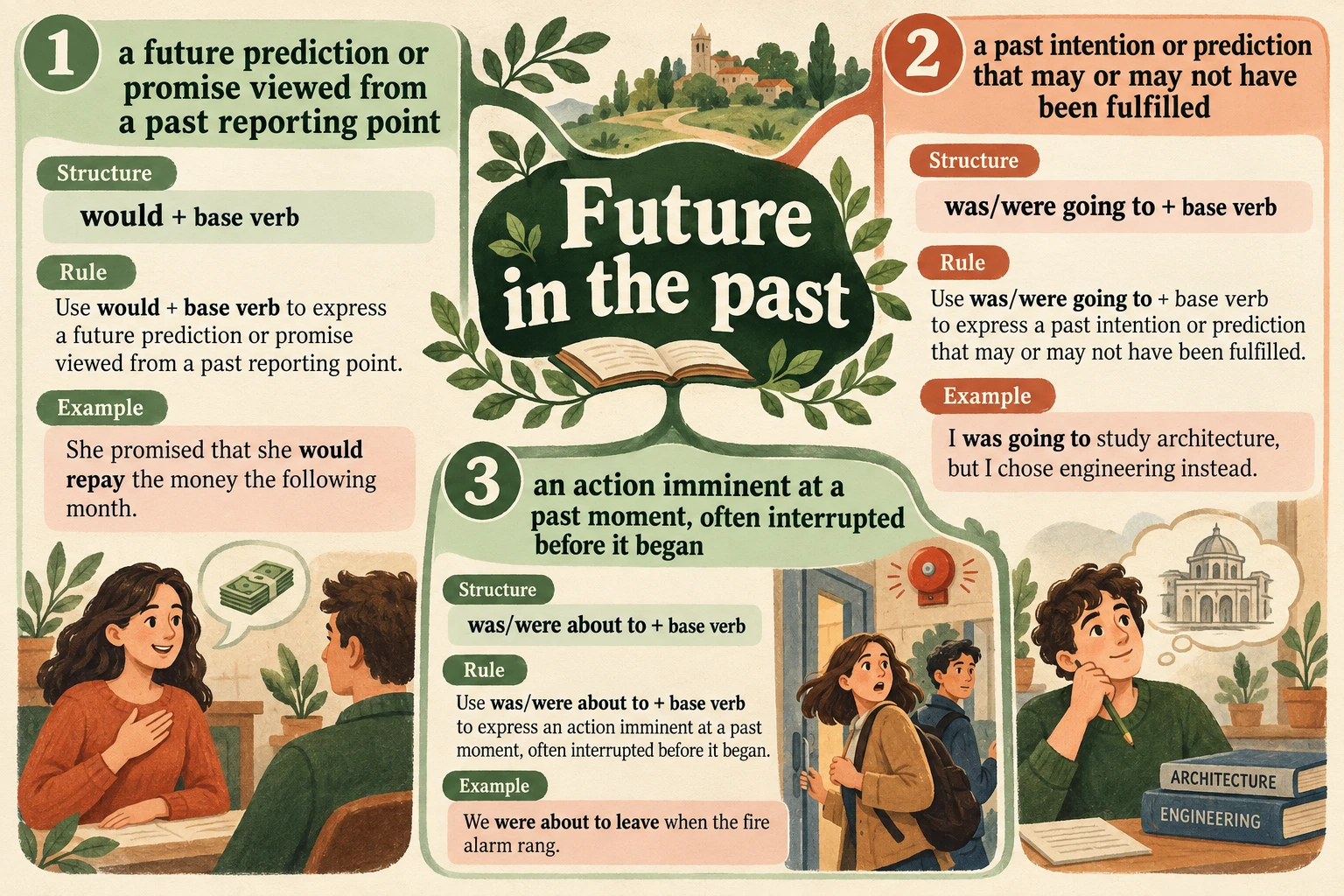
Utilisez would + base verb pour exprimer une prédiction ou promesse future vue depuis un repère passé.
She promised that she would repay the money the following month.
Futur dans le passé · B2. Utilisez would + base verb pour exprimer une prédiction ou promesse future vue depuis un repère passé.
Réalisez 12 exercices originaux. Appuyez-vous sur la situation pour interpréter le sens, pratiquer la forme et la réutiliser dans un nouveau contexte.
Utilisez would + base verb pour exprimer une prédiction ou promesse future vue depuis un repère passé.
She promised that she would repay the money the following month.Utilisez was/were going to + base verb pour exprimer une intention ou prévision passée, réalisée ou non.
I was going to study architecture, but I chose engineering instead.Utilisez was/were about to + base verb pour exprimer une action imminente dans le passé, souvent interrompue avant son début.
We were about to leave when the fire alarm rang.
The promise was made last year about a later event.
Utilisez would + base verb pour exprimer une prédiction ou promesse future vue depuis un repère passé.
She promised that she would repay the money the following month.Utilisez was/were going to + base verb pour exprimer une intention ou prévision passée, réalisée ou non.
I was going to study architecture, but I chose engineering instead.Utilisez was/were about to + base verb pour exprimer une action imminente dans le passé, souvent interrompue avant son début.
We were about to leave when the fire alarm rang.Gardez la première tentative, comprenez le changement et essayez dans une nouvelle situation.
Pas encore de notes. Essayez un court échauffement.
Utilisez would + base verb pour exprimer une prédiction ou promesse future vue depuis un repère passé.
She promised that she would repay the money the following month.Utilisez was/were going to + base verb pour exprimer une intention ou prévision passée, réalisée ou non.
I was going to study architecture, but I chose engineering instead.Utilisez was/were about to + base verb pour exprimer une action imminente dans le passé, souvent interrompue avant son début.
We were about to leave when the fire alarm rang.Ouvrir une réponse enregistre une aide pour cette question.
The promise was made last year about a later event.
L’indice décisif est « The promise was made last year about a later event. ». Utilisez would + base verb pour exprimer une prédiction ou promesse future vue depuis un repère passé. Dans cette tâche, la phrase complète est « She promised that she would repay the money the following month. ».
Describe an abandoned past intention.
L’indice décisif est « Describe an abandoned past intention. ». Utilisez was/were going to + base verb pour exprimer une intention ou prévision passée, réalisée ou non. Dans cette tâche, la phrase complète est « I was going to study architecture, but I chose engineering instead. ».
The action was imminent when an interruption occurred.
L’indice décisif est « The action was imminent when an interruption occurred. ». Utilisez was/were about to + base verb pour exprimer une action imminente dans le passé, souvent interrompue avant son début. Dans cette tâche, la phrase complète est « We were about to leave when the fire alarm rang. ».
A past prediction looked forward from the meeting date.
L’indice décisif est « A past prediction looked forward from the meeting date. ». Utilisez would + base verb pour exprimer une prédiction ou promesse future vue depuis un repère passé. Dans cette tâche, la phrase complète est « At that meeting, nobody knew how much the city would change. ».
Use the past going-to construction with call for an intention interrupted by losing the phone.
Phrase complète : « I was going to call you, but then I lost my phone. » Utilisez was/were going to + base verb pour exprimer une intention ou prévision passée, réalisée ou non. Le sujet, le temps et le sens de la consigne déterminent cette forme. Seules les réponses vérifiées sont comparées automatiquement ; toute autre formulation n’est pas automatiquement fausse.
The event was seconds away at a past moment.
L’indice décisif est « The event was seconds away at a past moment. ». Utilisez was/were about to + base verb pour exprimer une action imminente dans le passé, souvent interrompue avant son début. Dans cette tâche, la phrase complète est « The train was about to depart when we reached the platform. ».
Use a would-clause with become for a future prediction viewed from 2010.
Phrase complète : « In 2010, few predicted that this service would become so widespread. » Utilisez would + base verb pour exprimer une prédiction ou promesse future vue depuis un repère passé. Le sujet, le temps et le sens de la consigne déterminent cette forme. Seules les réponses vérifiées sont comparées automatiquement ; toute autre formulation n’est pas automatiquement fausse.
The report made a prediction about the following year.
L’indice décisif est « The report made a prediction about the following year. ». Utilisez would + base verb pour exprimer une prédiction ou promesse future vue depuis un repère passé. Dans cette tâche, la phrase complète est « The report forecast that demand would rise the following year. ».
Use the past going-to construction with move for the plan they held then before changing their minds.
Phrase complète : « They were going to move abroad, but changed their minds. » Utilisez was/were going to + base verb pour exprimer une intention ou prévision passée, réalisée ou non. Le sujet, le temps et le sens de la consigne déterminent cette forme. Seules les réponses vérifiées sont comparées automatiquement ; toute autre formulation n’est pas automatiquement fausse.
An immediate past intention is expressed with about to.
L’indice décisif est « An immediate past intention is expressed with about to. ». Utilisez was/were about to + base verb pour exprimer une action imminente dans le passé, souvent interrompue avant son début. Dans cette tâche, la phrase complète est « She was about to press the button when the warning appeared. ».
The context describes a past plan, whose fulfilment is not stated.
L’indice décisif est « The context describes a past plan, whose fulfilment is not stated. ». Utilisez was/were going to + base verb pour exprimer une intention ou prévision passée, réalisée ou non. Dans cette tâche, la phrase complète est « At the time, the company was going to open a branch overseas. ».
Supply the infinitive of speak after was about for an action imminent then.
Phrase complète : « He was about to speak when the chair interrupted. » Utilisez was/were about to + base verb pour exprimer une action imminente dans le passé, souvent interrompue avant son début. Le sujet, le temps et le sens de la consigne déterminent cette forme. Seules les réponses vérifiées sont comparées automatiquement ; toute autre formulation n’est pas automatiquement fausse.